


Traffic rulesSlovenia
 Traffic rules
 Slovenia
1. Slovenia
Slovenia lies at the meeting point of Central Europe, the Alps and the northern Adriatic, bordering Italy, Austria, Hungary and Croatia. Traffic drives on the right. Despite its relatively small size, driving conditions vary considerably: Alpine passes and valleys dominate the northwest, the limestone Karst shapes the southwest, and flatter terrain extends towards the Pannonian Plain in the east. Slovenian is the main language used on road signs. In officially bilingual areas, Italian or Hungarian also appears alongside Slovenian on traffic signage and place names.
Motorways and expressways are central to cross-country travel, and vehicles up to 3.5 tonnes generally need an electronic vignette before entering tolled sections. A notable change took effect on 1 January 2026: the coastal H5 and H6 expressway sections no longer require a vignette. Winter driving is also important, particularly in Alpine areas. Prescribed winter equipment is compulsory from 15 November to 15 March and whenever winter conditions occur outside that period, while daytime running lights or dipped headlights are required throughout the year.
AI-generated by Rijbewijs-online.be • WCIT • CC BY-SA
Which number can you call in an emergency in Slovenia?
Call 112 for urgent emergency assistance. Give the operator your location and explain what happened.
What is the alcohol limit for driving in Slovenia?
For most ordinary drivers, the maximum permitted alcohol level is 0.5 g/kg of blood or 0.24 mg/l of breath, provided the driver shows no signs of impairment. Zero alcohol applies to novice drivers and several categories of professional and other specified drivers.
🔗 europa.eu • Your Europe / national authorities, Slovenia road rules, Alcohol limits
What speed limits apply to passenger cars in Slovenia?
Built-up areas: The general maximum speed in a built-up area is 50 km/h, unless signs establish another limit.
Outside built-up areas: For an ordinary passenger car, the general maximum on roads outside built-up areas is 90 km/h, unless another limit is signed.
Expressways: For an ordinary passenger car, the general maximum on an expressway is 110 km/h, unless a lower limit is indicated.
Motorways: For an ordinary passenger car, the general motorway maximum is 130 km/h, unless signs impose a lower limit.
Special urban zones: The general maximum is 30 km/h in limited-speed zones, 20 km/h in shared traffic areas and 10 km/h in traffic-calmed areas and pedestrian zones, unless otherwise regulated.
Can you use a mobile phone while driving in Slovenia?
A handheld mobile phone must not be used while driving. A phone may be used with a hands-free system, provided it does not interfere with safe control of the vehicle.
🔗 europa.eu • Your Europe / national authorities, Slovenia road rules, Mobile telephone
What safety equipment must a car carry in Slovenia?
Required vehicle equipment includes a warning triangle, first-aid kit and reflective safety garment, together with prescribed equipment for dealing with a damaged tyre. A set of spare bulbs is also required where applicable to the vehicle's lighting system.
Must you use daytime running lights in Slovenia?
Yes. Motor vehicles must use daytime running lights or dipped headlights during daytime driving. Appropriate vehicle lights must also be used when visibility or other conditions require them.
🔗 europa.eu • Your Europe / national authorities, Slovenia road rules, Other specific rules, lights
Can a visitor use a driving licence issued in another EU country in Slovenia?
Yes. A valid, full EU driving licence is recognised for the vehicle categories it covers. You must meet the applicable minimum age. A learner licence or a temporary replacement certificate does not have the same automatic recognition.
Are motorcycle helmets compulsory in Slovenia?
Yes. On an ordinary, open motorcycle, both the rider and passenger must wear a protective helmet. Use a helmet that meets the applicable approval requirements and fasten it correctly. Check the specific rules before relying on an exemption for an enclosed or specially equipped vehicle.
🔗 europa.eu • Your Europe / national authorities, Slovenia road rules

2. Motorway
A motorway is a road specially designed and signposted for motor traffic. Motorways normally have separate carriageways for opposing traffic, controlled access through designated entrances and exits, no direct access to neighbouring properties, and no level crossings with other roads, railways or paths.
Special traffic rules apply on motorways. The permitted road users, speed limits, lane rules, tolls and emergency procedures vary between countries, so drivers must follow the local traffic signs and regulations.
Wikimedia.org • Kliek • CC BY-SA
How do people refer to a motorway in Slovenia?
The Slovenian term is avtocesta. A hitra cesta is an expressway and has a different general car speed limit.
🔗 pisrs.si • Slovenia, ZPrCP — articles 30, 46
🔗 pisrs.si • Slovenia, current Signs Regulation — relevant national signs and markings
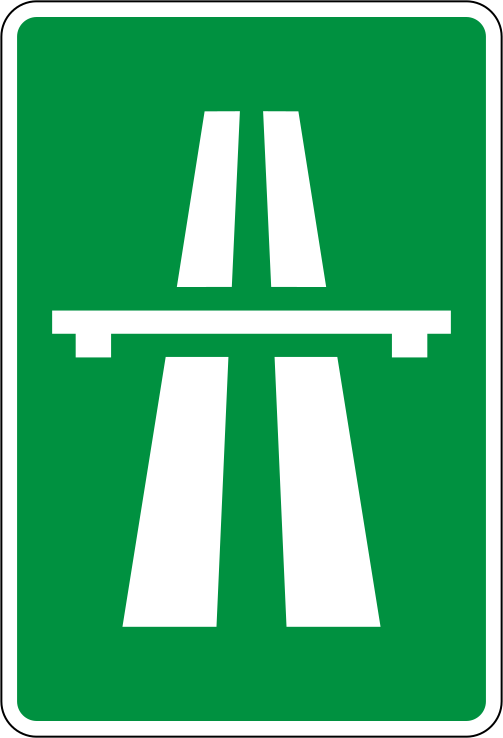 Start of a motorway.
English • Traffic sign 2401 • Motorway. The point where a motorway begins.
Slovenščina • Prometni znak 2401 • Avtocesta. Mesto, kjer se začenja avtocesta.
Sources
🔗 Commons.wikimedia.org
🔗 Pisrs.si • Pravilnik o prometni signalizaciji in prometni opremi na cestah • 16. člen • preglednica 10 • 2401 • NPB 2
🔗 Uradni-list.si • Uradni list RS, št. 26/2024 • 2401
SVG source: Government of Slovenia • Public domain • Original revision 2014-05-15. Wikimedia original unmodified.
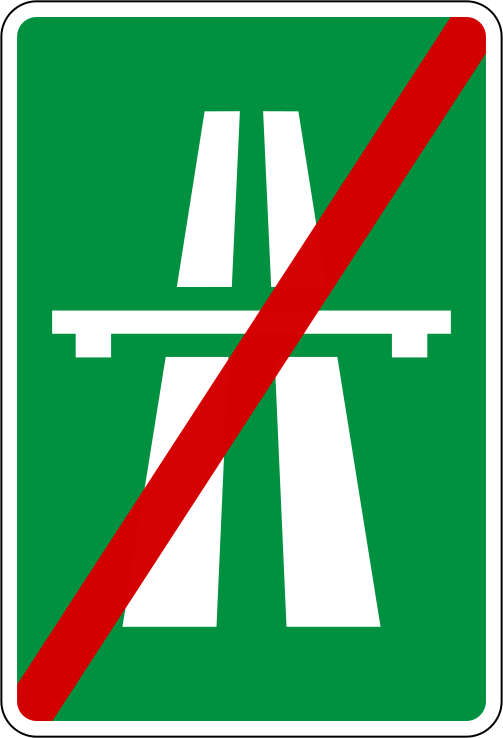 End of the motorway.
English • Traffic sign 2402 • End of motorway. The point where a motorway ends.
Slovenščina • Prometni znak 2402 • Konec avtoceste. Mesto, kjer se konča avtocesta.
Sources
🔗 Commons.wikimedia.org
🔗 Pisrs.si • Pravilnik o prometni signalizaciji in prometni opremi na cestah • 16. člen • preglednica 10 • 2402 • NPB 2
🔗 Uradni-list.si • Uradni list RS, št. 26/2024 • 2402
SVG source: Government of Slovenia • Public domain • Original revision 2014-05-16. Wikimedia original unmodified.
What speed limit applies to cars on a motorway in Slovenia?
For an ordinary passenger car without a trailer, the general maximum is 130 km/h. Obey lower posted limits and reduce speed when traffic, weather or visibility requires it. Different limits can apply to other vehicle classes.
🔗 pisrs.si • Slovenia, ZPrCP — articles 30, 46
🔗 pisrs.si • Slovenia, current Signs Regulation — relevant national signs and markings
Who may use a motorway in Slovenia?
Only eligible motor vehicles and combinations with a manufacturer-declared maximum speed of more than 60 km/h may normally use motorways. This admission condition does not require maintaining that speed in congestion or unsafe conditions.
🔗 pisrs.si • Slovenia, ZPrCP — articles 30, 46
🔗 pisrs.si • Slovenia, current Signs Regulation — relevant national signs and markings
What should I do if I miss a motorway exit in Slovenia?
Continue to the next exit and choose a safe onward route. Do not reverse, make a U-turn or cross the central reservation to return to a missed exit.
🔗 pisrs.si • Slovenia, ZPrCP — articles 30, 46
🔗 pisrs.si • Slovenia, current Signs Regulation — relevant national signs and markings
3. Zone
A traffic zone is an area in which a traffic rule applies throughout all included roads or road sections. The rule normally begins at a zone-entry sign and remains applicable until the corresponding end-of-zone sign is passed.
Zones may regulate speed, parking, access, vehicle categories, emissions or other traffic behaviour. The signs used, the roads covered and the effect of intersections or local exceptions depend on local traffic law.
Wikimedia.org • Doremo • CC BY-SA
How do people refer to traffic zones in Slovenia?
A Slovenian restricted-speed area is an območje omejene hitrosti. It is distinct from an območje umirjenega prometa, an area with stronger traffic-calming rules.
🔗 pisrs.si • Slovenia, ZPrCP — articles 31–31a, 46
🔗 pisrs.si • Slovenia, current Signs Regulation — relevant national signs and markings
Where does a zone rule apply in Slovenia?
The statutory maximum in a restricted-speed area is 30 km/h. Apply the rule on the roads included in the marked area and continue observing other applicable traffic signs.
🔗 pisrs.si • Slovenia, ZPrCP — articles 31–31a, 46
🔗 pisrs.si • Slovenia, current Signs Regulation — relevant national signs and markings
Is every Slovenian traffic-calming zone governed by the same speed limit?
No. Slovenian law distinguishes restricted-speed areas, residential areas and other special traffic arrangements. Identify the entrance sign and its category instead of using 30 km/h for every area described as a zone.
🔗 pisrs.si • Slovenia, ZPrCP — articles 31–31a, 46
🔗 pisrs.si • Slovenia, current Signs Regulation — relevant national signs and markings
How do you know when a traffic zone ends in Slovenia?
Observe the boundary signs for the area you are leaving and the rules for the road beyond. Passing an intersection within the designated area is not a reason to disregard its speed restriction.
🔗 pisrs.si • Slovenia, ZPrCP — articles 31–31a, 46
🔗 pisrs.si • Slovenia, current Signs Regulation — relevant national signs and markings
4. Speed limit
A speed limit is the maximum legal speed permitted on a road, lane or within a designated area. It may be established by general traffic law or indicated by fixed, variable or temporary traffic signs.
A speed limit is a maximum, not a target speed. Drivers must travel more slowly whenever traffic, visibility, weather, road conditions, vulnerable road users or the condition of the vehicle make the maximum permitted speed unsafe.
Wikimedia.org • Doremo • CC BY-SA
Which general speed limits should car drivers know in Slovenia?
For an ordinary passenger car, the general maxima are 50 km/h in built-up areas, 90 km/h on ordinary rural roads, 110 km/h on expressways and 130 km/h on motorways, subject to applicable signs. A road’s appearance alone does not establish its category. Special urban areas and other vehicle classes have lower limits.
🔗 pisrs.si • Slovenia, ZPrCP — articles 31–31a, 46
🔗 pisrs.si • Slovenia, current Signs Regulation — relevant national signs and markings
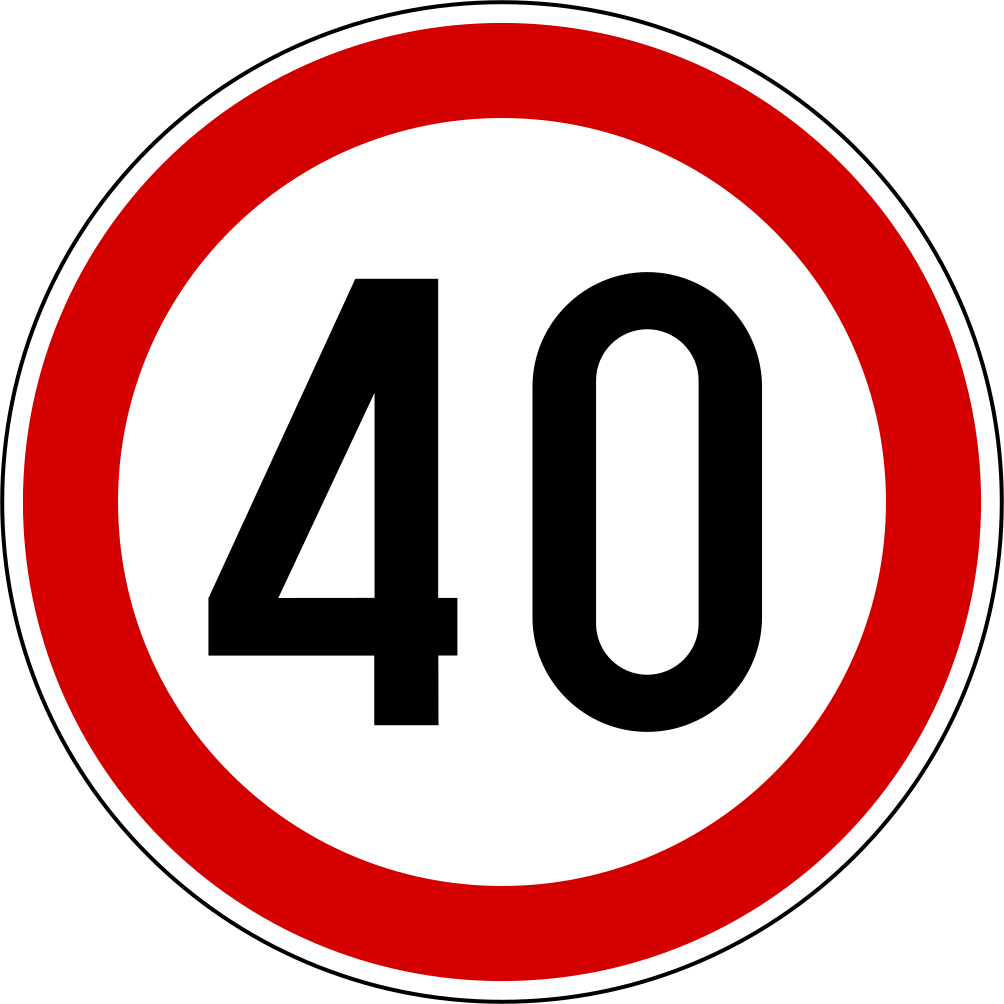 Start of a speed limit.
English • Traffic sign 2232 • Speed limit. A road or section where vehicle speed is limited to the maximum shown on the sign in km/h.
Slovenščina • Prometni znak 2232 • Omejitev hitrosti. Cesta ali njen del, kjer je hitrost vozil omejena na najvišjo dovoljeno hitrost, označeno na znaku (v km/h).
Sources
🔗 Commons.wikimedia.org
🔗 Pisrs.si • Pravilnik o prometni signalizaciji in prometni opremi na cestah • 16. člen • preglednica 10 • 2232 • NPB 2
🔗 Uradni-list.si • Uradni list RS, št. 26/2024 • 2232
SVG source: Commons.wikimedia.org • Original SVG
Government of Slovenia • Public domain • Original revision 2014-05-13. Wikimedia original unmodified.
Artwork reviewed against the Slovenian government PISRS catalogue, published consolidation NPB 2 applicable from 28 February 2026: Pisrs.si • Signal 2232, PDF page 29. Catalogue-equivalent illustration; intentional update from the previous PNG. This is an educational illustration, not a manufacturing specification.
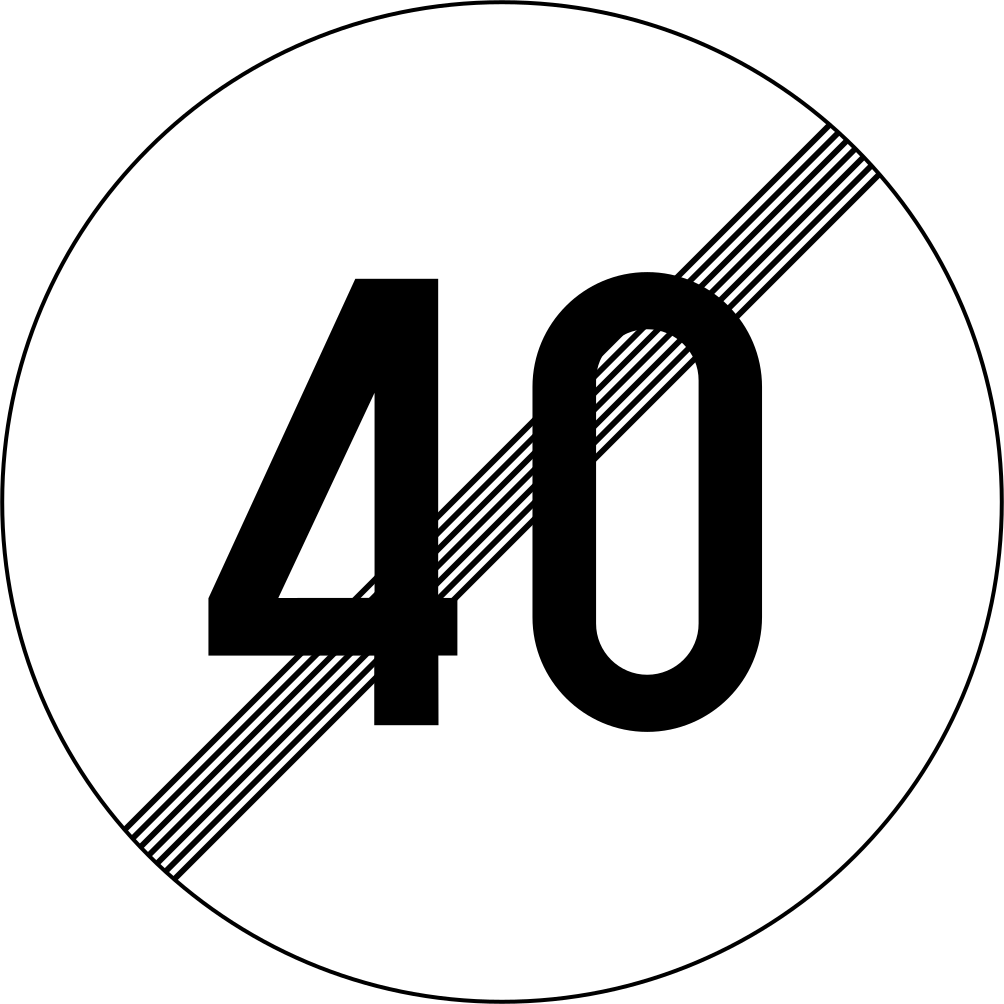 End of the speed limit.
English • Traffic sign 2233 • End of the speed limit. The place where the maximum speed restriction imposed by sign 2232 (Speed limit) ends.
Slovenščina • Prometni znak 2233 • Prenehanje omejitve hitrosti. Mesto, kjer preneha omejitev najvišje dovoljene hitrosti, ki je bila označena z znakom 2232 (omejitev hitrosti).
Sources
🔗 Commons.wikimedia.org
🔗 Pisrs.si • Pravilnik o prometni signalizaciji in prometni opremi na cestah • 16. člen • preglednica 10 • 2233 • NPB 2
🔗 Uradni-list.si • Uradni list RS, št. 26/2024 • 2233
SVG source: Commons.wikimedia.org • Original SVG
Government of Slovenia • Public domain • Original revision 2014-05-16. Wikimedia original unmodified.
Artwork reviewed against the Slovenian government PISRS catalogue, published consolidation NPB 2 applicable from 28 February 2026: Pisrs.si • Signal 2233, PDF page 29. Catalogue-equivalent illustration; intentional update from the previous PNG. This is an educational illustration, not a manufacturing specification.
Does every Slovenian urban road have a 50 km/h maximum?
No. Slovenia distinguishes restricted-speed areas at 30 km/h, residential areas and pedestrian areas at 10 km/h, and a separate shared traffic area normally at 20 km/h. In the latter category, prescribed signs may permit 30 km/h under the statutory conditions. Ordinary built-up-area roads generally have a 50 km/h maximum, subject to lawful signs and restrictions. Identify the actual category rather than applying one urban limit everywhere.
🔗 pisrs.si • Slovenia, ZPrCP — articles 31–31a, 46
🔗 pisrs.si • Slovenia, current Signs Regulation — relevant national signs and markings
Can I use the Slovenian motorway limit on a road that merely looks similar?
No. The 130 km/h general car maximum belongs to a designated motorway; an expressway generally has 110 km/h. Use the official road-category signs and actual speed restrictions, rather than estimating the legal category from the number of lanes.
🔗 pisrs.si • Slovenia, ZPrCP — articles 31–31a, 46
🔗 pisrs.si • Slovenia, current Signs Regulation — relevant national signs and markings
5. Bike path
A bike path is a part of a road or a separate route intended primarily or exclusively for people riding bicycles. It may be physically separated from motor traffic, marked on the road surface or identified by traffic signs.
Bike paths may be one-way, two-way or shared with other road users. The permitted users, direction of travel, priority rules and obligation to use the path depend on local traffic signs and regulations.

Wikimedia.org • juanma • CC BY
Must cyclists use provided Slovenian cycling facilities?
Yes. Use the designated cycling surface, identified by its signs and markings. The official terms include kolesarski pas for a cycle lane and kolesarska steza for a cycle track. A cycling route is a kolesarska pot.
🔗 pisrs.si • Slovenia, ZPrCP — articles 32, 46, 83, 93; Cycling Surfaces 5, 7
🔗 pisrs.si • Slovenia, current Signs Regulation — relevant national signs and markings
🔗 pisrs.si • Slovenia, Cycling Surfaces Regulation — articles 5 and 7, continuing application
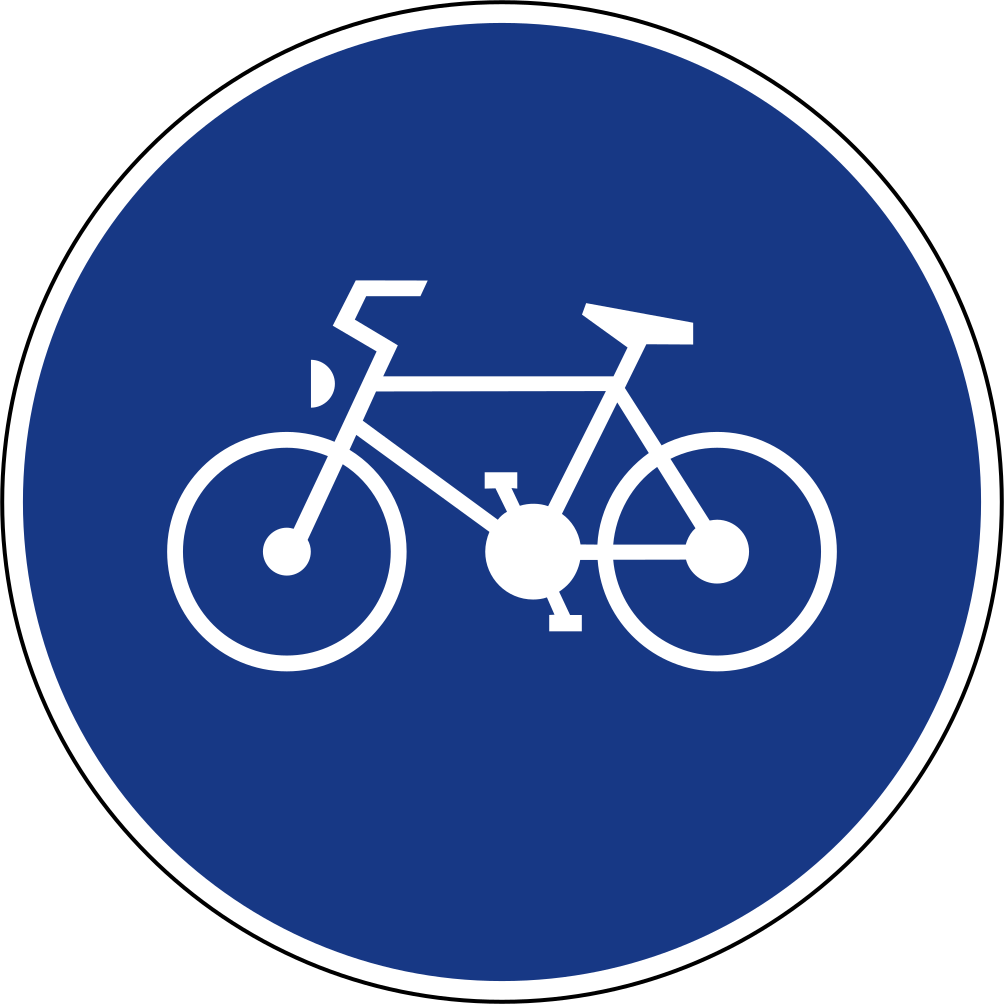 Mandatory path for cyclists.
English • Traffic sign 2309 • Cycle path or track. A cycle path or track. If tractors may also use the cycle path, supplementary sign 4503-2 is added.
Slovenščina • Prometni znak 2309 • Kolesarska pot ali steza. Kolesarska pot oziroma steza. Če je uporaba kolesarske poti dovoljena tudi za traktorje, je prometnemu znaku dodan dopolnilni znak 4503-2.
Sources
🔗 Commons.wikimedia.org
🔗 Pisrs.si • Pravilnik o prometni signalizaciji in prometni opremi na cestah • 16. člen • preglednica 10 • 2309 • NPB 2
🔗 Uradni-list.si • Uradni list RS, št. 26/2024 • 2309
SVG source: Commons.wikimedia.org • Original SVG
Government of Slovenia • Public domain • Original revision 2014-05-13. Wikimedia original unmodified.
Artwork reviewed against the Slovenian government PISRS catalogue, published consolidation NPB 2 applicable from 28 February 2026: Pisrs.si • Signal 2309, PDF page 31. Catalogue-equivalent illustration; intentional update from the previous PNG. This is an educational illustration, not a manufacturing specification.
Where should I ride if a Slovenian road has no cycle track or lane?
Ride close to the right edge of the carriageway in the direction of travel. The absence of a cycling facility does not generally make an ordinary pavement available for cycling. Continue to obey traffic signs and the road’s other restrictions.
🔗 pisrs.si • Slovenia, ZPrCP — articles 32, 46, 83, 93; Cycling Surfaces 5, 7
🔗 pisrs.si • Slovenia, current Signs Regulation — relevant national signs and markings
🔗 pisrs.si • Slovenia, Cycling Surfaces Regulation — articles 5 and 7, continuing application
Can cyclists normally ride side by side on a Slovenian road?
Normally, Slovenian cyclists riding together must ride one behind another. On a designated cycling route, kolesarska pot, they may ride two abreast if its width allows. This exception does not permit riding abreast across an ordinary road carriageway. Use the required cycling facilities and protect other users.
🔗 pisrs.si • Slovenia, ZPrCP — articles 32, 46, 83, 93; Cycling Surfaces 5, 7
🔗 pisrs.si • Slovenia, current Signs Regulation — relevant national signs and markings
🔗 pisrs.si • Slovenia, Cycling Surfaces Regulation — articles 5 and 7, continuing application
6. Tunnel
A tunnel is a covered passage that carries a road through or beneath an obstacle such as a hill, mountain, building, waterway or another transport route. Road tunnels may contain one or more traffic lanes and can carry traffic in one or both directions.
Driving in a tunnel requires particular attention because visibility, available escape routes and space for avoiding hazards are limited. Drivers should follow the applicable lighting, speed, lane and following-distance rules and pay attention to emergency exits, traffic signals and variable-message signs.

Wikimedia.org • MZaplotnik • CC BY-SA
What should I check before entering a tunnel in Slovenia?
Use the lights required by the traffic rules and obey the tunnel’s entrance and lane controls. Ordinary stopping and parking in a tunnel are prohibited; a necessary emergency stop requires protecting other road users.
🔗 pisrs.si • Slovenia, ZPrCP — articles 30, 45–46, 65
🔗 pisrs.si • Slovenia, current Signs Regulation — relevant national signs and markings
Does a tunnel sign in Slovenia set a universal speed limit?
No single speed can be read from the tunnel pictogram. Apply the road’s relevant limit and any permanent or electronic speed restriction, and drive more slowly when visibility, queues or another hazard require it.
🔗 pisrs.si • Slovenia, ZPrCP — articles 30, 45–46, 65
🔗 pisrs.si • Slovenia, current Signs Regulation — relevant national signs and markings
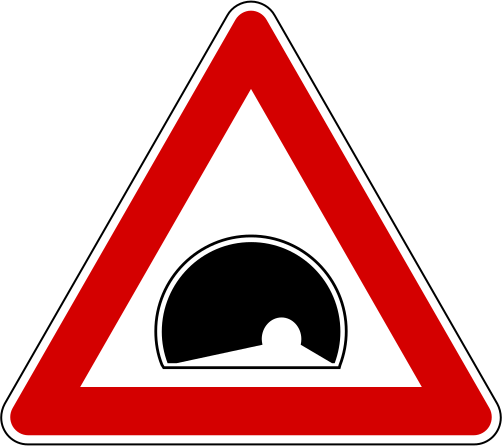 Warning for a tunnel.
Sources
SVG source: Government of Slovenia • Public domain • Original revision 2014-05-11. Wikimedia original unmodified.
Is every tunnel in Slovenia open to pedestrians and cyclists?
No. Check the road category and access signs before entering. A motorway tunnel, a vehicle-restricted tunnel and a purpose-built walking or cycling underpass have different access arrangements. Emergency evacuation routes do not establish ordinary public access.
🔗 pisrs.si • Slovenia, ZPrCP — articles 30, 45–46, 65
🔗 pisrs.si • Slovenia, current Signs Regulation — relevant national signs and markings
7. Pedestrian zone
A pedestrian zone is an area consisting of one or more streets that are reserved primarily for pedestrians. Motor-vehicle access is normally prohibited or restricted to authorised users, particular purposes or specified times.
Pedestrians may usually use the full width of the available road space. Rules concerning cyclists, deliveries, public transport, vehicle speed, stopping and parking depend on local traffic signs and regulations.
Wikimedia.org • RdA Suisse • CC BY
How should I recognise pedestrian-only access in Slovenia?
The official term is območje za pešce. The national Act gives pedestrians the space, with specified permitted users and service or emergency exceptions. Other vehicles need the access allowed by the traffic signs.
🔗 pisrs.si • Slovenia, ZPrCP — articles 32, 46, 83, 93; Cycling Surfaces 5, 7
🔗 pisrs.si • Slovenia, current Signs Regulation — relevant national signs and markings
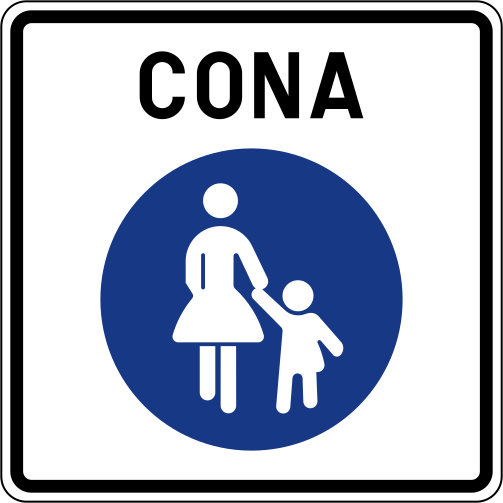 Start of a zone for pedestrians.
English • Traffic sign 2423 • Pedestrian zone. The point where an area intended for pedestrians begins, in which only cyclists and users of special means of transport may travel. A supplementary sign indicates the types of vehicle permitted as exceptions.
Slovenščina • Prometni znak 2423 • Območje za pešce. Mesto, kjer se začenja območje, namenjeno pešcem, in v katerem je vožnja dovoljena le kolesarjem in uporabnikom posebnih prevoznih sredstev. Z dopolnilnim znakom je označena vrsta vozil, ki lahko kot izjeme vozijo na območju.
Sources
🔗 Commons.wikimedia.org
🔗 Pisrs.si • Pravilnik o prometni signalizaciji in prometni opremi na cestah • 16. člen • preglednica 10 • 2423 • NPB 2
🔗 Uradni-list.si • Uradni list RS, št. 26/2024 • 2423
SVG source: Government of Slovenia • Public domain • Original revision 2014-05-20. Wikimedia original unmodified.
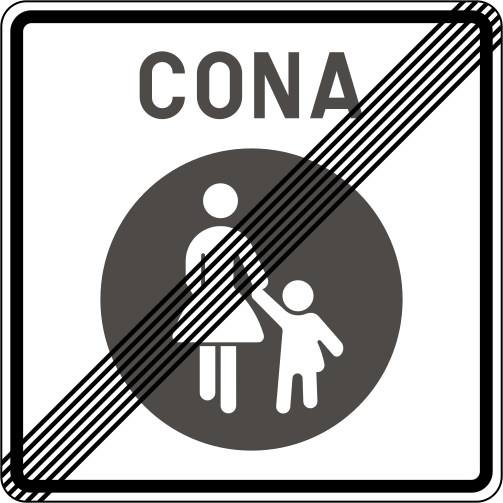 End of the zone for pedestrians.
English • Traffic sign 2424 • End of the pedestrian zone. The point where the area intended for pedestrians ends.
Slovenščina • Prometni znak 2424 • Konec območja za pešce. Mesto, kjer se konča območje, namenjeno pešcem.
Sources
🔗 Commons.wikimedia.org
🔗 Pisrs.si • Pravilnik o prometni signalizaciji in prometni opremi na cestah • 16. člen • preglednica 10 • 2424 • NPB 2
🔗 Uradni-list.si • Uradni list RS, št. 26/2024 • 2424
SVG source: Government of Slovenia • Public domain • Original revision 2014-05-21. Wikimedia original unmodified.
May cyclists ride in pedestrian areas in Slovenia?
Cycling is allowed only in the manner the Act permits: riders must not endanger pedestrians and must adapt their speed to walking. The area is different from a cycling-only facility or an ordinary mixed street.
🔗 pisrs.si • Slovenia, ZPrCP — articles 32, 46, 83, 93; Cycling Surfaces 5, 7
🔗 pisrs.si • Slovenia, current Signs Regulation — relevant national signs and markings
Which rules apply to vehicles admitted to pedestrian areas in Slovenia?
The general maximum in a pedestrian area is 10 km/h, with any stricter walking-speed duty still applying to the relevant users. Permitted service access must follow its signs and pedestrian-protection conditions.
🔗 pisrs.si • Slovenia, ZPrCP — articles 32, 46, 83, 93; Cycling Surfaces 5, 7
🔗 pisrs.si • Slovenia, current Signs Regulation — relevant national signs and markings
8. Speed bump
A speed bump is a raised traffic-calming device placed across all or part of a road to make drivers reduce their speed. It is commonly used near homes, schools, crossings, parking areas and other places where low vehicle speeds are important.
Speed bumps vary in shape, height and legal status. Drivers should approach them at a low, controlled speed and follow any warning signs or speed limits that apply.

Wikimedia.org • Doremo • CC BY-SA
How should I recognise and approach a speed bump in Slovenia?
Look for a raised surface, approach warnings, road markings and any separate speed instruction. A traffic-calming device can be part of a raised crossing or junction, so identify the layout and the road users who may use it.
🔗 pisrs.si • Slovenia, ZPrCP — articles 45, 83
🔗 pisrs.si • Slovenia, current Signs Regulation — relevant national signs and markings
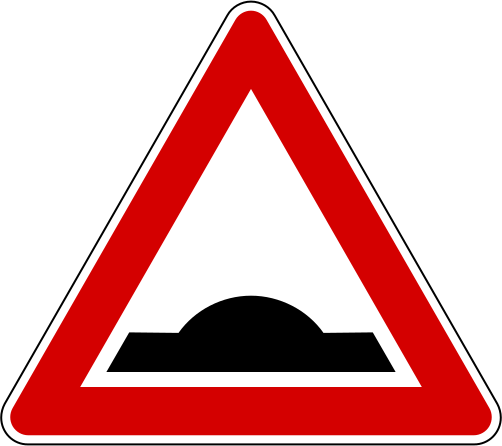 Warning for a speed bump.
English • Traffic sign 1110-1 • Uneven carriageway. A section with an uneven carriageway (1110) or a dangerous crest (1110-1) lies ahead.
Slovenščina • Prometni znak 1110-1 • Neravno vozišče. Bližina dela ceste z neravnim voziščem (1110) ali bližina dela ceste, kjer je nevarni prevoj (1110-1).
Sources
🔗 Commons.wikimedia.org
🔗 Pisrs.si • Pravilnik o prometni signalizaciji in prometni opremi na cestah • 13. člen • preglednica 9 • 1110-1 • NPB 2
🔗 Uradni-list.si • Uradni list RS, št. 26/2024 • 1110-1
SVG source: Government of Slovenia • Public domain • Original revision 2014-05-11. Wikimedia original unmodified.
Which speed should I use at a raised device in Slovenia?
Obey the applicable speed restriction and slow further for the device, visibility and other road users. Do not assume that a raised device carries the same numerical rule as one in another country; a safe approach can be well below the road’s maximum.
🔗 pisrs.si • Slovenia, ZPrCP — articles 45, 83
🔗 pisrs.si • Slovenia, current Signs Regulation — relevant national signs and markings
Does a raised road surface give pedestrians priority in Slovenia?
A raised device alone does not identify pedestrian priority. If it incorporates a crossing, apply the crossing’s controls and the national rules. At an uncontrolled crossing, allow pedestrians on it or entering it to pass safely. Approach at a speed that enables you to stop, rather than relying on the warning sign alone.
🔗 pisrs.si • Slovenia, ZPrCP — articles 45, 83
🔗 pisrs.si • Slovenia, current Signs Regulation — relevant national signs and markings
9. Customs
Customs is the government authority responsible for controlling goods entering or leaving a country or customs territory. In road traffic, a customs checkpoint is a place where drivers may be required to stop so officers can inspect the vehicle, luggage, cargo and relevant documents.
Customs controls may take place at borders, ports, ferry terminals, airports or inland control locations. Drivers must follow all traffic signs, lane signals, barriers and instructions from customs officers. Declaration requirements depend on the countries involved and on the type, value, quantity and intended use of the goods being carried.

Wikimedia.org • Eleassar • CC BY-SA
Which customs authority should drivers consult for travel to Slovenia?
Consult the Financial Administration of the Republic of Slovenia, FURS for the goods, luggage and vehicle-related customs requirements of the journey. Customs controls concern goods and declarations; they must be distinguished from passport checks, a road toll or ordinary traffic control.
🔗 fu.gov.si • Slovenia, FURS — travellers and customs formalities
🔗 pisrs.si • Slovenia, current Signs Regulation — relevant national signs and markings
Do customs requirements depend on the route and goods when entering Slovenia?
Yes. Travel within the EU customs territory is treated differently from bringing goods from outside it. Personal use, commercial use, restricted goods and tax or customs special territories can change the requirements. Schengen passport arrangements do not replace customs rules.
🔗 fu.gov.si • Slovenia, FURS — travellers and customs formalities
🔗 pisrs.si • Slovenia, current Signs Regulation — relevant national signs and markings
What should motorists check before declaring goods in Slovenia?
Check the official declaration requirements for goods over your applicable allowance, commercial goods, controlled articles and cash or other monetary instruments. These categories have different rules and thresholds. Declare as required and ask customs if unsure; do not assume a duty-free purchase is exempt from all controls.
🔗 fu.gov.si • Slovenia, FURS — travellers and customs formalities
🔗 pisrs.si • Slovenia, current Signs Regulation — relevant national signs and markings
10. One-way traffic
One-way traffic means that vehicles on a road or carriageway may travel only in one designated direction. The permitted direction is normally indicated by traffic signs, lane arrows or road markings.
Some road users, such as cyclists or public-transport vehicles, may be allowed to travel in the opposite direction when signs expressly permit it. A one-way road does not by itself determine the speed limit, priority or parking rules.

Wikimedia.org • MZaplotnik • CC BY-SA
How should I read a one-way restriction in Slovenia?
Follow the direction designated by the street’s one-way signs and any entrance restrictions or lane arrows. A compulsory turn at one junction is different from a restriction applying along the street.
🔗 pisrs.si • Slovenia, ZPrCP — articles 30, 37, 43
🔗 pisrs.si • Slovenia, current Signs Regulation — relevant national signs and markings
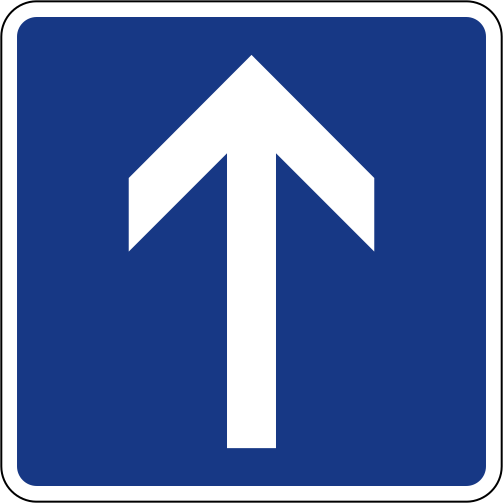 Road with one-way traffic.
English • Traffic sign 2407 • One-way road. A road with one-way traffic.
Slovenščina • Prometni znak 2407 • Enosmerna cesta. Enosmerna cesta.
Sources
🔗 Commons.wikimedia.org
🔗 Pisrs.si • Pravilnik o prometni signalizaciji in prometni opremi na cestah • 16. člen • preglednica 10 • 2407 • NPB 2
🔗 Uradni-list.si • Uradni list RS, št. 22/2025 • 2407
SVG source: Government of Slovenia • Public domain • Original revision 2014-05-14. Wikimedia original unmodified.
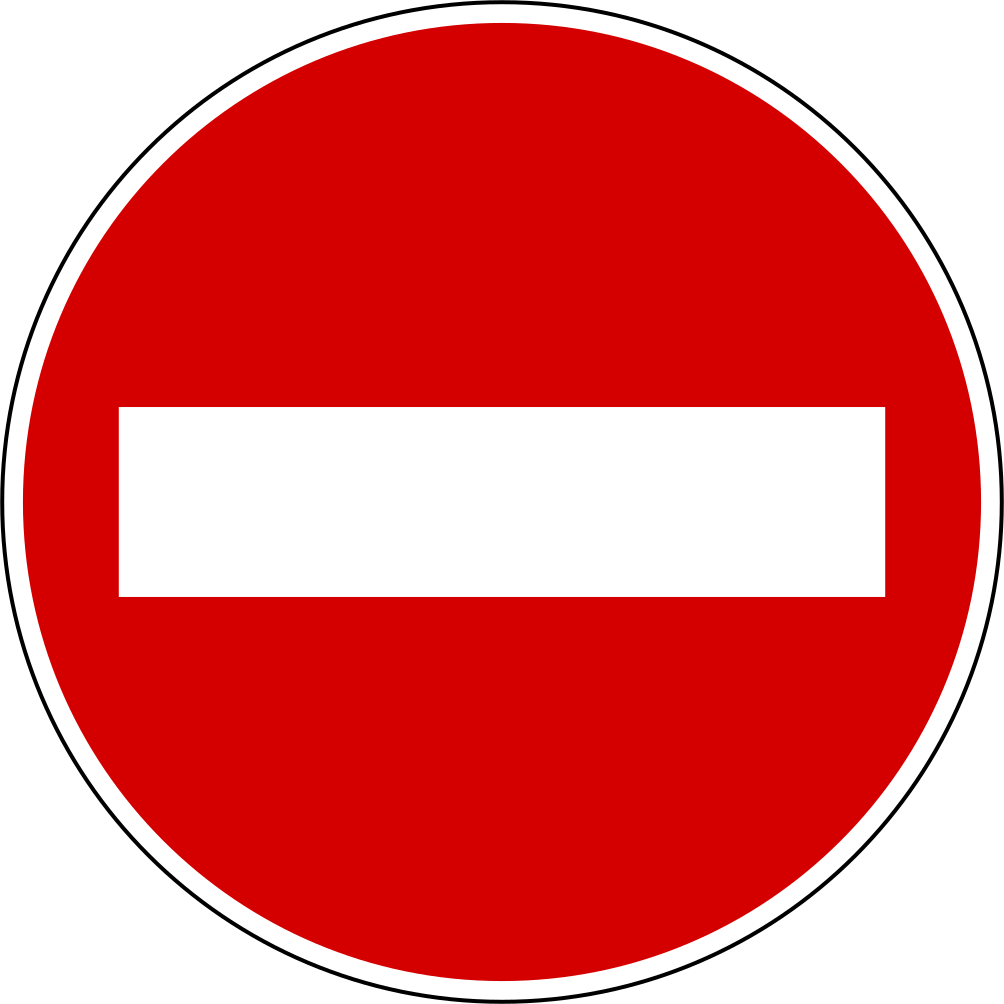 No entry.
English • Traffic sign 2201 • No traffic in one direction. A road or section where all vehicles are prohibited from entering from the direction towards which the sign faces.
Slovenščina • Prometni znak 2201 • Prepovedan promet v eno smer. Cesta ali njen del, kjer je prepovedan promet za vsa vozila iz smeri, proti kateri je prometni znak obrnjen.
Sources
🔗 Commons.wikimedia.org
🔗 Pisrs.si • Pravilnik o prometni signalizaciji in prometni opremi na cestah • 16. člen • preglednica 10 • 2201 • NPB 2
🔗 Uradni-list.si • Uradni list RS, št. 26/2024 • 2201
SVG source: Commons.wikimedia.org • Original SVG
Government of Slovenia • Public domain • Original revision 2014-05-12. Wikimedia original unmodified.
Artwork reviewed against the Slovenian government PISRS catalogue, published consolidation NPB 2 applicable from 28 February 2026: Pisrs.si • Signal 2201, PDF page 23. Catalogue-equivalent illustration; intentional update from the previous PNG. This is an educational illustration, not a manufacturing specification.
May cyclists travel against the general traffic direction in Slovenia?
Do not assume cyclists are exempt from a road’s direction restriction. Check whether the applicable signs, local traffic arrangement or separately designated cycle facility actually authorise movement in the opposite direction; an ordinary bicycle-route sign is not enough.
🔗 pisrs.si • Slovenia, ZPrCP — articles 30, 37, 43
🔗 pisrs.si • Slovenia, current Signs Regulation — relevant national signs and markings
Does one-way traffic give me priority or a different speed limit in Slovenia?
A one-way restriction concerns direction. Continue to follow the applicable speed limit, signals, give-way or stop controls and junction-priority rules. Where authorised counterflow traffic exists, check for it before turning or crossing; your permitted direction is not automatic junction priority.
🔗 pisrs.si • Slovenia, ZPrCP — articles 30, 37, 43
🔗 pisrs.si • Slovenia, current Signs Regulation — relevant national signs and markings
11. Slope
A slope is a section of road that rises or descends noticeably. A steep slope can affect vehicle speed, braking distance, traction, visibility and the ability of heavy or low-powered vehicles to maintain a steady speed.
Warning signs may indicate a steep ascent or dangerous descent and may show the gradient as a percentage. Drivers should adjust their speed early, select a suitable gear and remain prepared for slow vehicles, bends and changing road conditions.
Wikimedia.org • LeDucky • CC BY
What does a steep-slope warning mean in Slovenia?
Slovenian gradient warnings describe a steep ascent or descent. Adjust speed for the slope and sight distance and distinguish the warning from a numerical speed restriction.
🔗 pisrs.si • Slovenia, ZPrCP — articles 29, 45–46, 55, 83, 98; national warning catalogue
🔗 pisrs.si • Slovenia, current Signs Regulation — relevant national signs and markings
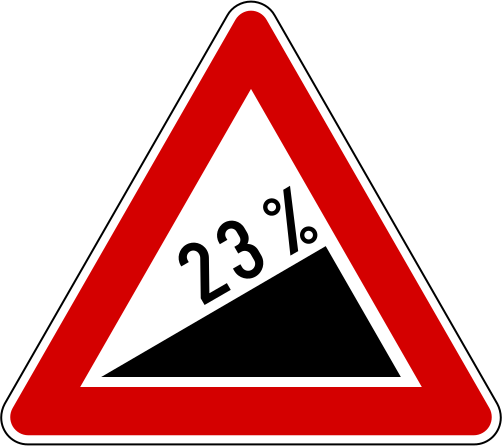 Warning for a steep ascent.
English • Traffic sign 1108 • Dangerous ascent. An ascent that is dangerous owing to its characteristics lies ahead.
Slovenščina • Prometni znak 1108 • Nevaren vzpon. Bližina vzpona ceste, ki je nevaren zaradi svojih značilnosti.
Sources
🔗 Commons.wikimedia.org
🔗 Pisrs.si • Pravilnik o prometni signalizaciji in prometni opremi na cestah • 13. člen • preglednica 9 • 1108 • NPB 2
🔗 Uradni-list.si • Uradni list RS, št. 26/2024 • 1108
SVG source: Government of Slovenia • Public domain • Original revision 2014-05-10. Wikimedia original unmodified.
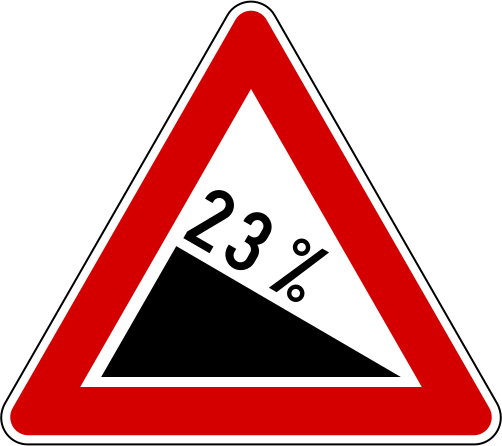 Warning for a steep descent.
English • Traffic sign 1107 • Dangerous descent. A descent that is dangerous owing to its characteristics lies ahead.
Slovenščina • Prometni znak 1107 • Nevaren klanec navzdol. Bližina klanca navzdol, ki je nevaren zaradi svojih značilnosti.
Sources
🔗 Commons.wikimedia.org
🔗 Pisrs.si • Pravilnik o prometni signalizaciji in prometni opremi na cestah • 13. člen • preglednica 9 • 1107 • NPB 2
🔗 Uradni-list.si • Uradni list RS, št. 26/2024 • 1107
SVG source: Government of Slovenia • Public domain • Original revision 2014-05-10. Wikimedia original unmodified.
How should I approach a steep descent in Slovenia?
Reduce speed before the descent and select a suitable gear to help control the vehicle. Keep enough following distance and avoid building up speed that requires continuous heavy braking. A warning gives no fixed safe descent speed: the gradient, surface, visibility, load and vehicle can require a speed well below the legal maximum.
🔗 pisrs.si • Slovenia, ZPrCP — articles 29, 45–46, 55, 83, 98; national warning catalogue
🔗 pisrs.si • Slovenia, current Signs Regulation — relevant national signs and markings
What should I check when meeting or overtaking on a slope in Slovenia?
On a steep narrow road where meeting is difficult, apply the Road Traffic Rules Act’s special meeting provisions. The downhill driver normally stops, but an available passing place and the rules for reversing can change which driver must manoeuvre.
🔗 pisrs.si • Slovenia, ZPrCP — articles 29, 45–46, 55, 83, 98; national warning catalogue
🔗 pisrs.si • Slovenia, current Signs Regulation — relevant national signs and markings
12. Bus lane
A bus lane is a traffic lane reserved primarily for buses or other authorised public-transport vehicles. It is intended to improve the reliability and flow of public transport by allowing authorised vehicles to avoid general traffic congestion.
Other road users, such as taxis, cyclists, motorcycles or vehicles carrying several occupants, may also be permitted when signs expressly allow them. The operating hours, permitted vehicles, direction of travel and rules for entering or crossing the lane depend on local traffic signs and regulations.

Wikimedia.org • Mich973 • CC BY-SA
Which vehicles may use a bus lane in Slovenia?
A Slovenian reserved lane must be used according to its indicated vehicle category and any supplementary information. Read the actual public-transport reservation before entering.
🔗 pisrs.si • Slovenia, ZPrCP — articles 37, 65, 98
🔗 pisrs.si • Slovenia, current Signs Regulation — relevant national signs and markings
May bicycles and motorcycles use a bus lane in Slovenia?
Cycles, taxis and motorcycles must follow the specific signs or authorisation. Do not assume that they are all included simply because the lane serves buses.
🔗 pisrs.si • Slovenia, ZPrCP — articles 37, 65, 98
🔗 pisrs.si • Slovenia, current Signs Regulation — relevant national signs and markings
Does bus-lane access also allow stopping or parking in Slovenia?
Apply the separate stopping and parking restrictions and leave the lane clear for its authorised users. A lane-access permission is not a general parking exemption.
🔗 pisrs.si • Slovenia, ZPrCP — articles 37, 65, 98
🔗 pisrs.si • Slovenia, current Signs Regulation — relevant national signs and markings
13. Dead end
A dead-end road is a road that does not provide a through route for some or all vehicles. It may end completely, terminate at a barrier or continue as a path that only certain road users may use.
Drivers may normally enter a dead-end road to reach homes, businesses, parking places or other destinations, but they must be prepared to turn around or leave by the same route. Signs may indicate that pedestrians or cyclists can continue beyond the point where motor traffic cannot.

Wikimedia.org • Doremo • CC BY-SA
What does a dead-end indication mean in Slovenia?
Slovenian slepa cesta information describes a dead-end road. It must be read separately from a prohibition or a vehicle-category restriction.
🔗 pisrs.si • Slovenia, ZPrCP — articles 43, 65, 98
🔗 pisrs.si • Slovenia, current Signs Regulation — relevant national signs and markings
Can pedestrians or cyclists continue beyond a motor-traffic dead end in Slovenia?
A pedestrian or cycle continuation must be assessed from the actual indicated route. Do not assume that a motor-traffic dead end prevents every person from continuing.
🔗 pisrs.si • Slovenia, ZPrCP — articles 43, 65, 98
🔗 pisrs.si • Slovenia, current Signs Regulation — relevant national signs and markings
Does a dead-end indication change speed or priority rules in Slovenia?
The no-through information itself does not assign junction priority or a numerical speed limit. Continue to obey the actual speed, access, parking and priority controls. If you need to turn around, use a suitable lawful place, check for pedestrians and cyclists, and do not obstruct the space needed for other vehicles to turn.
🔗 pisrs.si • Slovenia, ZPrCP — articles 43, 65, 98
🔗 pisrs.si • Slovenia, current Signs Regulation — relevant national signs and markings
14. Stop sign
A stop sign requires drivers to bring their vehicle to a complete stop and give way before entering or crossing the road ahead. The stop must be made at the stop line or another legally prescribed position.
After stopping, the driver may continue only when this can be done safely and without interfering with traffic that has priority. The sign does not create priority for the driver who has stopped.

Wikimedia.org • MZaplotnik • CC BY-SA
Must I stop completely at a stop sign in Slovenia?
Yes. Come to a complete stop when the applicable stop sign controls your approach, even when you cannot see another road user. Slowing to a crawl is not a stop. The stopping duty is separate from the duty to give way before continuing.
🔗 pisrs.si • PISRS, Traffic Signing Regulation, current illustrated sign tables
🔗 pisrs.si • PISRS, Road Traffic Rules Act, current consolidation 13
 Stop and give way.
English • Traffic sign 2102 • Stop. A junction or road location where vehicles must stop and give way to vehicles on the priority road (2102), or to rail vehicles crossing the road at the same level (2102-1, 2102-2).
Slovenščina • Prometni znak 2102 • Ustavi. Križišče ali mesto na cesti, kjer mora vozilo ustaviti in dati prednost vozilom, ki vozijo po prednostni cesti (2102), ali vozilom, ki vozijo po tirih in prečkajo cesto v isti ravnini (2102-1, 2102-2).
Sources
🔗 Commons.wikimedia.org
🔗 Pisrs.si • Pravilnik o prometni signalizaciji in prometni opremi na cestah • 16. člen • preglednica 10 • 2102 • NPB 2
🔗 Uradni-list.si • Uradni list RS, št. 26/2024 • 2102
SVG source: Commons.wikimedia.org • Original SVG
Government of Slovenia • Public domain • Original revision 2014-05-12. Wikimedia original unmodified.
Artwork reviewed against the Slovenian government PISRS catalogue, published consolidation NPB 2 applicable from 28 February 2026: Pisrs.si • Signal 2102, PDF page 22. Catalogue-equivalent illustration; intentional update from the previous PNG. This is an educational illustration, not a manufacturing specification.
Where must I stop at a stop-controlled junction in Slovenia?
Stop at the indicated stop line or prescribed position before entering the junction. A restricted view may require further careful observation; it does not permit entering in conflict with another road user.
🔗 pisrs.si • PISRS, Traffic Signing Regulation, current illustrated sign tables
🔗 pisrs.si • PISRS, Road Traffic Rules Act, current consolidation 13
Does stopping first give me priority at a stop sign in Slovenia?
A complete stop does not, by itself, give you priority. Give way to the road users entitled to pass under the junction’s signs and rules, check pedestrians and cyclists, and proceed only when the gap is safe. Do not follow another stopped vehicle through without satisfying your own stopping and yielding duties.
🔗 pisrs.si • PISRS, Traffic Signing Regulation, current illustrated sign tables
🔗 pisrs.si • PISRS, Road Traffic Rules Act, current consolidation 13
15. Roundabout
A roundabout is a circular road arrangement in which traffic travels around a central island in one designated direction. Vehicles enter and leave through connecting roads, and traffic signs or local rules determine who has priority.
Drivers should reduce speed, choose a suitable lane, observe all road users and signal as required when leaving. The direction of travel, entry priority, lane use and rules for cyclists and pedestrians depend on local traffic signs and regulations.
Wikimedia.org • Alen Ištoković • CC BY
Who has priority at a roundabout in Slovenia?
At a Slovenian krožno križišče, the Road Traffic Rules Act gives priority to vehicles already circulating over vehicles entering. Follow the marked lanes and any additional traffic controls.
How should you choose a roundabout lane in Slovenia?
On a multilane roundabout, Slovenian law normally requires using an inner lane, with exceptions including the first exit and the traffic or vehicle conditions specified in the Act. With a two-lane entry, the right entry lane joins the outer lane and the left joins the inner lane. Follow the actual markings.
What should you check when leaving a roundabout in Slovenia?
Move to the outer lane before leaving unless the signs expressly permit the exit from an inner lane. If traffic prevents the required move, continue around until you can position safely rather than force a path across the outer lane.
🔗 pisrs.si • Road Traffic Rules Act articles 58-60
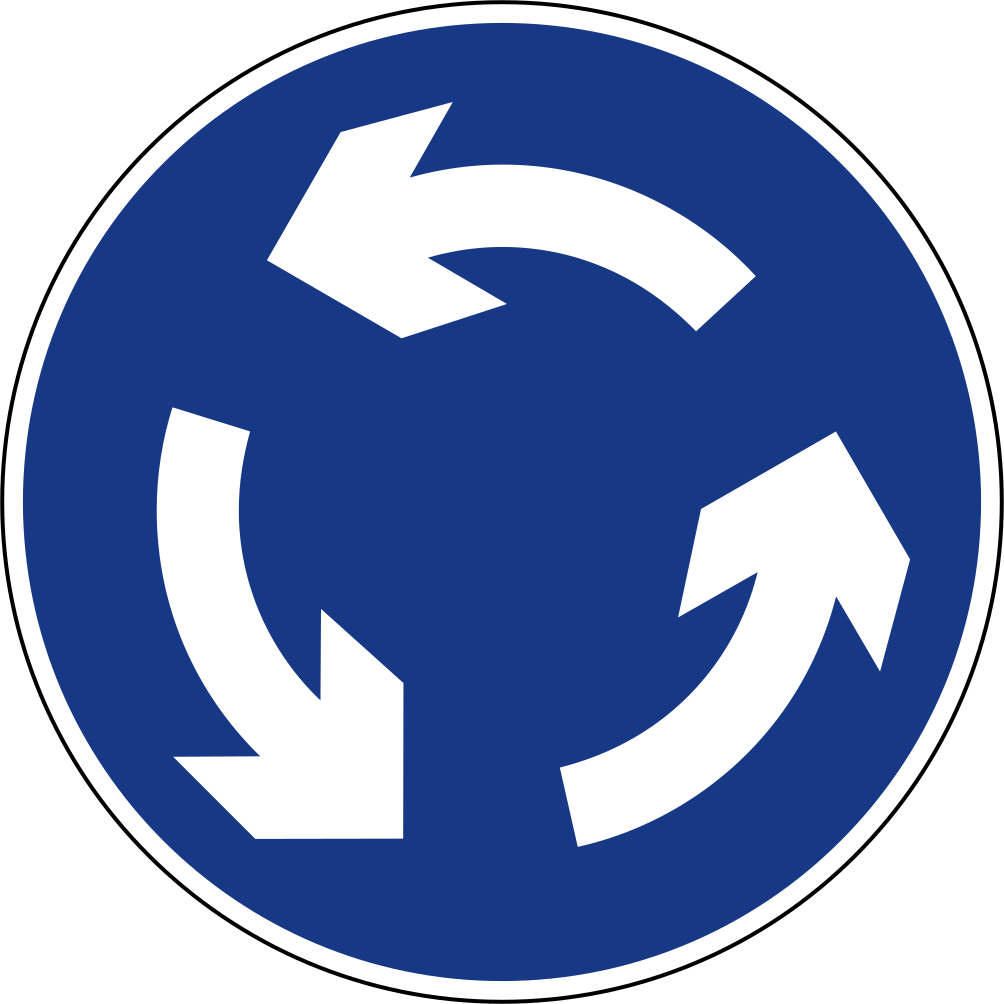 Mandatory roundabout direction.
English • Traffic sign 2304 • Roundabout. A junction with circulating traffic where roundabout driving rules apply.
Slovenščina • Prometni znak 2304 • Krožni promet. Križišče, na katerem je krožni promet in veljajo pravila vožnje na krožnem križišču.
Sources
🔗 Commons.wikimedia.org
🔗 Pisrs.si • Pravilnik o prometni signalizaciji in prometni opremi na cestah • 16. člen • preglednica 10 • 2304 • NPB 2
🔗 Uradni-list.si • Uradni list RS, št. 26/2024 • 2304
SVG source: Commons.wikimedia.org • Original SVG
Government of Slovenia • Public domain • Original revision 2014-05-14. Wikimedia original unmodified.
Artwork reviewed against the Slovenian government PISRS catalogue, published consolidation NPB 2 applicable from 28 February 2026: Pisrs.si • Signal 2304, PDF page 31. Catalogue-equivalent illustration; intentional update from the previous PNG. This is an educational illustration, not a manufacturing specification.
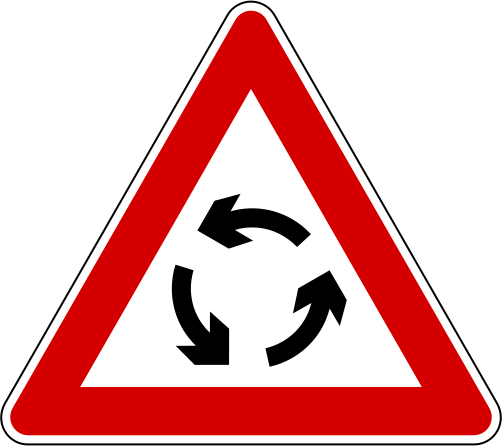 Warning for a roundabout.
English • Traffic sign 1105 • Roundabout ahead. A junction with circulating traffic lies ahead.
Slovenščina • Prometni znak 1105 • Križišče s krožnim prometom. Bližina križišča z urejenim krožnim prometom.
Sources
🔗 Commons.wikimedia.org
🔗 Pisrs.si • Pravilnik o prometni signalizaciji in prometni opremi na cestah • 13. člen • preglednica 9 • 1105 • NPB 2
🔗 Uradni-list.si • Uradni list RS, št. 26/2024 • 1105
SVG source: Government of Slovenia • Public domain • Original revision 2014-05-11. Wikimedia original unmodified.
16. Priority road
A priority road is a road whose traffic is given priority over traffic entering from intersecting roads. It is normally identified by a priority-road sign, while an end sign indicates where that continuing priority status stops.
Drivers on a priority road must still obey traffic lights, authorised officers, speed limits, crossings and turning rules. Having priority never allows a driver to proceed when doing so would create danger or block an intersection.

Wikimedia.org • Doremo • CC BY-SA
How does priority-road status work in Slovenia?
Slovenia recognises a prednostna cesta, a priority road. A driver joining must let the traffic in the lane being entered pass; read any supplementary indication of the priority road’s course.
🔗 pisrs.si • PISRS, Traffic Signing Regulation, current illustrated sign tables
🔗 pisrs.si • PISRS, Road Traffic Rules Act, current consolidation 13
How can you tell where a priority road applies in Slovenia?
Read the priority-road sign, the corresponding end indication and any supplementary junction diagram. Distinguish a continuing road designation from a sign that regulates only one junction. If a diagram shows the priority route turning, follow that diagram rather than assuming the straight-ahead road has priority.
🔗 pisrs.si • PISRS, Traffic Signing Regulation, current illustrated sign tables
🔗 pisrs.si • PISRS, Road Traffic Rules Act, current consolidation 13
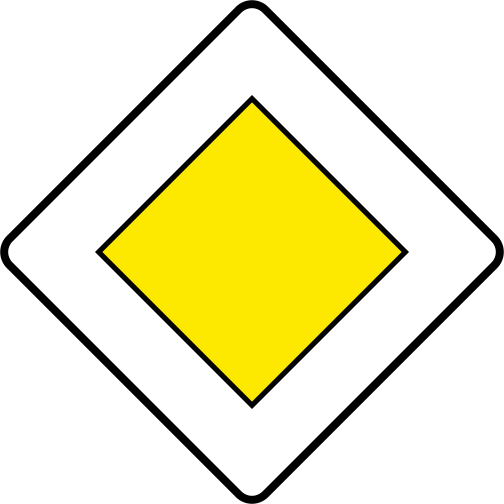 Start of a priority road.
English • Traffic sign 2103 • Priority road. A road or section where vehicles have priority over vehicles on roads that intersect it.
Slovenščina • Prometni znak 2103 • Prednostna cesta. Cesta ali njen del, na katerem imajo vozila prednost pred vozili na cestah, ki se križajo s cesto oziroma njenim delom.
Sources
🔗 Commons.wikimedia.org
🔗 Pisrs.si • Pravilnik o prometni signalizaciji in prometni opremi na cestah • 16. člen • preglednica 10 • 2103 • NPB 2
🔗 Uradni-list.si • Uradni list RS, št. 26/2024 • 2103
SVG source: Government of Slovenia • Public domain • Original revision 2022-07-28. Wikimedia original unmodified.
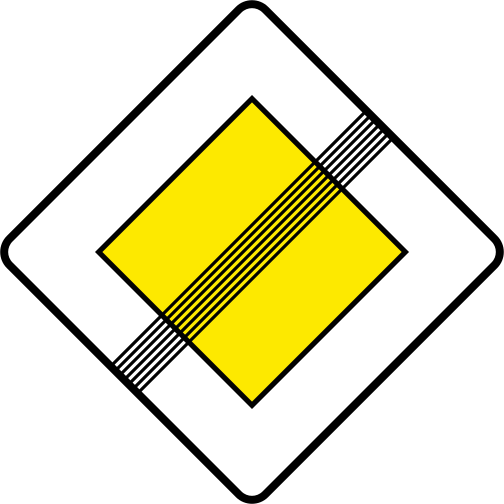 End of the priority road.
English • Traffic sign 2104 • End of the priority road. The point where a priority road or section ends.
Slovenščina • Prometni znak 2104 • Konec prednostne ceste. Mesto, kjer se konča prednostna cesta ali njen del.
Sources
🔗 Commons.wikimedia.org
🔗 Pisrs.si • Pravilnik o prometni signalizaciji in prometni opremi na cestah • 16. člen • preglednica 10 • 2104 • NPB 2
🔗 Uradni-list.si • Uradni list RS, št. 26/2024 • 2104
SVG source: Government of Slovenia • Public domain • Original revision 2022-07-28. Wikimedia original unmodified.
Does having road priority let you ignore other controls in Slovenia?
No. Obey the applicable traffic signals and authorised directions, speed limits and crossing rules. Turning or changing lanes can require yielding, and having priority never permits entering a conflict that cannot be crossed safely.
17. Road narrowing
A road narrowing is a section where the available width of the road or carriageway becomes smaller. The narrowing may occur on both sides, on one side only, or because one or more traffic lanes end.
Drivers should reduce speed, observe approaching and adjacent traffic, maintain sufficient lateral clearance and merge when necessary. Warning signs do not always determine priority, so drivers must follow any priority signs, lane markings and local traffic rules.

Wikimedia.org • Tiia Monto • CC BY-SA
What does a road-narrowing warning mean in Slovenia?
Slovenian narrowing warnings identify a smaller usable road width. Follow the current traffic-sign regulation and any separate priority or signal control at the restricted section.
🔗 pisrs.si • PISRS, Traffic Signing Regulation, current illustrated sign tables
🔗 pisrs.si • PISRS, Road Traffic Rules Act, current consolidation 13
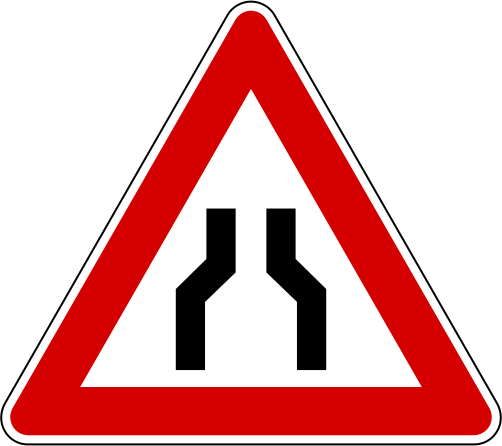 Warning for a road narrowing.
English • Traffic sign 1109 • Road narrows. The carriageway narrows ahead on both sides (1109), on the right (1109-1) or on the left (1109-2).
Slovenščina • Prometni znak 1109 • Zoženje vozišča. Bližina obojestransko (1109), desno (1109-1) ali levo (1109-2) zoženega vozišča.
Sources
🔗 Commons.wikimedia.org
🔗 Pisrs.si • Pravilnik o prometni signalizaciji in prometni opremi na cestah • 13. člen • preglednica 9 • 1109 • NPB 2
🔗 Uradni-list.si • Uradni list RS, št. 26/2024 • 1109
SVG source: Government of Slovenia • Public domain • Original revision 2014-05-10. Wikimedia original unmodified.
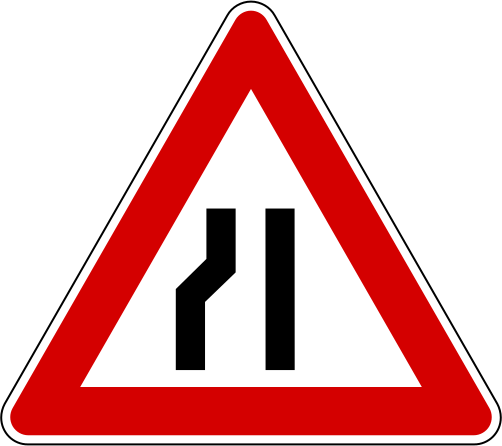 Warning for a road narrowing on the left.
English • Traffic sign 1109-2 • Road narrows. The carriageway narrows ahead on both sides (1109), on the right (1109-1) or on the left (1109-2).
Slovenščina • Prometni znak 1109-2 • Zoženje vozišča. Bližina obojestransko (1109), desno (1109-1) ali levo (1109-2) zoženega vozišča.
Sources
🔗 Commons.wikimedia.org
🔗 Pisrs.si • Pravilnik o prometni signalizaciji in prometni opremi na cestah • 13. člen • preglednica 9 • 1109-2 • NPB 2
🔗 Uradni-list.si • Uradni list RS, št. 26/2024 • 1109-2
SVG source: Government of Slovenia • Public domain • Original revision 2014-05-10. Wikimedia original unmodified.
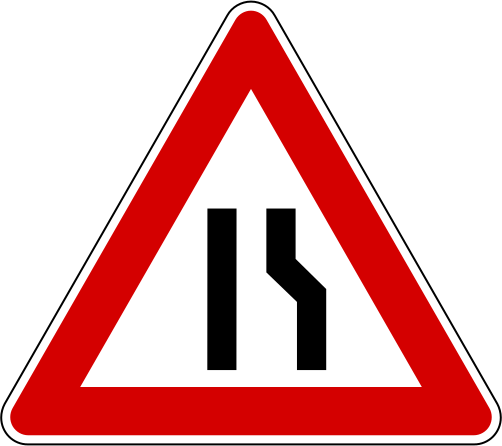 Warning for a road narrowing on the right.
English • Traffic sign 1109-1 • Road narrows. The carriageway narrows ahead on both sides (1109), on the right (1109-1) or on the left (1109-2).
Slovenščina • Prometni znak 1109-1 • Zoženje vozišča. Bližina obojestransko (1109), desno (1109-1) ali levo (1109-2) zoženega vozišča.
Sources
🔗 Commons.wikimedia.org
🔗 Pisrs.si • Pravilnik o prometni signalizaciji in prometni opremi na cestah • 13. člen • preglednica 9 • 1109-1 • NPB 2
🔗 Uradni-list.si • Uradni list RS, št. 26/2024 • 1109-1
SVG source: Government of Slovenia • Public domain • Original revision 2014-05-10. Wikimedia original unmodified.
Does a narrowing warning give you priority in Slovenia?
No. A warning describes the reduced width, rather than allocating priority or setting a numerical speed limit. Follow any separate priority signs, signals and meeting rules, and slow enough to pass safely or wait before entering.
🔗 pisrs.si • PISRS, Traffic Signing Regulation, current illustrated sign tables
🔗 pisrs.si • PISRS, Road Traffic Rules Act, current consolidation 13
What should you do if traffic lanes merge at a narrowing in Slovenia?
Where a lane on a carriageway with two or more marked lanes is blocked or ends, drivers in the adjacent lane must adjust speed and following distance so that one vehicle at a time can enter alternately. Follow this zipper system and make the manoeuvre safely, taking account of the actual signs and markings.
18. Pedestrian crossing
A pedestrian crossing is a designated place where pedestrians may cross a road. It is commonly indicated by road markings, traffic signs, signals or a combination of these measures.
Drivers must approach with appropriate caution and give way when required by local law. Pedestrians must also observe approaching traffic and follow any pedestrian signals or instructions from authorised traffic controllers.

Wikimedia.org • CC0
When must drivers give way at a pedestrian crossing in Slovenia?
At an uncontrolled marked pedestrian crossing in Slovenia, drivers must allow pedestrians already on or stepping onto the crossing to cross safely.
🔗 pisrs.si • Slovenia, PISRS, Road Traffic Rules Act, NPB13, applicable from 11 March 2026
Are all pedestrian crossings controlled the same way in Slovenia?
Where a traffic light or authorised officer controls the pedestrian crossing, follow that control. Slovenian Road Traffic Rules Act Article 41 distinguishes these situations.
🔗 pisrs.si • Slovenia, PISRS, Road Traffic Rules Act, NPB13, applicable from 11 March 2026
May I enter a pedestrian crossing if the road beyond it is blocked in Slovenia?
Wait before the crossing until you can clear it without obstructing pedestrians. Do not overtake a vehicle slowing or stopping before a crossing where pedestrians are on or beside it. Passing a vehicle stopped before a crossing is prohibited when a pedestrian is on the crossing or stepping onto it.
🔗 pisrs.si • Slovenia, PISRS, Road Traffic Rules Act, NPB13, applicable from 11 March 2026
How near must a Slovenian pedestrian crossing be before pedestrians must use it?
Less than 100 metres away.
May Slovenian pedestrians cross away from a crossing where traffic directions are separated?
No, if the carriageways are physically divided or separated by an unbroken centre line.
What route should Slovenian pedestrians take across the carriageway?
The shortest route, without stopping. Check before stepping out that crossing is safe.
May Slovenian pedestrians step suddenly into the carriageway?
No. Article 83 expressly prohibits it.
19. Railway crossing
A railway crossing, also called a level crossing or railroad crossing, is a place where a road or path crosses railway tracks at the same level. It may be protected by barriers, warning lights, bells, traffic signs or a combination of these measures.
Road users must approach carefully and never enter when a train is approaching, warning signals are active or the exit is blocked. They should cross promptly and must never stop, wait or become trapped on the tracks.
Wikimedia.org • patrizia tirel • CC BY
When must drivers stop at a railway level crossing in Slovenia?
Stop before the crossing when lights announce an approaching train or the forthcoming lowering of barriers, when barriers are lowering or down, when an authorised railway worker signals stop, or when traffic would leave you stopped on the tracks. At an unprotected crossing, stop for an approaching train even without a separate warning and cross only after checking that no train is approaching. Obey any STOP sign.
🔗 pisrs.si • Slovenia, PISRS, Road Traffic Rules Act, NPB13, applicable from 11 March 2026
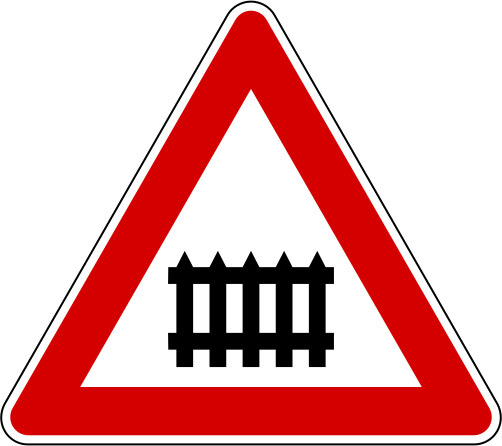 Warning for a railway crossing with barriers.
English • Traffic sign 1201 • Protected level crossing. A level crossing protected by traffic signals (8301), full barriers or half barriers lies ahead.
Slovenščina • Prometni znak 1201 • Zavarovan prehod ceste čez železniško progo. Bližina prehoda ceste čez železniško progo v isti ravnini, ki je zavarovan s svetlobnim prometnim znakom (8301), zapornicami ali polzapornicami.
Sources
🔗 Commons.wikimedia.org
🔗 Pisrs.si • Pravilnik o prometni signalizaciji in prometni opremi na cestah • 13. člen • preglednica 9 • 1201 • NPB 2
🔗 Uradni-list.si • Uradni list RS, št. 26/2024 • 1201
SVG source: Government of Slovenia • Public domain • Original revision 2014-05-11. Wikimedia original unmodified.
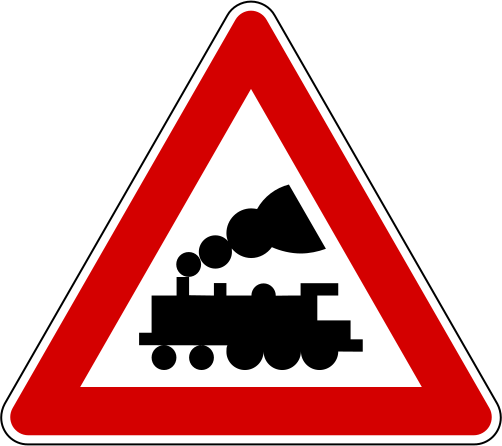 Warning for a railway crossing without barriers.
English • Traffic sign 1202 • Unprotected level crossing. A level crossing without traffic signals (8301), full barriers or half barriers lies ahead.
Slovenščina • Prometni znak 1202 • Nezavarovan prehod ceste čez železniško progo. Bližina prehoda ceste čez železniško progo v isti ravnini, ki ni zavarovan s svetlobnim prometnim znakom (8301), zapornicami ali polzapornicami.
Sources
🔗 Commons.wikimedia.org
🔗 Pisrs.si • Pravilnik o prometni signalizaciji in prometni opremi na cestah • 13. člen • preglednica 9 • 1202 • NPB 2
🔗 Uradni-list.si • Uradni list RS, št. 26/2024 • 1202
SVG source: Government of Slovenia • Public domain • Original revision 2014-05-11. Wikimedia original unmodified.
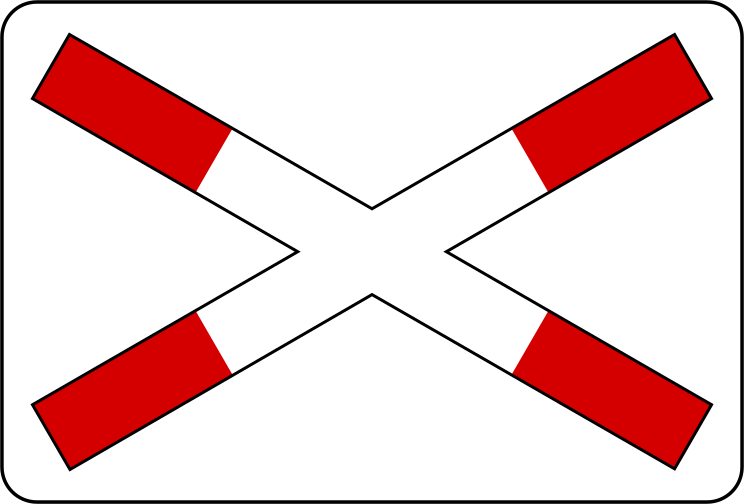 Warning for a railway crossing with one track.
English • Traffic sign 1204 • Crossbuck. A level crossing over a single-track railway (1204) or a railway with two or more tracks (1204-1), either unprotected or protected only by traffic signals (8301).
Slovenščina • Prometni znak 1204 • Andrejev križ. Prehod ceste čez enotirno (1204) oziroma dvo ali večtirno (1204-1) železniško progo v isti ravnini, ki je nezavarovan ali zavarovan samo s svetlobnim prometnim znakom (8301).
Sources
🔗 Commons.wikimedia.org
🔗 Pisrs.si • Pravilnik o prometni signalizaciji in prometni opremi na cestah • 13. člen • preglednica 9 • 1204 • NPB 2
🔗 Uradni-list.si • Uradni list RS, št. 22/2025 • 1204
Image via Commons.wikimedia.org
Government of Slovenia • Public domain • Source revision 2014-05-11. Wikimedia original unmodified.
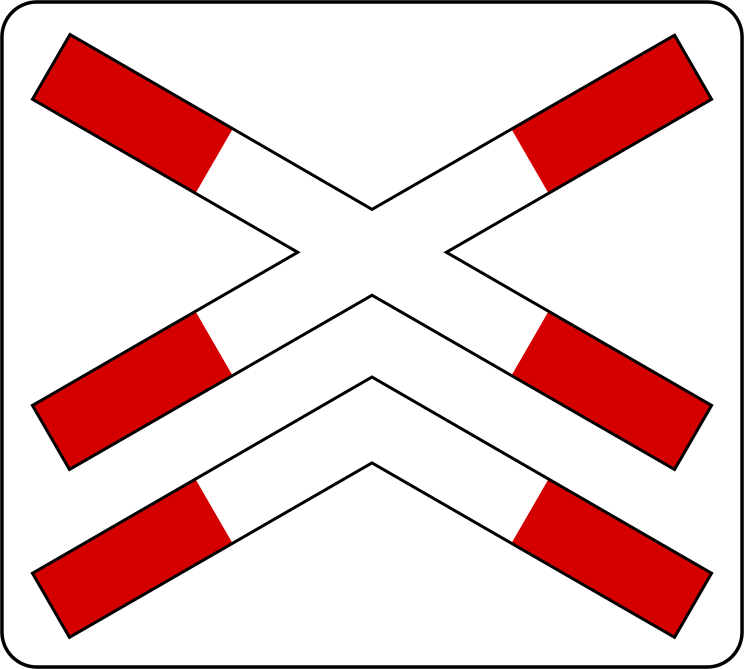 Warning for a railway crossing with two or more tracks.
English • Traffic sign 1204-1 • Crossbuck. A level crossing over a single-track railway (1204) or a railway with two or more tracks (1204-1), either unprotected or protected only by traffic signals (8301).
Slovenščina • Prometni znak 1204-1 • Andrejev križ. Prehod ceste čez enotirno (1204) oziroma dvo ali večtirno (1204-1) železniško progo v isti ravnini, ki je nezavarovan ali zavarovan samo s svetlobnim prometnim znakom (8301).
Sources
🔗 Commons.wikimedia.org
🔗 Pisrs.si • Pravilnik o prometni signalizaciji in prometni opremi na cestah • 13. člen • preglednica 9 • 1204-1 • NPB 2
🔗 Uradni-list.si • Uradni list RS, št. 22/2025 • 1204-1
SVG source: Government of Slovenia • Public domain • Original revision 2014-05-11. Wikimedia original unmodified.
Must I stop at every unguarded railway crossing in Slovenia?
Check and obey the controls at the crossing: a STOP sign requires a full stop. At an unprotected crossing, article 40 also requires stopping when a train approaches, even without a separate warning. Cross only after checking that no train is approaching and that you can clear the tracks.
🔗 pisrs.si • Slovenia, PISRS, Road Traffic Rules Act, NPB13, applicable from 11 March 2026
What if road traffic is queued beyond a railway crossing in Slovenia?
Wait before the tracks until there is room to take your entire vehicle off the crossing. Do not follow another vehicle onto the tracks without checking the exit. Keep the tracks clear even if no train is visible.
🔗 pisrs.si • Slovenia, PISRS, Road Traffic Rules Act, NPB13, applicable from 11 March 2026
20. Mandatory direction
A mandatory-direction sign requires drivers to travel only in the direction or one of the directions indicated by its arrow or arrows. It may require traffic to continue straight ahead, turn, or pass an obstacle on a specified side.
The sign does not itself determine priority or speed. Drivers must still use the appropriate lane, signal when required and give way according to local traffic signs and regulations.

Wikimedia.org • Szeder László • CC BY-SA
What does a mandatory-direction sign require in Slovenia?
Where a compulsory-direction sign is installed in Slovenia, follow only the arrow direction or permitted combination of directions. The restriction applies at the location or movement it regulates; it is not an instruction to ignore other traffic controls.
🔗 pisrs.si • PISRS, Traffic Signing Regulation, current illustrated sign tables
🔗 pisrs.si • PISRS, Road Traffic Rules Act, current consolidation 13
Can I choose another turn if the mandatory-direction arrow is inconvenient in Slovenia?
No, unless another applicable sign, lane instruction or authorised traffic direction lawfully permits it. Plan a permitted alternative route; do not make an abrupt or prohibited turn to reach your destination.
🔗 pisrs.si • PISRS, Traffic Signing Regulation, current illustrated sign tables
🔗 pisrs.si • PISRS, Road Traffic Rules Act, current consolidation 13
Does a mandatory-direction sign give me priority over pedestrians in Slovenia?
No. A direction instruction does not remove the turning rules. When turning at a junction, give way to pedestrians crossing the carriageway you intend to enter. When crossing a two-way cycle track while turning, let all vehicles on that track pass.
21. School area
A school area is a road or group of roads near a school where large numbers of children may walk, cycle, cross the road or enter and leave vehicles. It may be identified by warning signs, zone signs, road markings, traffic-calming measures or flashing lights.
Special speed limits, parking restrictions or access rules may apply permanently or only during school arrival and departure times. Drivers should reduce speed, watch carefully for children and be prepared to stop.
Wikimedia.org • Juanma Pérez Rabasco • CC BY
What speed rules apply around schools in Slovenia?
School approaches may use a signed 30 km/h limited-speed zone or a different local measure; the sign and zone boundary determine the rule.
🔗 pisrs.si • Slovenia, ZPrCP — articles 29, 45–46, 55, 83, 98; national warning catalogue
🔗 pisrs.si • Slovenia, current Signs Regulation — relevant national signs and markings
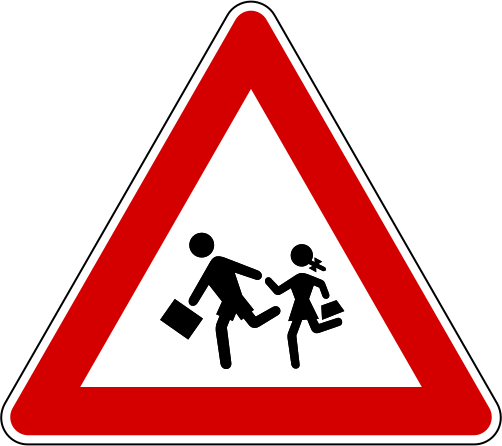 Warning for children.
English • Traffic sign 1116 • Children on the carriageway. A road location or section frequently used by groups of children crossing or walking along the road, or waiting for transport, lies ahead.
Slovenščina • Prometni znak 1116 • Otroci na vozišču. Bližina mesta na cesti ali njenem delu, kjer se pogosto zadržuje več otrok, ki prečkajo cesto, hodijo po njej ali tam čakajo na prevoz.
Sources
🔗 Commons.wikimedia.org
🔗 Pisrs.si • Pravilnik o prometni signalizaciji in prometni opremi na cestah • 13. člen • preglednica 9 • 1116 • NPB 2
🔗 Uradni-list.si • Uradni list RS, št. 26/2024 • 1116
SVG source: Government of Slovenia • Public domain • Original revision 2014-05-11. Wikimedia original unmodified.
Does a school warning sign in Slovenia automatically set the speed limit?
A children or school warning alerts you to a potential hazard; the enforceable numerical speed limit depends on the applicable law, regulatory signs and any time or variable display. Slow further if children are near the road.
🔗 pisrs.si • Slovenia, ZPrCP — articles 29, 45–46, 55, 83, 98; national warning catalogue
🔗 pisrs.si • Slovenia, current Signs Regulation — relevant national signs and markings
How should you pass a school entrance in Slovenia?
Watch for children stepping out from between parked vehicles, obey crossings and any school patrol, and follow stopping or parking restrictions. Do not obstruct visibility near a crossing or school entrance; approach at a speed that permits a safe stop.
🔗 pisrs.si • Slovenia, ZPrCP — articles 29, 45–46, 55, 83, 98; national warning catalogue
🔗 pisrs.si • Slovenia, current Signs Regulation — relevant national signs and markings
22. Crossing animals
An animals-crossing warning indicates a place or road section where wild animals, livestock or ridden animals may enter or cross the road. Animals may appear suddenly, move unpredictably or be difficult to see in darkness, vegetation or poor weather.
Drivers should reduce speed, scan both sides of the road and remain prepared to stop. The warning sign does not itself give animals priority or impose a numerical speed limit, but drivers must avoid frightening, endangering or colliding with them.
Wikimedia.org • Tiia Monto • CC BY-SA
Which animals might drivers encounter on roads in Slovenia?
Depending on the locality, drivers may meet deer, wild boar and livestock near forest or mountain roads. Roadside animal-warning signs and local hazard information indicate where extra care may be needed; do not assume the hazard ends immediately after a sign.
🔗 pisrs.si • Slovenia, ZPrCP — articles 29, 45–46, 55, 83, 98; national warning catalogue
🔗 pisrs.si • Slovenia, current Signs Regulation — relevant national signs and markings
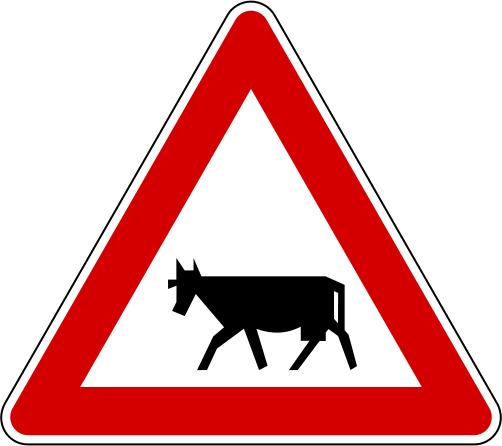 Warning for cattle on the road.
English • Traffic sign 1118 • Animals on the carriageway. A place where domestic animals cross or walk along the road lies ahead.
Slovenščina • Prometni znak 1118 • Živali na vozišču. Bližina mesta, kjer domače živali prehajajo čez cesto ali hodijo vzdolž nje.
Sources
🔗 Commons.wikimedia.org
🔗 Pisrs.si • Pravilnik o prometni signalizaciji in prometni opremi na cestah • 13. člen • preglednica 9 • 1118 • NPB 2
🔗 Uradni-list.si • Uradni list RS, št. 26/2024 • 1118
SVG source: Government of Slovenia • Public domain • Original revision 2014-05-11. Wikimedia original unmodified.
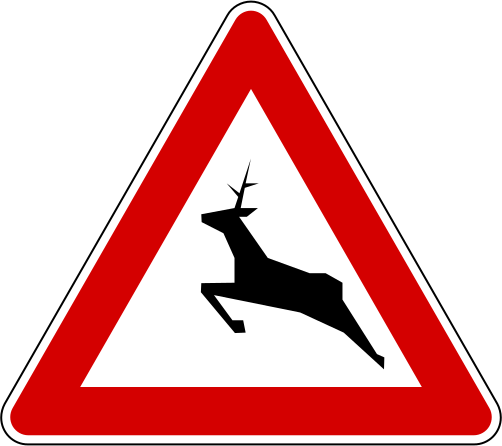 Warning for crossing deer.
English • Traffic sign 1119 • Wild animals on the road. A dangerous location where game and other wild animals regularly cross the road lies ahead.
Slovenščina • Prometni znak 1119 • Divje živali na cesti. Bližina nevarnega mesta, kjer divjad in druge divje živali na stalnih prehodih prehajajo čez cesto.
Sources
🔗 Commons.wikimedia.org
🔗 Pisrs.si • Pravilnik o prometni signalizaciji in prometni opremi na cestah • 13. člen • preglednica 9 • 1119 • NPB 2
🔗 Uradni-list.si • Uradni list RS, št. 26/2024 • 1119
SVG source: Government of Slovenia • Public domain • Original revision 2014-05-11. Wikimedia original unmodified.
Does an animal-crossing warning sign in Slovenia set a new speed limit?
A warning of animals is not, by itself, a numerical speed-limit sign. Continue to obey the applicable speed limit, but slow down whenever animals could enter the road or visibility is poor. A separate regulatory speed sign must also be obeyed.
🔗 pisrs.si • Slovenia, ZPrCP — articles 29, 45–46, 55, 83, 98; national warning catalogue
🔗 pisrs.si • Slovenia, current Signs Regulation — relevant national signs and markings
What should you do if an animal enters the road in Slovenia?
Ease off the accelerator, assess the traffic behind and brake smoothly if necessary. Avoid abrupt swerving into opposing traffic or off the road. Give farm animals and ridden animals room, avoid frightening them with unnecessary horn use, and be alert for more animals following.
🔗 pisrs.si • Slovenia, ZPrCP — articles 29, 45–46, 55, 83, 98; national warning catalogue
🔗 pisrs.si • Slovenia, current Signs Regulation — relevant national signs and markings
23. Rockfall
A rockfall warning indicates a road section where rocks or stones may fall from a cliff, cutting or steep slope, or where fallen material may already be present on the road. The danger may affect the full carriageway and can appear suddenly.
Drivers should reduce speed, scan the road and slopes ahead, increase their following distance and remain prepared to stop. They should avoid unnecessary stopping in the exposed section and never attempt to move unstable rocks themselves.

Wikimedia.org • Tiia Monto • CC BY-SA
Where might falling rocks be a hazard on roads in Slovenia?
Pay extra attention around Alpine roads and steep limestone cuttings. After heavy rain, freeze–thaw cycles or work on a steep slope, the hazard may increase depending on local conditions.
🔗 pisrs.si • Slovenia, ZPrCP — articles 29, 45–46, 55, 83, 98; national warning catalogue
🔗 pisrs.si • Slovenia, current Signs Regulation — relevant national signs and markings
Does a falling-rocks warning sign in Slovenia impose a speed limit?
A falling-rocks sign is a hazard warning, not normally a numerical speed-limit sign. Follow any separate speed or closure signs, slow down to match visibility and conditions, and watch for material already on the road.
🔗 pisrs.si • Slovenia, ZPrCP — articles 29, 45–46, 55, 83, 98; national warning catalogue
🔗 pisrs.si • Slovenia, current Signs Regulation — relevant national signs and markings
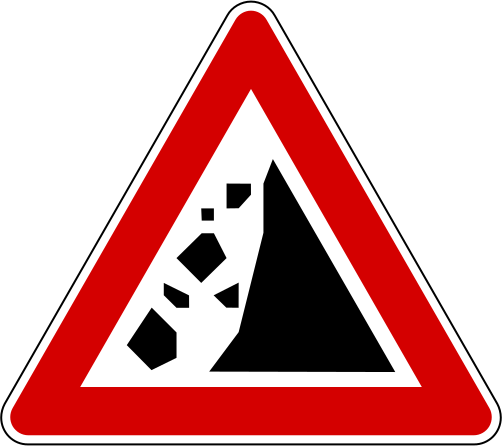 Warning for falling rocks.
English • Traffic sign 1114 • Falling rocks. A section lies ahead where rocks may fall onto the carriageway from the right (1114) or left (1114-1), leaving rocks on the road.
Slovenščina • Prometni znak 1114 • Kamenje pada na vozišče. Bližina dela ceste, kjer je nevarnost padanja kamenja na vozišče z desne (1114) oziroma leve strani (1114-1) in kot posledica tega prisotnost kamenja na vozišču.
Sources
🔗 Commons.wikimedia.org
🔗 Pisrs.si • Pravilnik o prometni signalizaciji in prometni opremi na cestah • 13. člen • preglednica 9 • 1114 • NPB 2
🔗 Uradni-list.si • Uradni list RS, št. 26/2024 • 1114
SVG source: Government of Slovenia • Public domain • Original revision 2014-05-11. Wikimedia original unmodified.
What should you do if rocks are blocking the road in Slovenia?
Slow or stop in a safe place away from the exposed slope if possible. Do not drive over unstable debris or stop beneath a cliff unnecessarily. Follow any closure or traffic-control instructions and report a dangerous obstruction through the appropriate road authority or emergency channel.
🔗 pisrs.si • Slovenia, ZPrCP — articles 29, 45–46, 55, 83, 98; national warning catalogue
🔗 pisrs.si • Slovenia, current Signs Regulation — relevant national signs and markings
24. Chevron
A chevron is a V-shaped or arrow-shaped road marker used to show a sharp change in the direction of a road. Chevron boards are normally placed along the outside of a curve so that their points indicate the direction in which the road continues.
Chevrons improve the visibility and alignment of a curve, especially in darkness or poor weather. They do not normally impose a speed limit or determine priority, so drivers must reduce speed before the curve and follow all other signs and road markings.

Wikimedia.org • Doremo • CC BY-SA
What is the purpose of chevron boards on a road in Slovenia?
Chevron alignment boards help drivers see which way a sharp bend continues, especially in darkness or poor visibility. Their precise shape and colour depend on the local sign system; pay attention to the alignment shown rather than assuming one universal design.
🔗 pisrs.si • Slovenia, ZPrCP — articles 45, 98–100; Signs warning and guidance catalogue
🔗 pisrs.si • Slovenia, current Signs Regulation — relevant national signs and markings
Do chevron boards give priority or order a turn at junctions in Slovenia?
Not ordinary curve-alignment chevrons. They guide you around a bend. Give-way, no-entry, keep-direction and other mandatory traffic signs must be read separately; similar-looking arrows can have different legal meanings.
🔗 pisrs.si • Slovenia, ZPrCP — articles 45, 98–100; Signs warning and guidance catalogue
🔗 pisrs.si • Slovenia, current Signs Regulation — relevant national signs and markings
Is the speed shown by a chevron in Slovenia a compulsory maximum?
A chevron alone does not set a numerical maximum speed. If an advisory-speed panel or a regulatory speed-limit sign is displayed alongside it, identify which type it is and follow the binding speed rules.
🔗 pisrs.si • Slovenia, ZPrCP — articles 45, 98–100; Signs warning and guidance catalogue
🔗 pisrs.si • Slovenia, current Signs Regulation — relevant national signs and markings
25. Wrong-way driving
Wrong-way driving occurs when a driver travels against the legally permitted direction of traffic. It may happen on a one-way road, divided road, motorway entrance or exit, or another road section reserved for traffic travelling in one direction.
Wrong-way driving creates an extreme risk of a head-on collision. Drivers must follow direction signs, no-entry signs, lane arrows and road markings. Anyone who accidentally enters a road in the wrong direction should slow down, warn other traffic, stop in the safest available place and contact the emergency services.

Wikimedia.org • Sébastien Bertrand • CC BY
How can you avoid driving the wrong way in Slovenia?
Traffic normally keeps right here. Keep to the correct side of the road and use no-entry and one-way signs to identify prohibited approaches; do not enter an exit ramp against its permitted direction.
🔗 pisrs.si • Slovenia, ZPrCP — articles 30, 37, 43, 98
🔗 pisrs.si • Slovenia, current Signs Regulation — relevant national signs and markings
🔗 policija.si • Slovenian Police — wrong-way motorway driving: stop immediately and notify police
What signs can prevent wrong-way driving in Slovenia?
Read no-entry signs, one-way signs, lane arrows and temporary directions together; a wide road is not automatically two-way. Before entering a motorway, expressway, one-way street or slip road, check the permitted direction rather than relying only on a navigation app.
🔗 pisrs.si • Slovenia, ZPrCP — articles 30, 37, 43, 98
🔗 pisrs.si • Slovenia, current Signs Regulation — relevant national signs and markings
🔗 policija.si • Slovenian Police — wrong-way motorway driving: stop immediately and notify police
What should you do if you enter a road against traffic in Slovenia?
If you enter against traffic in Slovenia, stop immediately, if possible off the carriageway without endangering anyone, and notify the police. Do not try to correct the mistake by driving on, reversing or making a U-turn on a motorway. Follow police instructions and obtain assistance from a safe position.
🔗 pisrs.si • Slovenia, ZPrCP — articles 30, 37, 43, 98
🔗 pisrs.si • Slovenia, current Signs Regulation — relevant national signs and markings
🔗 policija.si • Slovenian Police — wrong-way motorway driving: stop immediately and notify police