


Traffic rulesAustria
 Traffic rules
 Austria
1. Austria
Austria is a landlocked country in Central Europe, with the Alps shaping much of its landscape and many of its roads. Traffic drives on the right, and drivers may encounter steep mountain roads, long tunnels and rapidly changing weather conditions. Winter driving is especially important, while vehicles up to 3.5 tonnes generally need a vignette to use Austria's motorways and expressways. Certain tunnels and Alpine crossings are covered by separate section tolls instead.
German is Austria's official language and is the main language used on road signs. Croatian, Slovenian and Hungarian also have official status in certain minority-language areas, where bilingual place-name signs may be encountered. Drivers should also watch carefully for local restrictions, including speed limits marked IG-L, which are imposed under Austria's air-pollution legislation.
AI-generated by Rijbewijs-online.be • WCIT • CC BY-SA
Which number can you call in an emergency in Austria?
Call 112 for urgent emergency assistance. Give the operator your location and explain what happened.
🔗 oesterreich.gv.at • Austrian Government, emergency numbers
What is the legal alcohol limit for drivers in Austria?
For most drivers, the blood-alcohol level must remain below 0.5‰ (0.5 g/l). A much lower limit of 0.1‰ applies to probationary drivers and certain other categories, including drivers of category C and D vehicles.
🔗 ris.bka.gv.at • Austria, Driving Licence Act, section 4(7), probationary alcohol restriction
What speed limits apply to passenger cars in Austria?
Built-up areas: For cars and motorcycles, the general maximum speed is 50 km/h, unless signs indicate another limit.
Outside built-up areas: For cars and motorcycles, the general maximum speed on ordinary roads outside built-up areas is 100 km/h, unless signs indicate another limit.
Expressways: For cars and motorcycles, the general maximum speed on an Autostraße is 100 km/h, unless signs indicate another limit.
Motorways: For cars and motorcycles, the general maximum speed on motorways is 130 km/h, unless a lower limit is indicated.
What are the seat-belt and child-restraint rules in Austria?
Seat belts are mandatory for occupants using seats equipped with them. Each person aged 14 or older is responsible for wearing their own seat belt.
Children under 14 years old and shorter than 135 cm must use a suitable child restraint. From 135 cm, the seat belt is sufficient under the main rule, although the Austrian Government recommends continuing with a child restraint below 150 cm.
A child seat may be used on the front passenger seat, but a rear-facing seat must never be placed in front of an active frontal airbag. The driver is responsible for correctly securing children under 14.
🔗 europa.eu • Your Europe / national authorities, Austria road rules, Seat belts and child restraints; 🔗 oesterreich.gv.at • Austrian Government, child restraints and front-seat airbags
Can you use a mobile phone while driving in Austria?
Drivers may not hold or otherwise use a mobile phone while driving, except for permitted hands-free calling or navigation when the phone is securely mounted. Texting, browsing and operating apps while driving are prohibited.
When are winter tyres mandatory in Austria?
Cars and light goods vehicles up to 3.5 tonnes must use winter tyres on all wheels between 1 November and 15 April when wintry road conditions are present, such as snow, slush or ice. Snow chains on at least two driven wheels may be used as an alternative when the road is continuously covered with snow or ice.
🔗 europa.eu • Your Europe / national authorities, Austria road rules, Other specific rules and winter equipment; 🔗 oesterreich.gv.at • Austrian Government, compulsory winter tyres, 1 November–15 April, wintry conditions
What safety equipment must you carry in a car in Austria?
Drivers of cars must carry a warning triangle, reflective high-visibility clothing and a suitable first-aid kit. The reflective clothing should be put on before leaving the vehicle after a breakdown or accident.
Can a visitor use a driving licence issued in another EU country in Austria?
Yes. A valid, full EU driving licence is recognised for the vehicle categories it covers. You must meet the applicable minimum age. A learner licence or a temporary replacement certificate does not have the same automatic recognition.
Are motorcycle helmets compulsory in Austria?
Yes. On an ordinary, open motorcycle, both the rider and passenger must wear a protective helmet. Use a helmet that meets the applicable approval requirements and fasten it correctly. Check the specific rules before relying on an exemption for an enclosed or specially equipped vehicle.
🔗 europa.eu • Your Europe / national authorities, Austria road rules

2. Motorway
A motorway is a road specially designed and signposted for motor traffic. Motorways normally have separate carriageways for opposing traffic, controlled access through designated entrances and exits, no direct access to neighbouring properties, and no level crossings with other roads, railways or paths.
Special traffic rules apply on motorways. The permitted road users, speed limits, lane rules, tolls and emergency procedures vary between countries, so drivers must follow the local traffic signs and regulations.
Wikimedia.org • Robot8A • CC BY-SA
How do people refer to a motorway in Austria?
The official German term is Autobahn. An Autostraße is a separate road category for motor vehicles; do not assume it has the same speed limit as a motorway.
What speed limit applies to cars on a motorway in Austria?
For an ordinary passenger car without a trailer, the general maximum is 130 km/h. Obey lower posted limits and reduce speed when traffic, weather or visibility requires it. Different limits can apply to other vehicle classes.
Who may use a motorway in Austria?
Normally, only motor vehicles with a design speed of at least 60 km/h which may legally exceed 60 km/h are admitted. This is an admission condition; it does not require that speed when traffic or safety requires slower driving.
How should I make space for emergency vehicles on an Austrian motorway?
When a queue forms on a carriageway with two or more lanes, leave an emergency corridor between the leftmost lane and the lane immediately to its right. Move left in the leftmost lane and right in the other lanes.
3. Expressway
An expressway is a road intended to carry through traffic efficiently, usually at higher speeds than ordinary roads. Expressways often have limited access, multiple lanes, separated carriageways or grade-separated junctions, but their design and legal status vary between countries.
An expressway is not always a motorway. It may have intersections, traffic lights or direct access, and the permitted road users, speed limits and special rules depend on local signs and regulations.
Wikimedia.org • GT1976 • CC BY-SA
How do people refer to an expressway in Austria?
The legal road-for-motor-vehicles category is Autostraße. It is identified by its official road-for-motor-vehicles sign and is distinct from an Autobahn. Follow the actual road designation and applicable speed signs.
What speed limit applies to cars on an expressway in Austria?
On a road designated as a road for motor vehicles rather than a motorway, the normal car maximum outside built-up areas is 100 km/h. A motorway-designated section can have a 130 km/h maximum. Follow the actual designation and posted limit.
Who may use an expressway in Austria?
The motorway admission conditions also apply to roads for motor vehicles: normally, the motor vehicle must have a design speed of at least 60 km/h and be legally permitted to exceed 60 km/h. This does not require maintaining that speed in congestion.
Does an Austrian expressway automatically have two carriageways?
No. The road-for-motor-vehicles designation does not itself guarantee separate carriageways or motorway construction. Watch the actual layout and junction signs; the law designates these roads as priority roads.
4. Residential area
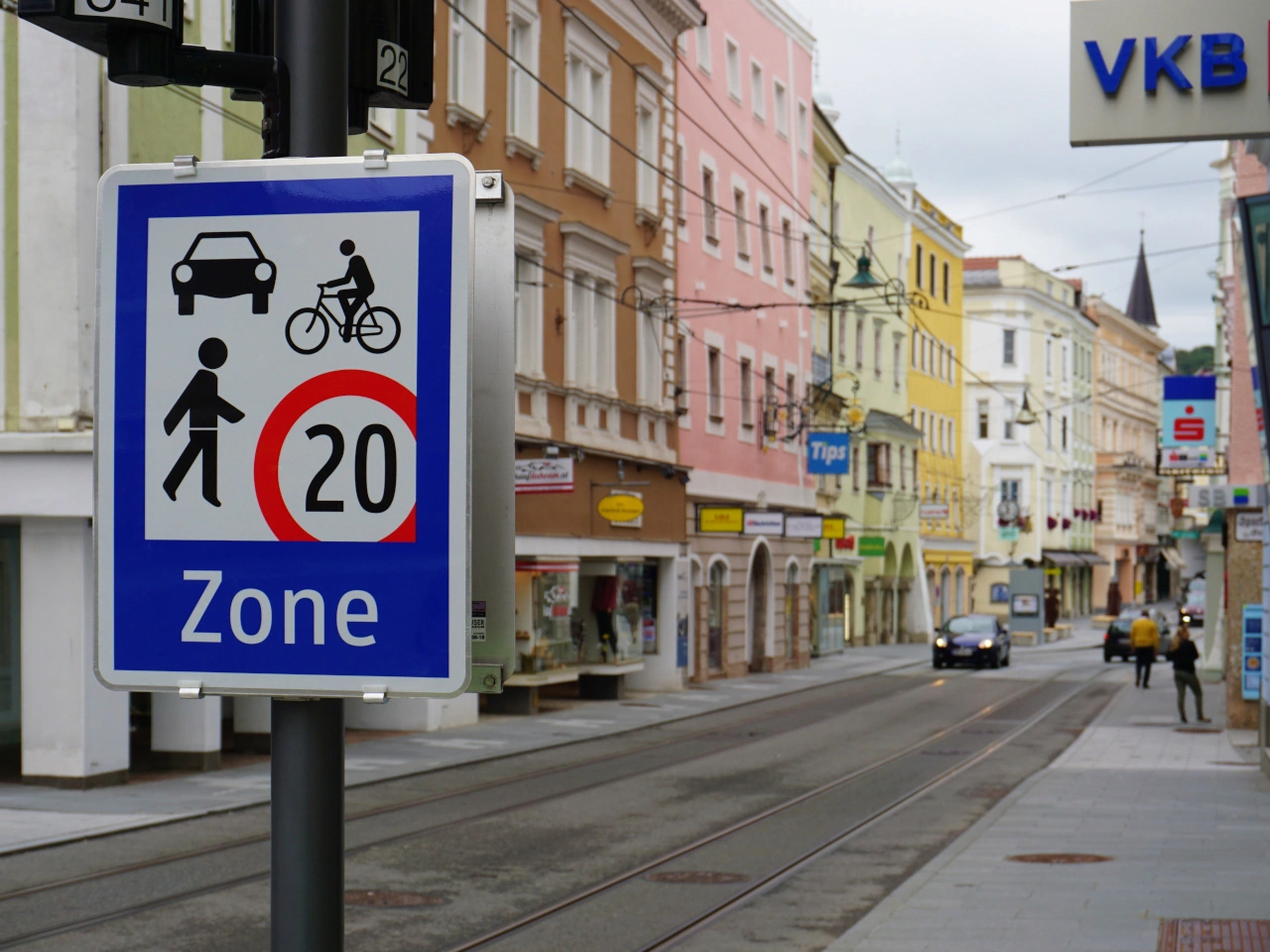
A residential area is a street or group of streets where housing and access to local properties are the main functions. Drivers should expect pedestrians, cyclists, children, parked vehicles and vehicles entering or leaving driveways.
Some countries identify particular residential areas with traffic signs and apply special low-speed and residential-area rules. The speed limit, pedestrian rights, parking rules and permitted road users therefore depend on local signs and regulations.
Wikimedia.org • Simon Legner • CC BY-SA
How do people refer to a residential area in Austria?
A specially signposted residential street is a Wohnstraße. A Begegnungszone is a separate signed category with different speed and through-traffic rules.
What speed limit applies in a residential area in Austria?
In the specially signposted residential-street category, vehicles must travel at walking pace. This is different from the separate category normally limited to 20 km/h, where 30 km/h may be specifically authorised and signed.
What rights do pedestrians have in a signposted residential area in Austria?
People may use the street and children may play there. Drivers must not endanger or hinder pedestrians or cyclists and must stop if necessary. Pedestrians must not obstruct permitted vehicle traffic unnecessarily.
May I use a signposted Austrian residential street as a shortcut?
Ordinary through-driving is prohibited in this category. Access to and from properties is permitted, alongside statutory exceptions. When leaving, give way to traffic outside the residential street.
5. Zone
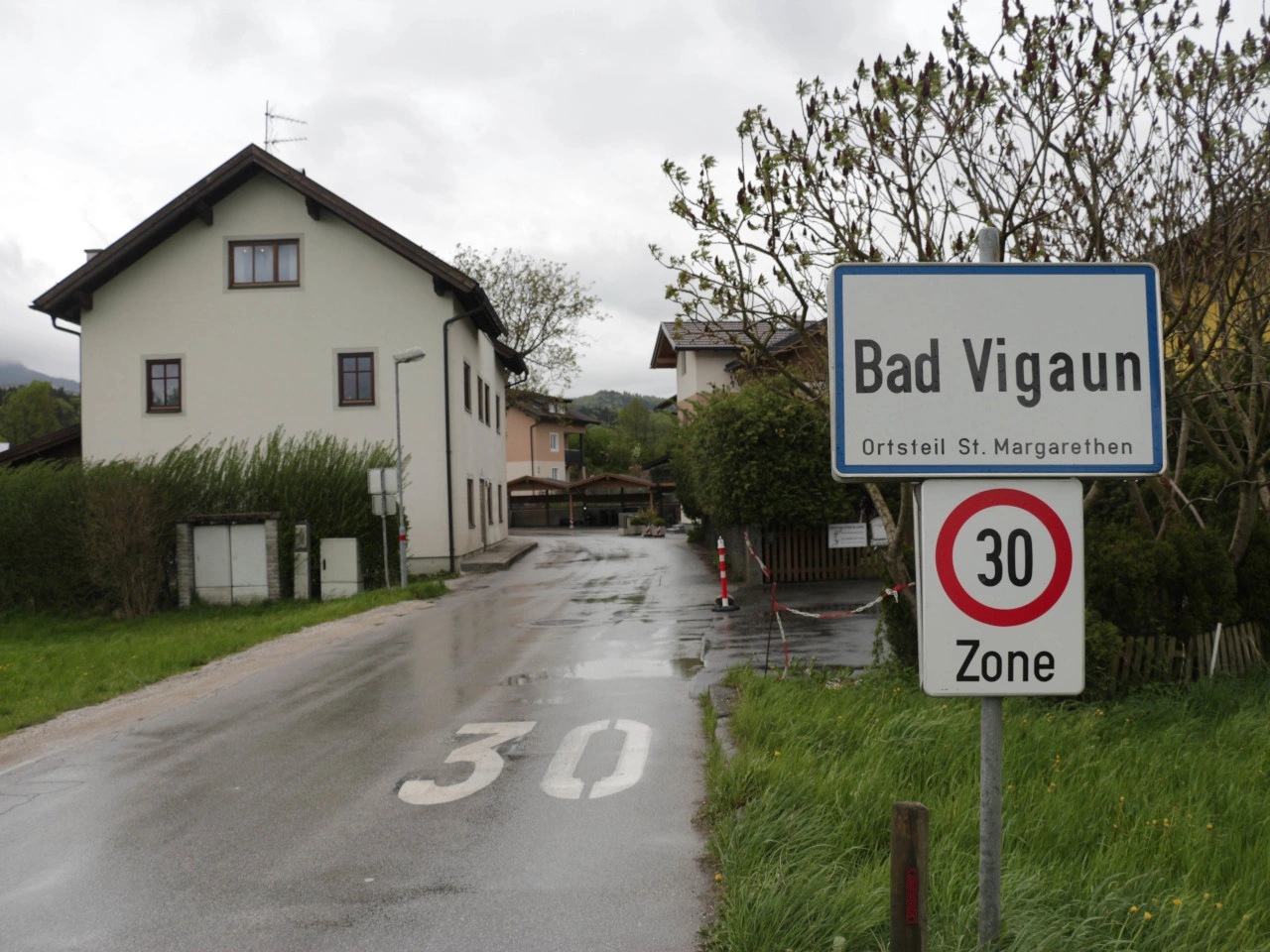
A traffic zone is an area in which a traffic rule applies throughout all included roads or road sections. The rule normally begins at a zone-entry sign and remains applicable until the corresponding end-of-zone sign is passed.
Zones may regulate speed, parking, access, vehicle categories, emissions or other traffic behaviour. The signs used, the roads covered and the effect of intersections or local exceptions depend on local traffic law.
Wikimedia.org • Eweht • CC BY-SA
How do people refer to traffic zones in Austria?
A zonal restriction is called a Zonenbeschränkung. A Kurzparkzone is a short-stay parking zone. Read the symbol and any times or conditions: the word zone does not identify one universal rule.
🔗 ris.bka.gv.at • Austrian RIS, StVO — sections 20, 25, 52(11a–11b,13d–13e)
Where does a zone rule apply in Austria?
The restriction displayed within the zone panel applies throughout the designated zone. Crossing a junction or turning into another included street does not by itself end the restriction.
🔗 ris.bka.gv.at • Austrian RIS, StVO — sections 20, 25, 52(11a–11b,13d–13e)
What should I check before parking in an Austrian parking zone?
Check the zone’s operating times, permitted parking duration and any local payment or permit requirements. A short-stay parking zone can cover several streets; an empty parking space does not mean the zone’s requirements have ended.
🔗 ris.bka.gv.at • Austrian RIS, StVO — sections 20, 25, 52(11a–11b,13d–13e)
How do you know when a traffic zone ends in Austria?
Look for the corresponding end-of-zone sign. After leaving, apply the rule for the road you enter and any new signs; ending a zone does not automatically permit unrestricted speed or parking.
🔗 ris.bka.gv.at • Austrian RIS, StVO — sections 20, 25, 52(11a–11b,13d–13e)
6. Speed limit
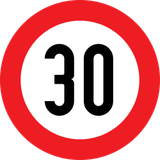
A speed limit is the maximum legal speed permitted on a road, lane or within a designated area. It may be established by general traffic law or indicated by fixed, variable or temporary traffic signs.
A speed limit is a maximum, not a target speed. Drivers must travel more slowly whenever traffic, visibility, weather, road conditions, vulnerable road users or the condition of the vehicle make the maximum permitted speed unsafe.
Wikimedia.org • Eweht • CC BY-SA
Which general speed limits should car drivers know in Austria?
For an ordinary passenger car without a trailer, the general maxima are 50 km/h in built-up areas, 100 km/h on ordinary roads outside them and 130 km/h on motorways. Follow applicable signed restrictions and special-area rules. These figures do not cover every vehicle or towing combination.
🔗 ris.bka.gv.at • Austrian RIS, StVO — sections 20, 43, 46–47, 52(10a–10b,19)
Does an Austrian town-entry sign cancel a separately signed speed restriction?
No. Town-entry and town-end signs do not themselves cancel an existing separately signed speed restriction. Keep observing its applicable scope; entering or leaving the town is not automatic permission to disregard it.
🔗 ris.bka.gv.at • Austrian RIS, StVO — sections 20, 43, 46–47, 52(10a–10b,19)
Can I drive at the Austrian maximum when I cannot see far ahead?
No. Austrian law requires a speed adapted to the road, traffic and visibility. The maximum remains a ceiling; slow down so that limited sight distance, a bend or poor weather does not make your chosen speed unsafe.
🔗 ris.bka.gv.at • Austrian RIS, StVO — sections 20, 43, 46–47, 52(10a–10b,19)
7. Footpath
A footpath is a path or part of a road intended primarily for pedestrian traffic. It may run alongside a road, through a park or residential area, or independently from roads used by motor vehicles.
A footpath may be reserved exclusively for pedestrians or may form part of a shared route with cyclists or other permitted users. Access, priority and permitted users depend on the traffic signs and local regulations applying to the path.
Wikimedia.org • Linie29 • CC BY-SA
How does Austria distinguish a footpath from a roadside pavement?
A Gehweg is a marked route intended for pedestrians. A Gehsteig is the pedestrian part of a road separated from the carriageway by a kerb, markings or a similar feature. A combined walking and cycling route is a Geh- und Radweg.
🔗 ris.bka.gv.at • Austrian RIS, StVO — sections 2, 8(4), 68(1), 76
Must pedestrians use an available footpath or pavement in Austria?
Yes. Pedestrians must use the footpath or pavement where one is available. Its existence normally means walking there rather than along the carriageway. Crossing the carriageway is governed by separate crossing rules.
🔗 ris.bka.gv.at • Austrian RIS, StVO — sections 2, 8(4), 68(1), 76
May I cycle along an ordinary Austrian footpath?
Ordinary cycling along a Gehweg or Gehsteig is prohibited. A signed combined walking and cycling path is different: cyclists may use it but must not endanger pedestrians. Special rules for small children’s play bicycles must not be treated as permission for ordinary bicycle traffic.
🔗 ris.bka.gv.at • Austrian RIS, StVO — sections 2, 8(4), 68(1), 76
8. Bike path
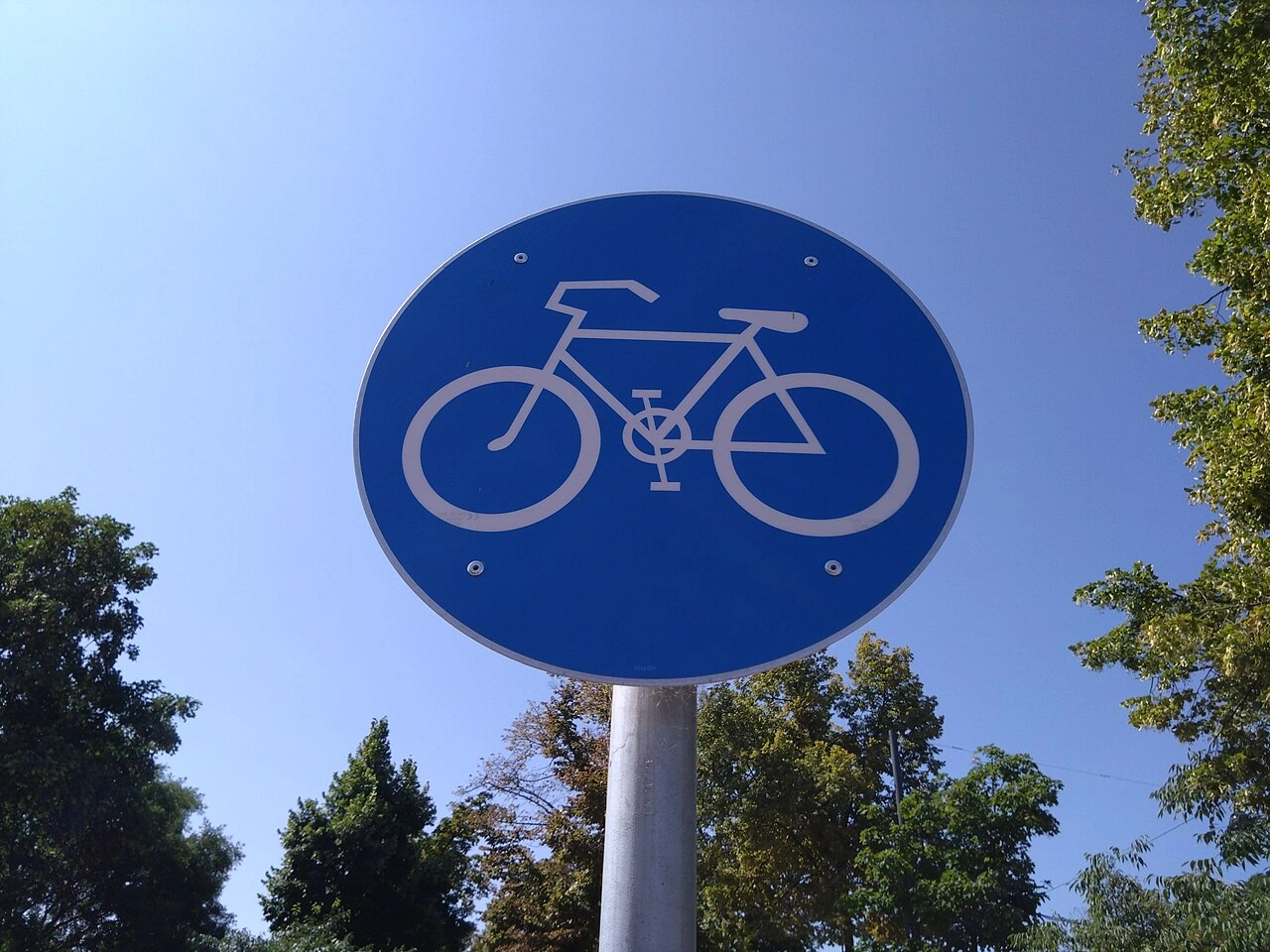
A bike path is a part of a road or a separate route intended primarily or exclusively for people riding bicycles. It may be physically separated from motor traffic, marked on the road surface or identified by traffic signs.
Bike paths may be one-way, two-way or shared with other road users. The permitted users, direction of travel, priority rules and obligation to use the path depend on local traffic signs and regulations.
Wikimedia.org • RandomDuck5000 • CC BY-SA
How does Austria distinguish a cycle path from a cycle lane?
A Radweg is a signed path intended for cycling. A Radfahrstreifen is a specially marked part of the carriageway. A combined walking and cycling route is a Geh- und Radweg. These facilities have different layouts and access rules.
🔗 ris.bka.gv.at • Austrian RIS, StVO — sections 2, 8a, 52(16–17a), 53(27–28), 68
Must I use every Austrian cycle path?
Normally use the cycling facility provided for your direction when riding an ordinary bicycle without a trailer. Square optional-path signs remove that obligation. The Act also provides exceptions for specified bicycle dimensions, trailers and racing-bike training; check which applies to your bicycle.
🔗 ris.bka.gv.at • Austrian RIS, StVO — sections 2, 8a, 52(16–17a), 53(27–28), 68
Does an Austrian cycle path always give cyclists a separate space from pedestrians?
No. A cycle-only path differs from a combined walking and cycling path. On the combined facility, cyclists must not endanger pedestrians. Where the sign divides the users into separate parts, follow that allocation instead of assuming the whole surface is for cycling.
🔗 ris.bka.gv.at • Austrian RIS, StVO — sections 2, 8a, 52(16–17a), 53(27–28), 68
9. Shared-use path
A shared-use path is a path or part of a road intended for use by both pedestrians and cyclists. Unlike facilities where pedestrians and cyclists have clearly separated sections, users of a shared-use path normally travel within the same general space.
Because users may travel at very different speeds, cyclists should approach pedestrians carefully, adapt their speed and leave sufficient space when passing. The permitted users, priority rules and any speed restrictions depend on the local traffic signs and regulations.
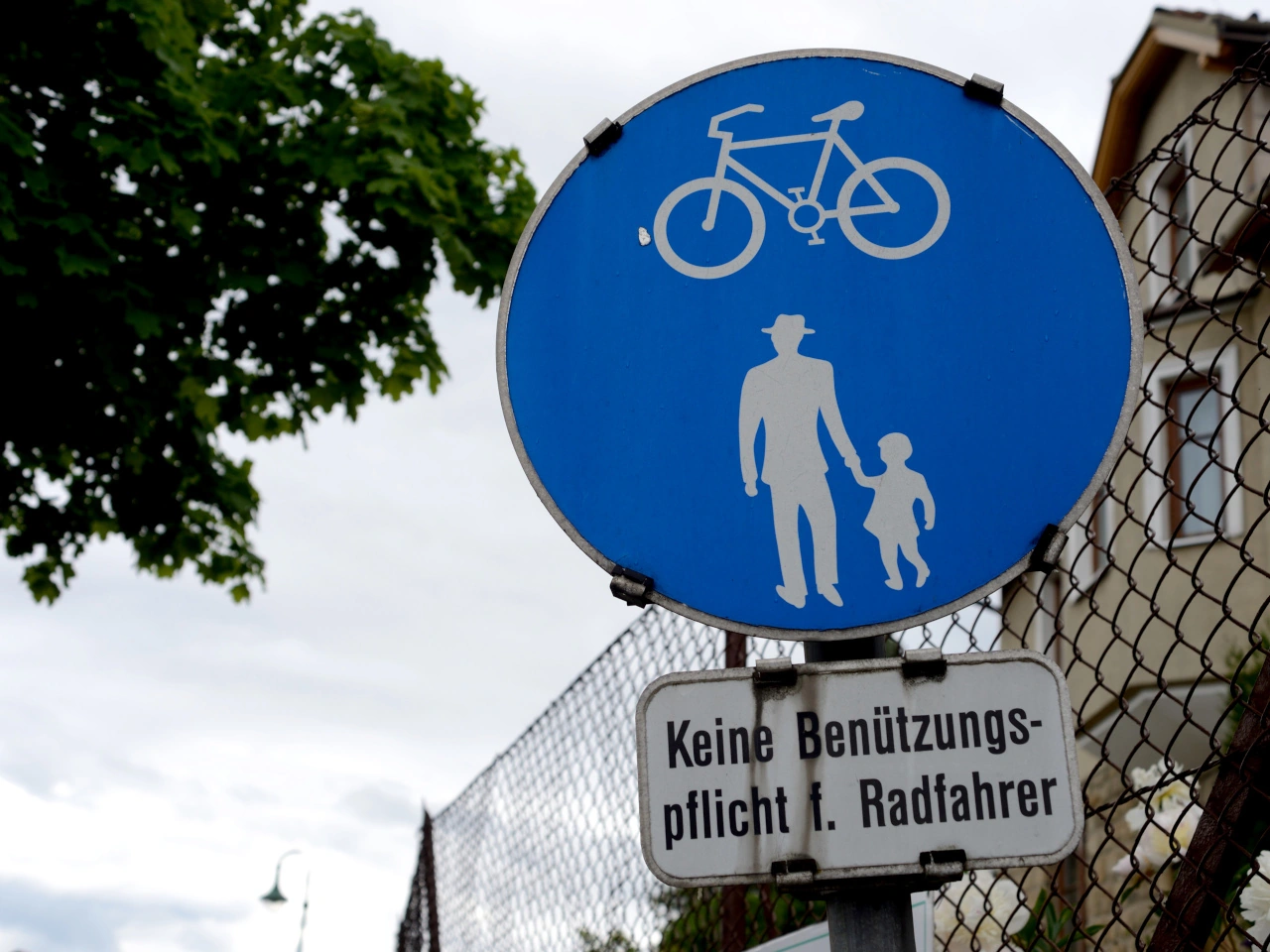
What does Austria call a shared walking and cycling path?
The term is Geh- und Radweg. The sign with pedestrian and bicycle symbols sharing the space identifies the joint arrangement. A version with the symbols on opposite sides of a dividing line instead allocates separate walking and cycling parts.
🔗 ris.bka.gv.at • Austrian RIS, StVO — sections 2, 8a, 52(16–17a), 53(27–28), 68
Must cyclists use every Austrian shared-use path?
No. The round sign normally makes the facility compulsory for ordinary bicycles, subject to the statutory exceptions. The square sign identifies a facility without compulsory cycling use. Check the shape and layout of the actual sign.
🔗 ris.bka.gv.at • Austrian RIS, StVO — sections 2, 8a, 52(16–17a), 53(27–28), 68
How must cyclists treat pedestrians on an Austrian shared-use path?
Cyclists must not endanger pedestrians. Adjust your riding to the people and space available. If the facility separates walkers and cyclists, use the cycling part instead of treating both sections as one shared surface.
🔗 ris.bka.gv.at • Austrian RIS, StVO — sections 2, 8a, 52(16–17a), 53(27–28), 68
10. Tunnel
A tunnel is a covered passage that carries a road through or beneath an obstacle such as a hill, mountain, building, waterway or another transport route. Road tunnels may contain one or more traffic lanes and can carry traffic in one or both directions.
Driving in a tunnel requires particular attention because visibility, available escape routes and space for avoiding hazards are limited. Drivers should follow the applicable lighting, speed, lane and following-distance rules and pay attention to emergency exits, traffic signals and variable-message signs.
Wikimedia.org • Herzi_Pinki • CC BY-SA
What should I check before entering a tunnel in Austria?
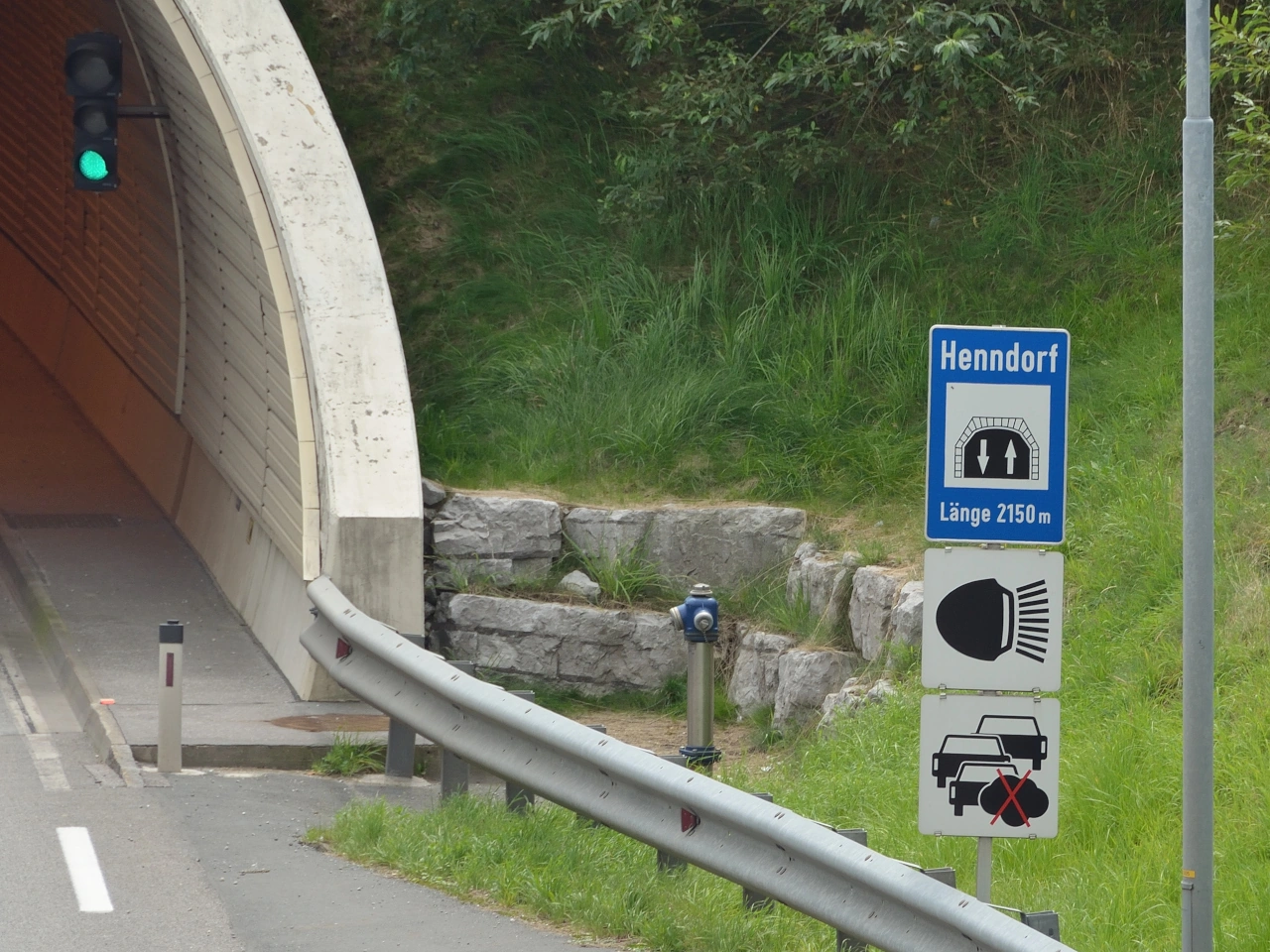
Read the entrance signs, clearance limits and lane controls. Use lighting appropriate to visibility and comply with any headlights instruction. Austria normally prohibits stopping and parking in road tunnels, with exceptions where lawful signs or road markings provide otherwise.
🔗 ris.bka.gv.at • Austrian RIS, StVO — sections 20, 24(1)(b), 24(2), 46, 50, 52–53
Does a tunnel sign in Austria set a universal speed limit?
No single speed can be read from the tunnel pictogram. Apply the road’s relevant limit and any permanent or electronic speed restriction, and drive more slowly when visibility, queues or another hazard require it.
🔗 ris.bka.gv.at • Austrian RIS, StVO — sections 20, 24(1)(b), 24(2), 46, 50, 52–53
Is every tunnel in Austria open to pedestrians and cyclists?
No. Check the road category and access signs before entering. A motorway tunnel, a vehicle-restricted tunnel and a purpose-built walking or cycling underpass have different access arrangements. Emergency evacuation routes do not establish ordinary public access.
🔗 ris.bka.gv.at • Austrian RIS, StVO — sections 20, 24(1)(b), 24(2), 46, 50, 52–53
11. Cycling street
A cycling street is a street designed or legally designated to give cyclists a prominent position in mixed traffic. Motor vehicles may usually enter, but they must adapt their speed and driving behaviour to the presence of cyclists.
Depending on the country, cyclists may be permitted to use more of the carriageway and motor vehicles may be prohibited from overtaking them. The speed limit, priority rules, permitted vehicles and beginning and end of the street depend on local traffic signs and regulations.
Wikimedia.org • Franzfoto • CC BY-SA
How should I interpret a cycling-priority street in Austria?
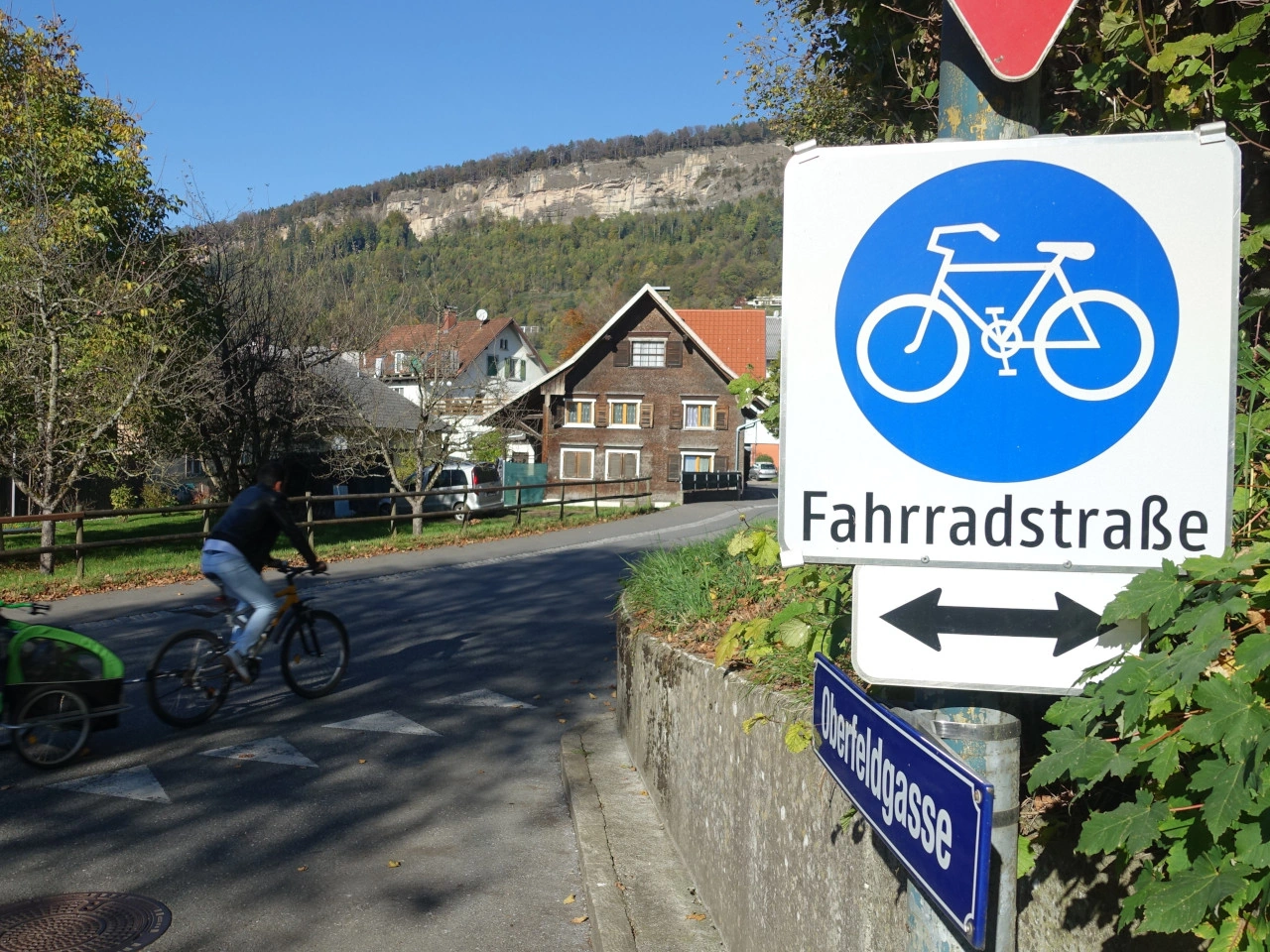
A signed Fahrradstraße is Austria’s specific bicycle-street category. General vehicle traffic is restricted, with statutory exceptions including access to and from properties and any further authorised traffic.
🔗 ris.bka.gv.at • Austrian RIS, StVO — sections 19, 67, 68(2)
Which driving rules matter on a mixed cycling street in Austria?
The limit is 30 km/h. Drivers must not endanger or obstruct cyclists. Crossing the bicycle street is permitted; through-driving is not automatically permitted merely because property access is allowed.
🔗 ris.bka.gv.at • Austrian RIS, StVO — sections 19, 67, 68(2)
Which priority rules apply on cycling streets in Austria?
A bicycle-street designation does not itself grant priority at every junction. Apply the actual priority signs, signals and ordinary junction rules. Cyclists may ride side by side under the bicycle-street provisions.
🔗 ris.bka.gv.at • Austrian RIS, StVO — sections 19, 67, 68(2)
12. Pedestrian zone
A pedestrian zone is an area consisting of one or more streets that are reserved primarily for pedestrians. Motor-vehicle access is normally prohibited or restricted to authorised users, particular purposes or specified times.
Pedestrians may usually use the full width of the available road space. Rules concerning cyclists, deliveries, public transport, vehicle speed, stopping and parking depend on local traffic signs and regulations.
Wikimedia.org • Sebastian Wallroth • CC BY
How should I recognise pedestrian-only access in Austria?
The official term is Fußgängerzone. It reserves the street or area for pedestrians, with the statutory exceptions and any permissions specified by the authority. Walking with a bicycle is permitted.
May cyclists ride in pedestrian areas in Austria?
Cycling needs permission for bicycle traffic. When admitted, cyclists must follow the pedestrian-zone conditions, including walking pace and protection of pedestrians. Bicycle access is not automatic from the zone name alone.
Which rules apply to vehicles admitted to pedestrian areas in Austria?
Admitted vehicles must travel at walking pace, except that rail vehicles have a speed limit prescribed under railway law. Drivers must exercise caution and consideration around pedestrians. Loading is limited to authorised times, with the statutory emergency, maintenance and accessibility provisions applying where relevant.
13. One-way traffic
One-way traffic means that vehicles on a road or carriageway may travel only in one designated direction. The permitted direction is normally indicated by traffic signs, lane arrows or road markings.
Some road users, such as cyclists or public-transport vehicles, may be allowed to travel in the opposite direction when signs expressly permit it. A one-way road does not by itself determine the speed limit, priority or parking rules.
Wikimedia.org • Kiwi63 • CC BY-SA
How should I read a one-way restriction in Austria?
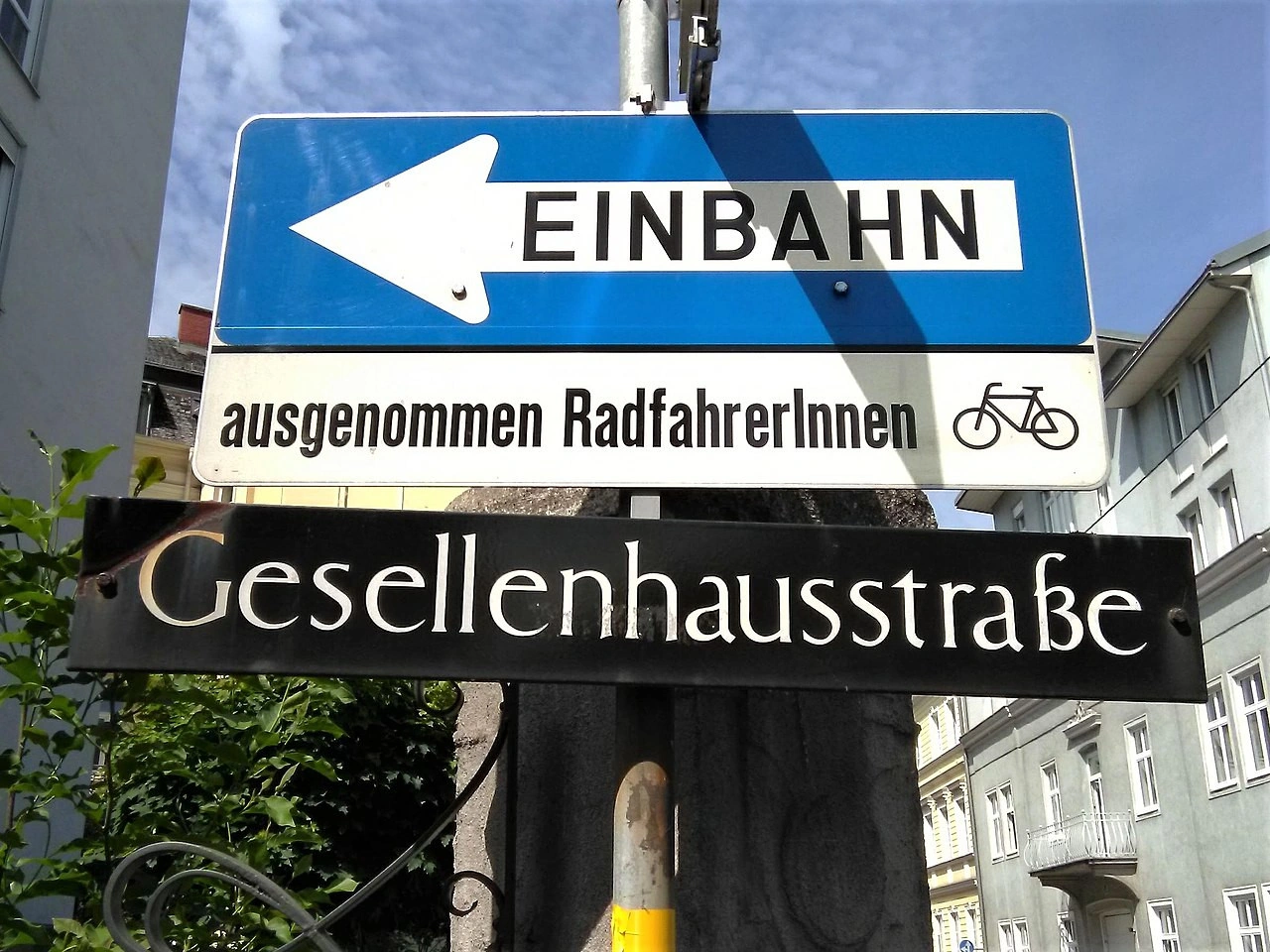
The official term Einbahnstraße means a road to be driven in the indicated direction. A mandatory turn arrow at one junction and a one-way road designation have different scopes.
🔗 ris.bka.gv.at • Austrian RIS, StVO — sections 7(5), 53(10)
May cyclists travel against the general traffic direction in Austria?
Cycling against the direction is allowed where the applicable exemption provides for it. Austria also expressly exempts cyclists on one-way roads that are Wohnstraßen, its residential-street category; do not reduce every case to a supplementary-panel requirement.
🔗 ris.bka.gv.at • Austrian RIS, StVO — sections 7(5), 53(10)
Does one-way traffic give me priority or a different speed limit in Austria?
A one-way restriction concerns direction. Continue to follow the applicable speed limit, signals, give-way or stop controls and junction-priority rules. Where authorised counterflow traffic exists, check for it before turning or crossing; your permitted direction is not automatic junction priority.
🔗 ris.bka.gv.at • Austrian RIS, StVO — sections 7(5), 53(10)
14. Quay
A quay is a constructed area beside a river, canal, harbour or other body of water, commonly used for loading, unloading, mooring vessels or providing waterside access. A road may run alongside the water or lead directly towards the quay edge.
In road traffic, a quay warning indicates a risk that a vehicle could leave the road and enter the water. Drivers should reduce speed, observe the road layout carefully and keep a safe distance from the waterside edge.
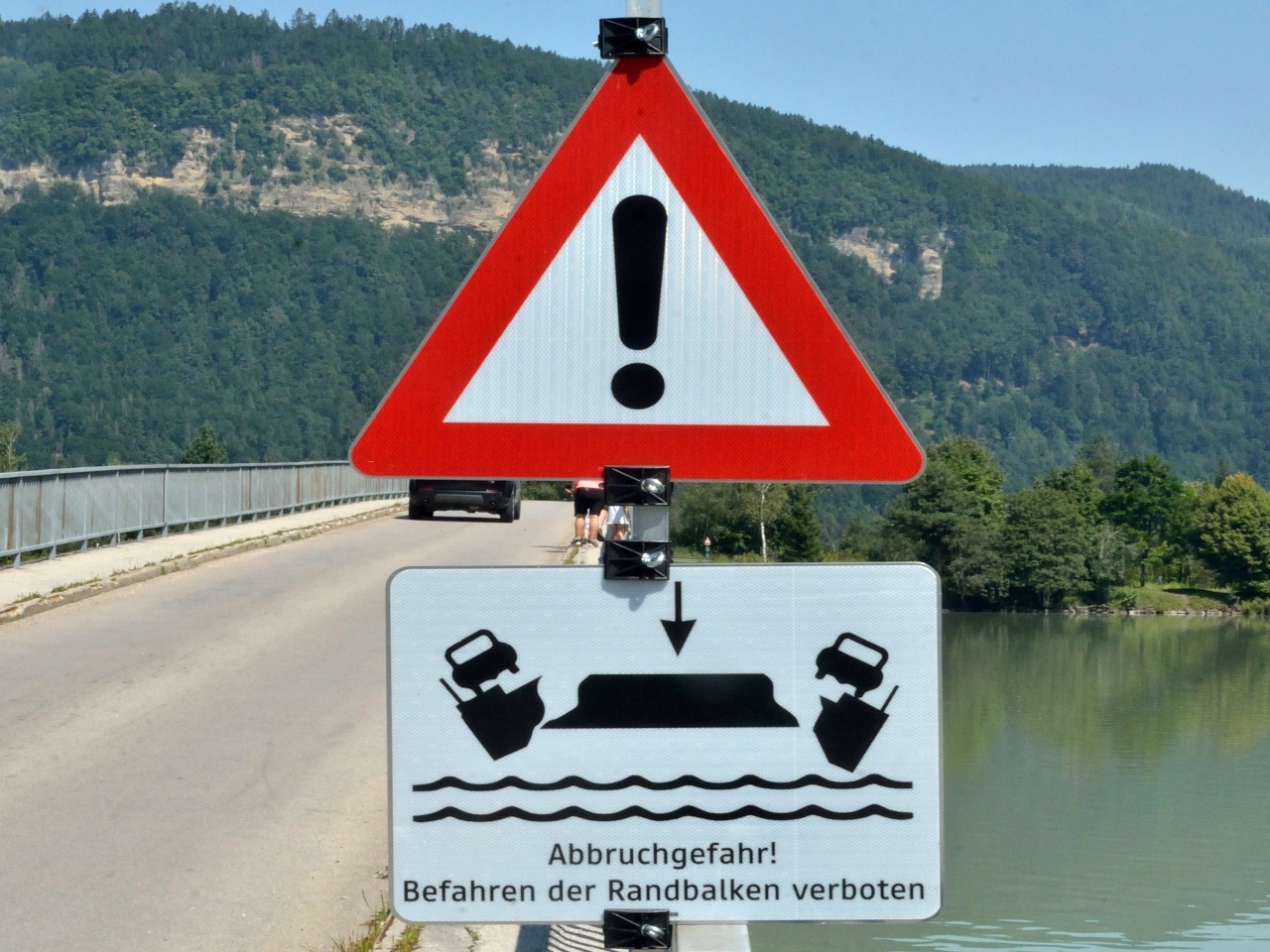
Wikimedia.org • Herzi Pinki • CC BY-SA
What should I watch for near a quay or waterside road in Austria?
Austria does not list a dedicated quay or waterside pictogram in its national StVO danger-sign catalogue. A general danger warning with supplementary information, other lawful signs or local barriers may identify the risk. Near water, check the actual road alignment and edge; do not assume a foreign quay sign is a standard Austrian sign.
🔗 ris.bka.gv.at • Austrian RIS, StVO — sections 20, 22, 50; 15–16 for overtaking
How should I choose a safe speed beside water in Austria?
Use the applicable road or local speed limit and slow further for the foreseeable waterside danger. A hazard warning is not a promise that driving at the maximum is safe. Keep enough visibility and control to avoid the edge, pedestrians, loading activity or a blocked route.
🔗 ris.bka.gv.at • Austrian RIS, StVO — sections 20, 22, 50; 15–16 for overtaking
Does a quay warning allow me to enter or park beside the water in Austria?
Check the actual access and parking restrictions, including any port or dock controls. A waterside warning does not provide permission to enter a restricted facility or park on the edge. Keep the required passage clear and use a permitted place without endangering traffic or people beside the water.
🔗 ris.bka.gv.at • Austrian RIS, StVO — sections 20, 22, 50; 15–16 for overtaking
15. Slope
A slope is a section of road that rises or descends noticeably. A steep slope can affect vehicle speed, braking distance, traction, visibility and the ability of heavy or low-powered vehicles to maintain a steady speed.
Warning signs may indicate a steep ascent or dangerous descent and may show the gradient as a percentage. Drivers should adjust their speed early, select a suitable gear and remain prepared for slow vehicles, bends and changing road conditions.
Wikimedia.org • Ralf_Roletschek • CC BY-SA
What does a steep-slope warning mean in Austria?
Austria calls the warnings Gefährliches Gefälle and Starke Steigung, for a dangerous descent and a steep ascent. Read the gradient and any additional distance information separately from a speed restriction.
🔗 ris.bka.gv.at • Austrian RIS, StVO — sections 20, 22, 50; 15–16 for overtaking
How should I approach a steep descent in Austria?
Reduce speed before the descent and select a suitable gear to help control the vehicle. Keep enough following distance and avoid building up speed that requires continuous heavy braking. A warning gives no fixed safe descent speed: the gradient, surface, visibility, load and vehicle can require a speed well below the legal maximum.
🔗 ris.bka.gv.at • Austrian RIS, StVO — sections 20, 22, 50; 15–16 for overtaking
What should I check when meeting or overtaking on a slope in Austria?
On a narrow road, follow the signed priority and the rules for meeting traffic. The gradient warning itself does not give you priority; slow early and use a safe passing place rather than forcing another driver towards the edge.
🔗 ris.bka.gv.at • Austrian RIS, StVO — sections 20, 22, 50; 15–16 for overtaking
16. Bus lane
A bus lane is a traffic lane reserved primarily for buses or other authorised public-transport vehicles. It is intended to improve the reliability and flow of public transport by allowing authorised vehicles to avoid general traffic congestion.
Other road users, such as taxis, cyclists, motorcycles or vehicles carrying several occupants, may also be permitted when signs expressly allow them. The operating hours, permitted vehicles, direction of travel and rules for entering or crossing the lane depend on local traffic signs and regulations.
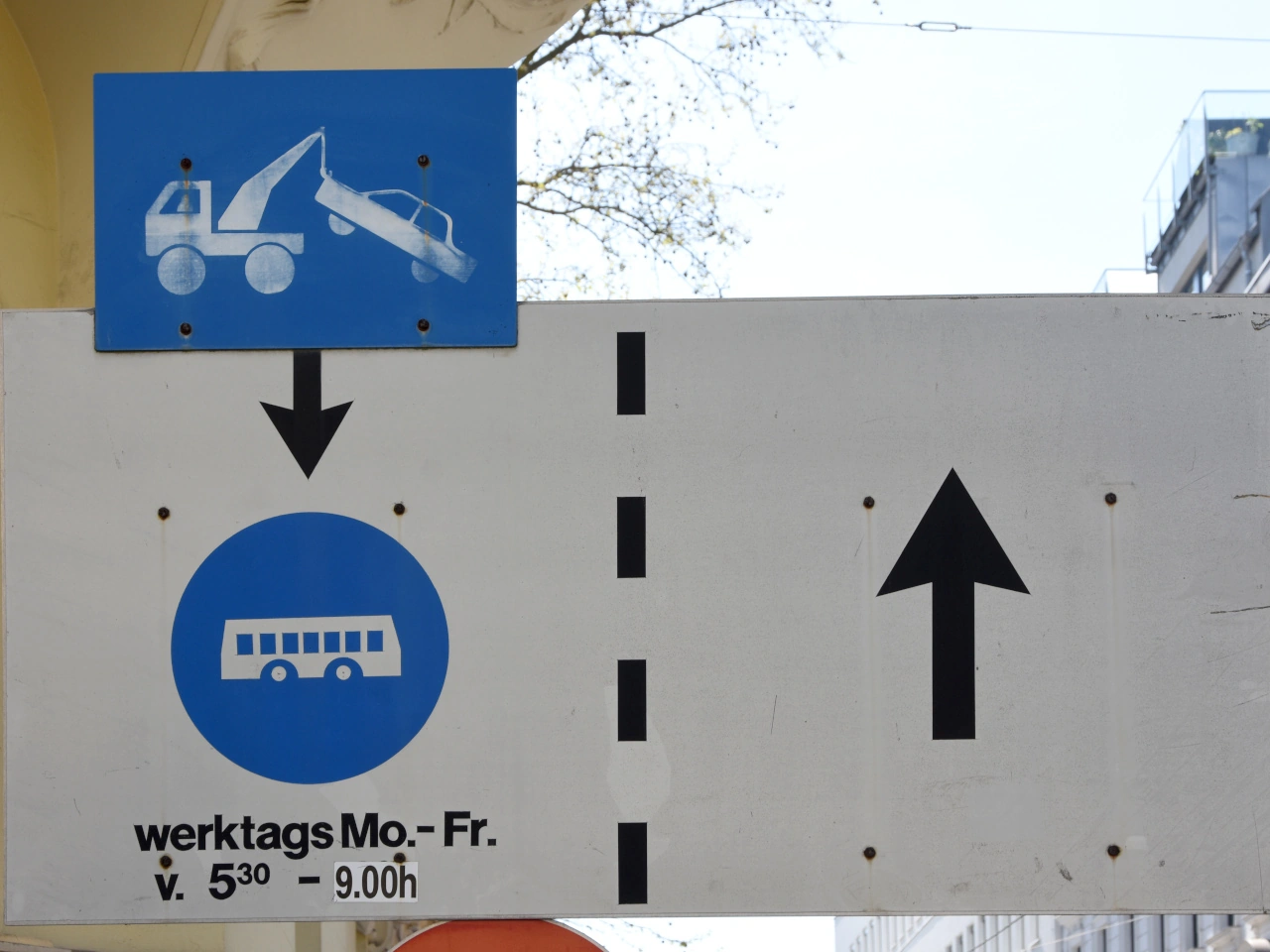
Wikimedia.org • Linie29 • CC BY-SA
Which vehicles may use a bus lane in Austria?
Austria’s Fahrstreifen für Omnibusse is reserved for scheduled bus services and the other classes provided for by the Road Traffic Act, including taxis and patient-transport vehicles. Other categories can be authorised by the sign or an additional panel.
🔗 ris.bka.gv.at • Austrian RIS, StVO — sections 24(3)(c), 53(24–25)
May bicycles and motorcycles use a bus lane in Austria?
Do not assume that a bicycle, moped or motorcycle is covered by the bus symbol. Check whether the additional indication authorises that category.
🔗 ris.bka.gv.at • Austrian RIS, StVO — sections 24(3)(c), 53(24–25)
Does bus-lane access also allow stopping or parking in Austria?
Parking on a bus lane is prohibited. Any limited use or stopping permission must be assessed separately; permission to drive along the lane is not permission to leave a vehicle there.
🔗 ris.bka.gv.at • Austrian RIS, StVO — sections 24(3)(c), 53(24–25)
17. Bus stop
A bus stop is a designated place where buses stop to allow passengers to board or leave. It may be identified by a sign, shelter, raised platform, road marking or other public-transport infrastructure and can be located beside the road or in a specially constructed stopping area.
Drivers approaching a bus stop should watch carefully for buses, pedestrians and passengers crossing or entering the roadway. Parking or stopping restrictions may apply around bus stops to keep the area accessible and visible.
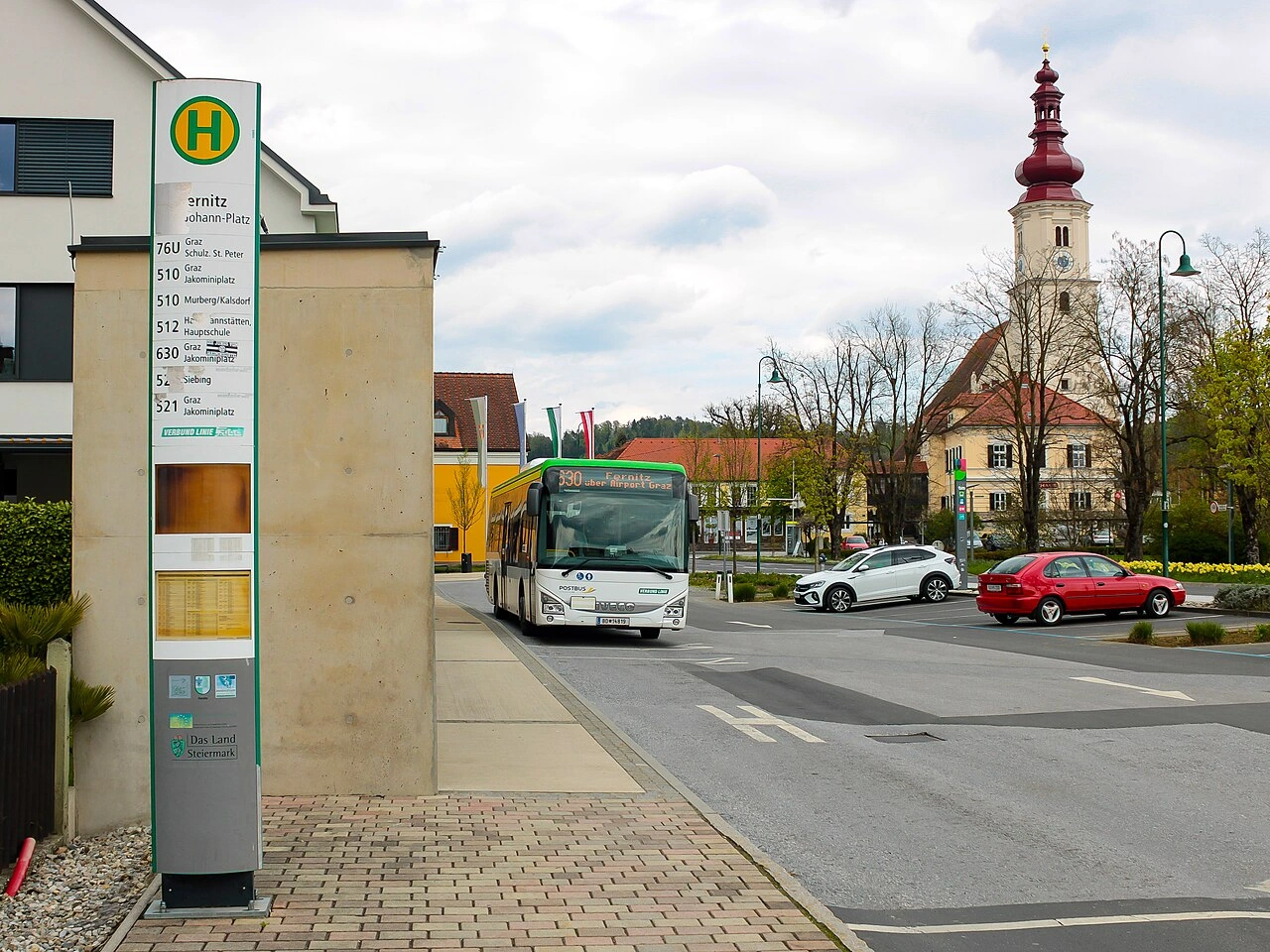
Wikimedia.org • Armin Ademovic • CC BY-SA
What stopping or parking restrictions apply at bus stops in Austria?
During public-transport operating hours, stopping and parking are prohibited in the marked stop area or, without a different marking, within 15 metres before and after the stop sign.
🔗 ris.bka.gv.at • Austrian RIS, StVO — sections 24(1)(e), 24(2a), 26a(2)
May I briefly drop off a passenger at a bus stop in Austria?
The Road Traffic Act allows a brief stop for immediate passenger boarding or alighting in this area. It does not allow waiting or parking, and it does not authorise an otherwise prohibited use of a bus lane.
🔗 ris.bka.gv.at • Austrian RIS, StVO — sections 24(1)(e), 24(2a), 26a(2)
What should I do near a stopped bus in Austria?
In a built-up area, allow a scheduled bus to leave its marked stop once its driver signals the intention to do so. Following drivers must slow down and stop if necessary; the bus driver must also avoid endangering others.
🔗 ris.bka.gv.at • Austrian RIS, StVO — sections 24(1)(e), 24(2a), 26a(2)
18. Dead end
A dead-end road is a road that does not provide a through route for some or all vehicles. It may end completely, terminate at a barrier or continue as a path that only certain road users may use.
Drivers may normally enter a dead-end road to reach homes, businesses, parking places or other destinations, but they must be prepared to turn around or leave by the same route. Signs may indicate that pedestrians or cyclists can continue beyond the point where motor traffic cannot.
Wikimedia.org • Naturpuur • CC BY-SA
What does a dead-end indication mean in Austria?
Austria uses Sackgasse for a dead-end road. It describes the absence of a through route and is different from a sign prohibiting entry.
Can pedestrians or cyclists continue beyond a motor-traffic dead end in Austria?
Austria has separate dead-end variants indicating a walking continuation and a continuation for cyclists and pedestrians under section 53(11a–11b). Read the actual variant and the route beyond it. An ordinary dead-end sign alone does not authorise cycling on every adjoining path.
Does a dead-end indication change speed or priority rules in Austria?
The no-through information itself does not assign junction priority or a numerical speed limit. Continue to obey the actual speed, access, parking and priority controls. If you need to turn around, use a suitable lawful place, check for pedestrians and cyclists, and do not obstruct the space needed for other vehicles to turn.
19. Stop sign
A stop sign requires drivers to bring their vehicle to a complete stop and give way before entering or crossing the road ahead. The stop must be made at the stop line or another legally prescribed position.
After stopping, the driver may continue only when this can be done safely and without interfering with traffic that has priority. The sign does not create priority for the driver who has stopped.
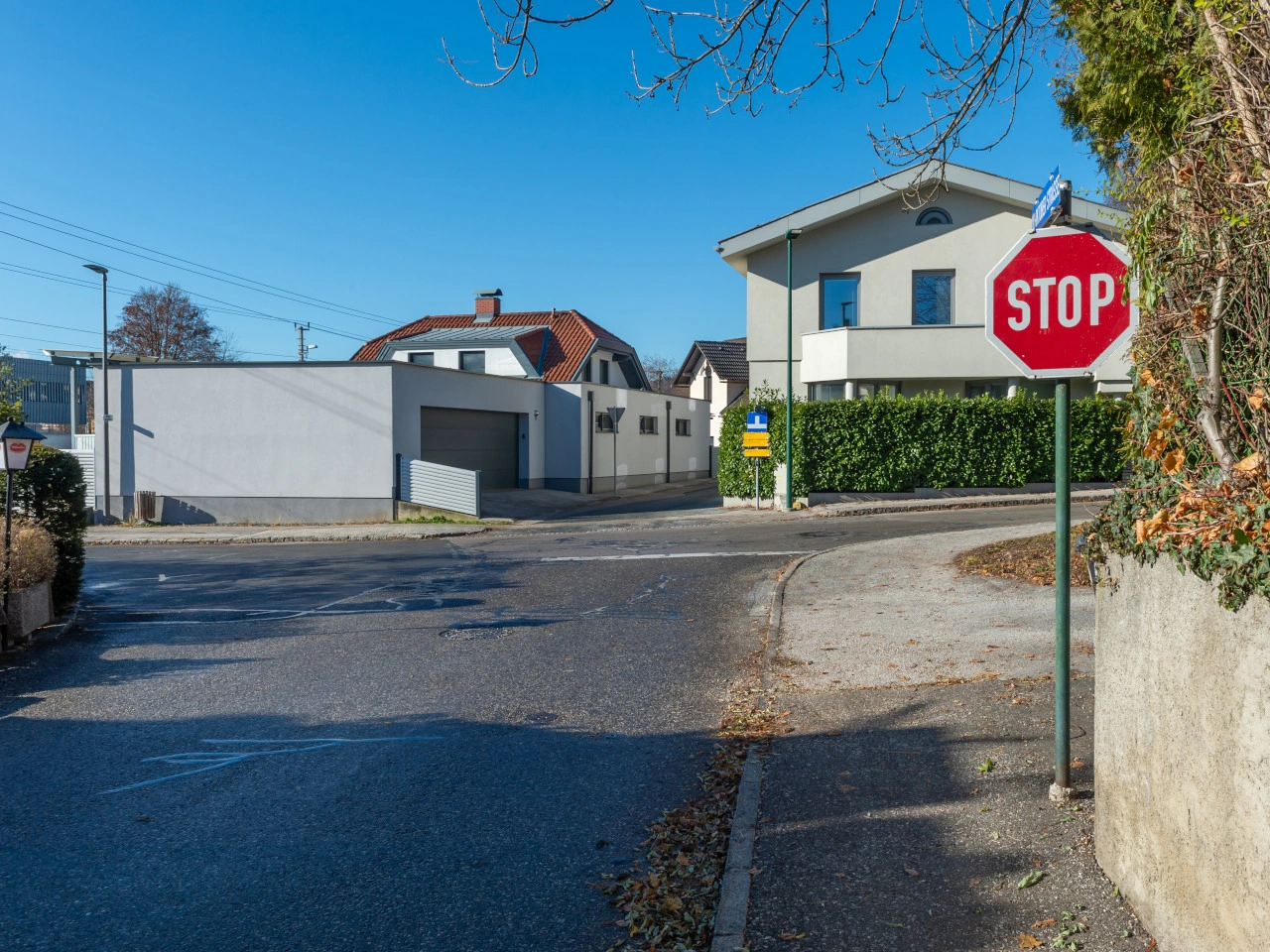
Wikimedia.org • Johann_Jaritz • CC BY-SA
Must I stop completely at a stop sign in Austria?
Yes. Come to a complete stop when the applicable stop sign controls your approach, even when you cannot see another road user. Slowing to a crawl is not a stop. Austria’s regulatory wording is Halt: stop and give way.
🔗 ris.bka.gv.at • Austrian RIS, StVO — sections 19, 52(23–24)
Where must I stop at a stop-controlled junction in Austria?
Stop before the prescribed stop line. If the marking is missing or not visible, stop where you have a good view before entering the junction, as required by the Austrian Halt provision.
🔗 ris.bka.gv.at • Austrian RIS, StVO — sections 19, 52(23–24)
Does stopping first give me priority at a stop sign in Austria?
A complete stop does not, by itself, give you priority. Give way to the road users entitled to pass under the junction’s signs and rules, check pedestrians and cyclists, and proceed only when the gap is safe. Do not follow another stopped vehicle through without satisfying your own stopping and yielding duties.
🔗 ris.bka.gv.at • Austrian RIS, StVO — sections 19, 52(23–24)
20. Give way
A give-way sign requires drivers to allow traffic with priority to proceed before entering, crossing or joining a road. Drivers must reduce speed, observe approaching traffic and stop when necessary.
Unlike a stop sign, a give-way sign does not always require a complete stop. The driver may continue without stopping only when the route is clearly safe and no road user with priority is forced to change speed or direction.
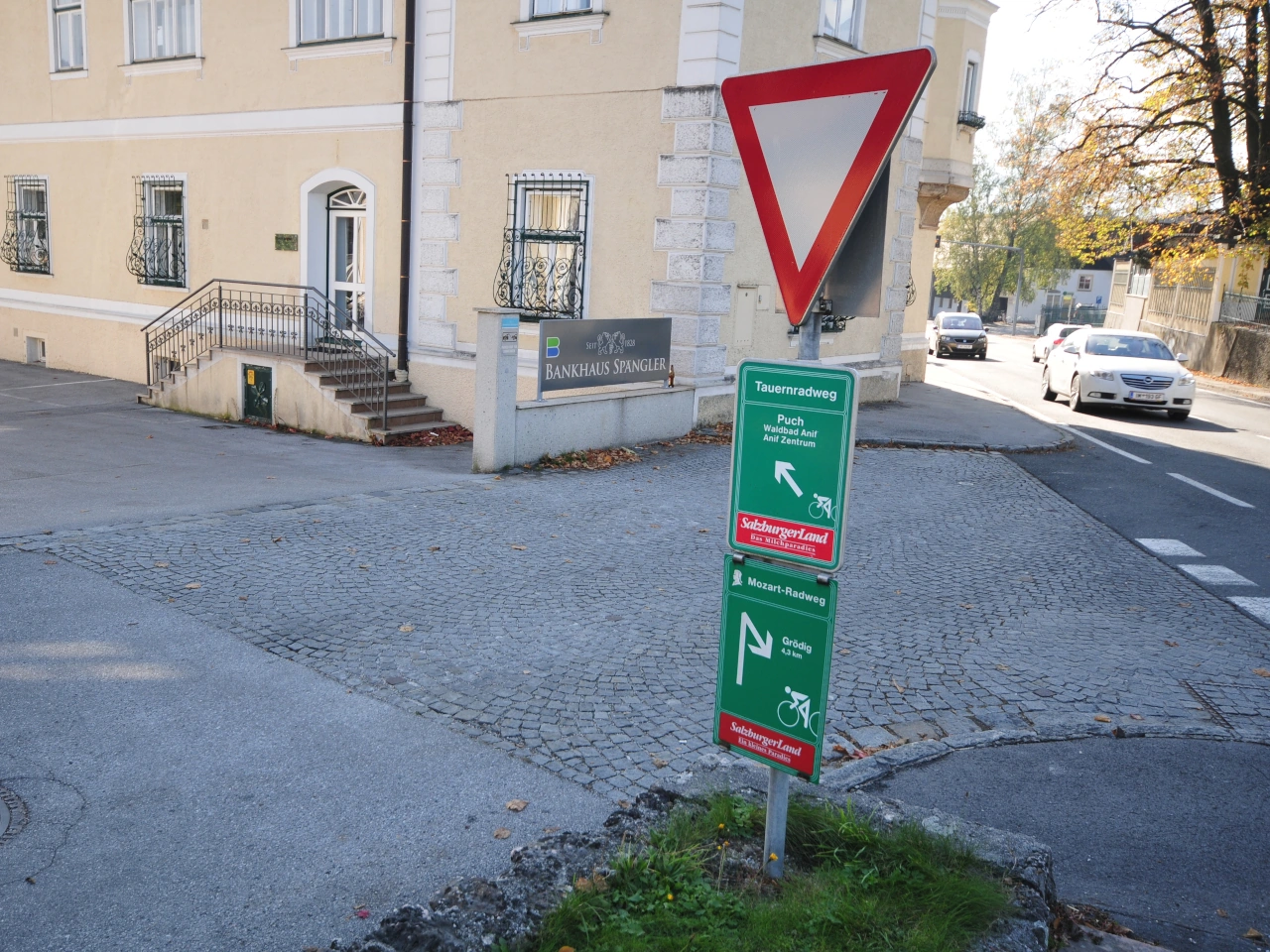
Wikimedia.org • Ralf_Roletschek • CC BY-SA
What does giving way mean in Austria?
The Austrian sign is called Vorrang geben. At the controlled junction, give way to traffic on the priority road from both directions; read any supplementary diagram showing that road’s course.
🔗 ris.bka.gv.at • Austrian RIS, StVO — sections 19, 52(23–24)
Must you always stop when giving way in Austria?
No. A give-way control requires stopping when necessary to yield or obtain a safe view. A stop sign requires a complete stop even if the road appears empty.
🔗 ris.bka.gv.at • Austrian RIS, StVO — sections 19, 52(23–24)
What should you check before proceeding after giving way in Austria?
Wait until the manoeuvre is safe. Check the priority traffic, the view in both directions and enough space to complete the entry. Giving way to one vehicle does not remove duties towards another driver, a cyclist or a pedestrian.
🔗 ris.bka.gv.at • Austrian RIS, StVO — sections 19, 52(23–24)
21. Roundabout
A roundabout is a circular road arrangement in which traffic travels around a central island in one designated direction. Vehicles enter and leave through connecting roads, and traffic signs or local rules determine who has priority.
Drivers should reduce speed, choose a suitable lane, observe all road users and signal as required when leaving. The direction of travel, entry priority, lane use and rules for cyclists and pedestrians depend on local traffic signs and regulations.
Wikimedia.org • Herzi Pinki • CC BY-SA
Who has priority at a roundabout in Austria?
An Austrian Kreisverkehr is not automatically a priority arrangement. Where entry has a give-way sign, yield to circulating traffic. Without a different priority control, the ordinary priority-from-the-right rule can favour entering traffic.
🔗 ris.bka.gv.at • Austrian RIS, StVO — sections 11, 19, 52(15)
How should you choose a roundabout lane in Austria?
Choose your intended exit before entering and follow the lane arrows and destination signs. Keep to the marked route and make any permitted lane change only when safe; having priority over entering traffic does not give you priority to change lanes.
🔗 ris.bka.gv.at • Austrian RIS, StVO — sections 11, 19, 52(15)
What should you check when leaving a roundabout in Austria?
Check the lane you will cross or enter, signal the manoeuvre as required and look for cyclists and pedestrians at the exit. Obey any separate crossing controls and do not force an exit across another vehicle’s path.
🔗 ris.bka.gv.at • Austrian RIS, StVO — sections 11, 19, 52(15)
22. Priority road
A priority road is a road whose traffic is given priority over traffic entering from intersecting roads. It is normally identified by a priority-road sign, while an end sign indicates where that continuing priority status stops.
Drivers on a priority road must still obey traffic lights, authorised officers, speed limits, crossings and turning rules. Having priority never allows a driver to proceed when doing so would create danger or block an intersection.
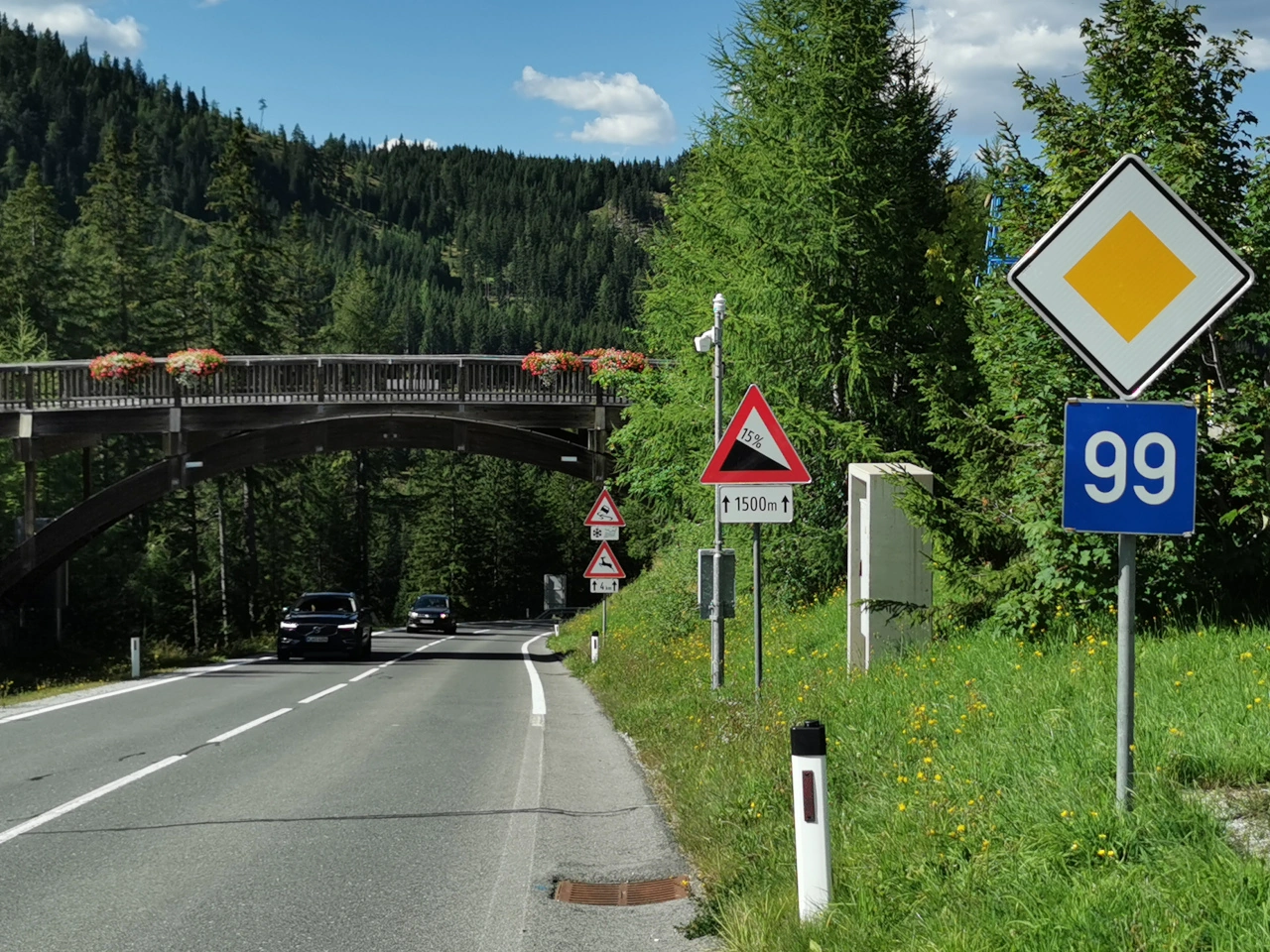
Wikimedia.org • Mateus2019 • CC BY-SA
How does priority-road status work in Austria?
Austria recognises a signed Vorrangstraße. Traffic using it has priority over traffic on intersecting or joining roads; a supplementary diagram can show that the priority route turns.
🔗 ris.bka.gv.at • Austrian RIS, StVO — sections 19, 50(4), 52(25a–25b), 53(13a), 54(5)(e)
How can you tell where a priority road applies in Austria?
Read the priority-road sign, the corresponding end indication and any supplementary junction diagram. Distinguish a continuing road designation from a sign that regulates only one junction. If a diagram shows the priority route turning, follow that diagram rather than assuming the straight-ahead road has priority.
🔗 ris.bka.gv.at • Austrian RIS, StVO — sections 19, 50(4), 52(25a–25b), 53(13a), 54(5)(e)
Does having road priority let you ignore other controls in Austria?
No. Obey the applicable traffic signals and authorised directions, speed limits and crossing rules. Turning or changing lanes can require yielding, and having priority never permits entering a conflict that cannot be crossed safely.
🔗 ris.bka.gv.at • Austrian RIS, StVO — sections 19, 50(4), 52(25a–25b), 53(13a), 54(5)(e)
23. Give way to oncoming traffic
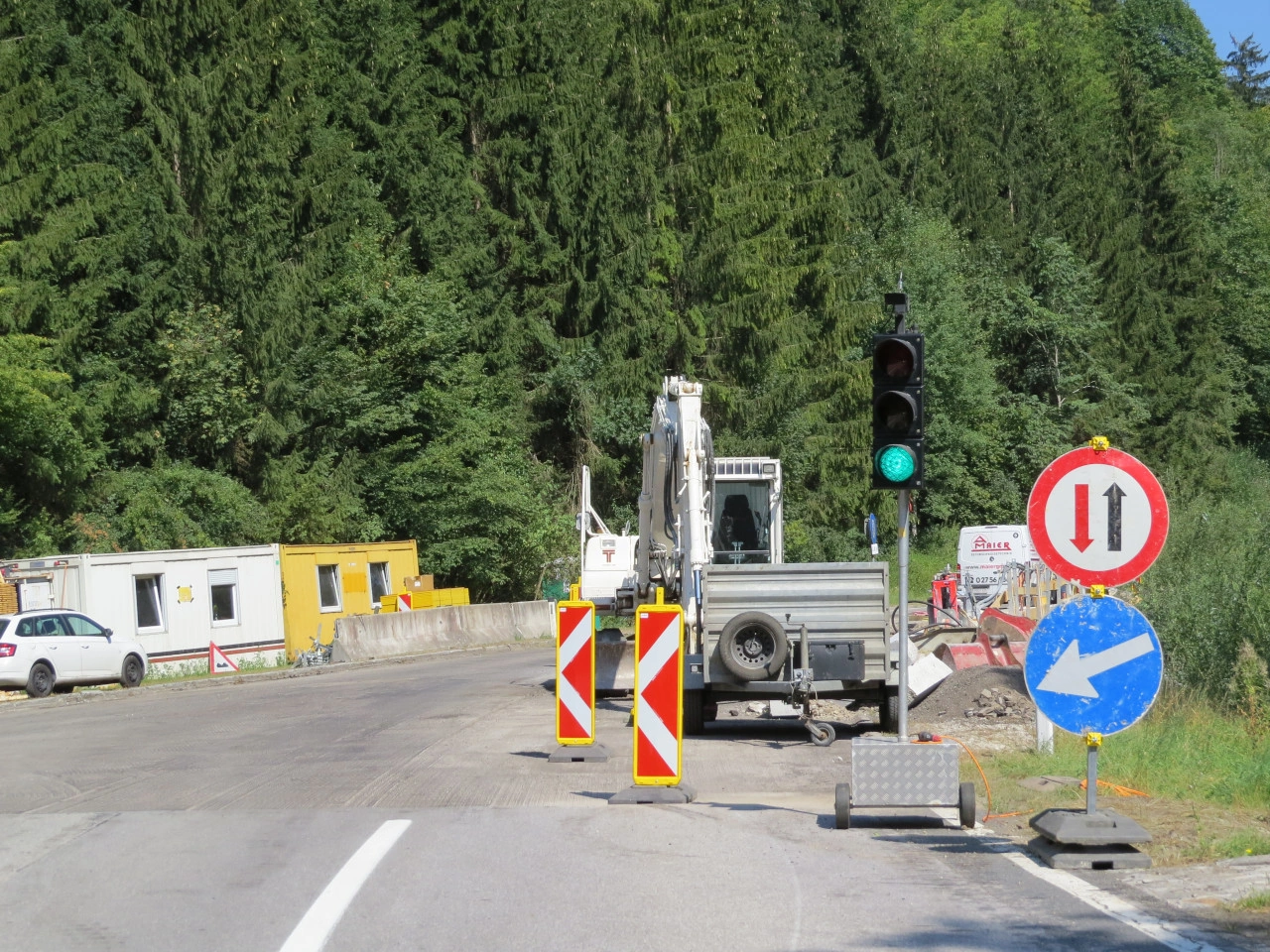
Give way to oncoming traffic means that drivers must allow vehicles approaching from the opposite direction to pass first through a narrow section of road. The rule is normally indicated by a sign facing the direction that must yield and a corresponding priority sign facing oncoming traffic.
Drivers must reduce speed and stop when necessary before entering the narrow passage. They may continue only when they can do so safely and without obstructing oncoming traffic that has priority.
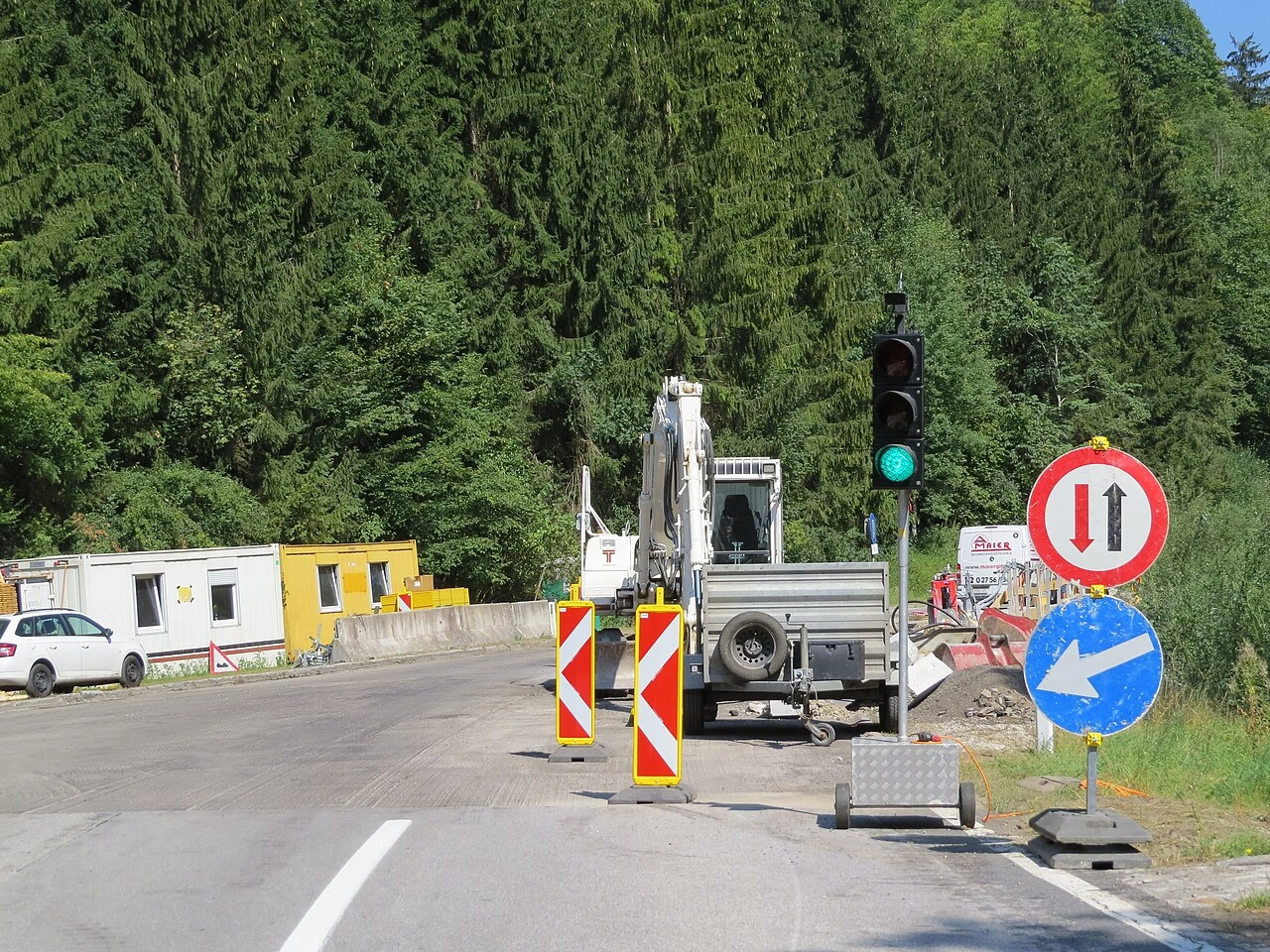
Wikimedia.org • GT1976 • CC BY-SA
When must I give way to oncoming traffic in Austria?
Where priority signs, temporary signals or an authorised controller in Austria require your direction to yield at a narrow road or bridge, allow opposing traffic through first. Do not assume every narrowing has the same priority arrangement.
🔗 ris.bka.gv.at • Austrian RIS, StVO — sections 10, 20, 52(5), 53(7a)
Does a road-narrows warning automatically give oncoming traffic priority in Austria?
Not necessarily. A warning of a narrow carriageway is not itself the same as an instruction to give way. Check whether there is a separate priority sign, signal or temporary traffic control, and take account of any rules for an obstruction on your side.
🔗 ris.bka.gv.at • Austrian RIS, StVO — sections 10, 20, 52(5), 53(7a)
What if an oncoming vehicle is already entering a narrow passage in Austria?
Reduce speed and wait where you can do so safely rather than forcing two vehicles into insufficient space. Even if a sign gives your approach priority, that does not justify a collision or endangering another road user.
🔗 ris.bka.gv.at • Austrian RIS, StVO — sections 10, 20, 52(5), 53(7a)
24. Railway crossing
A railway crossing, also called a level crossing or railroad crossing, is a place where a road or path crosses railway tracks at the same level. It may be protected by barriers, warning lights, bells, traffic signs or a combination of these measures.
Road users must approach carefully and never enter when a train is approaching, warning signals are active or the exit is blocked. They should cross promptly and must never stop, wait or become trapped on the tracks.
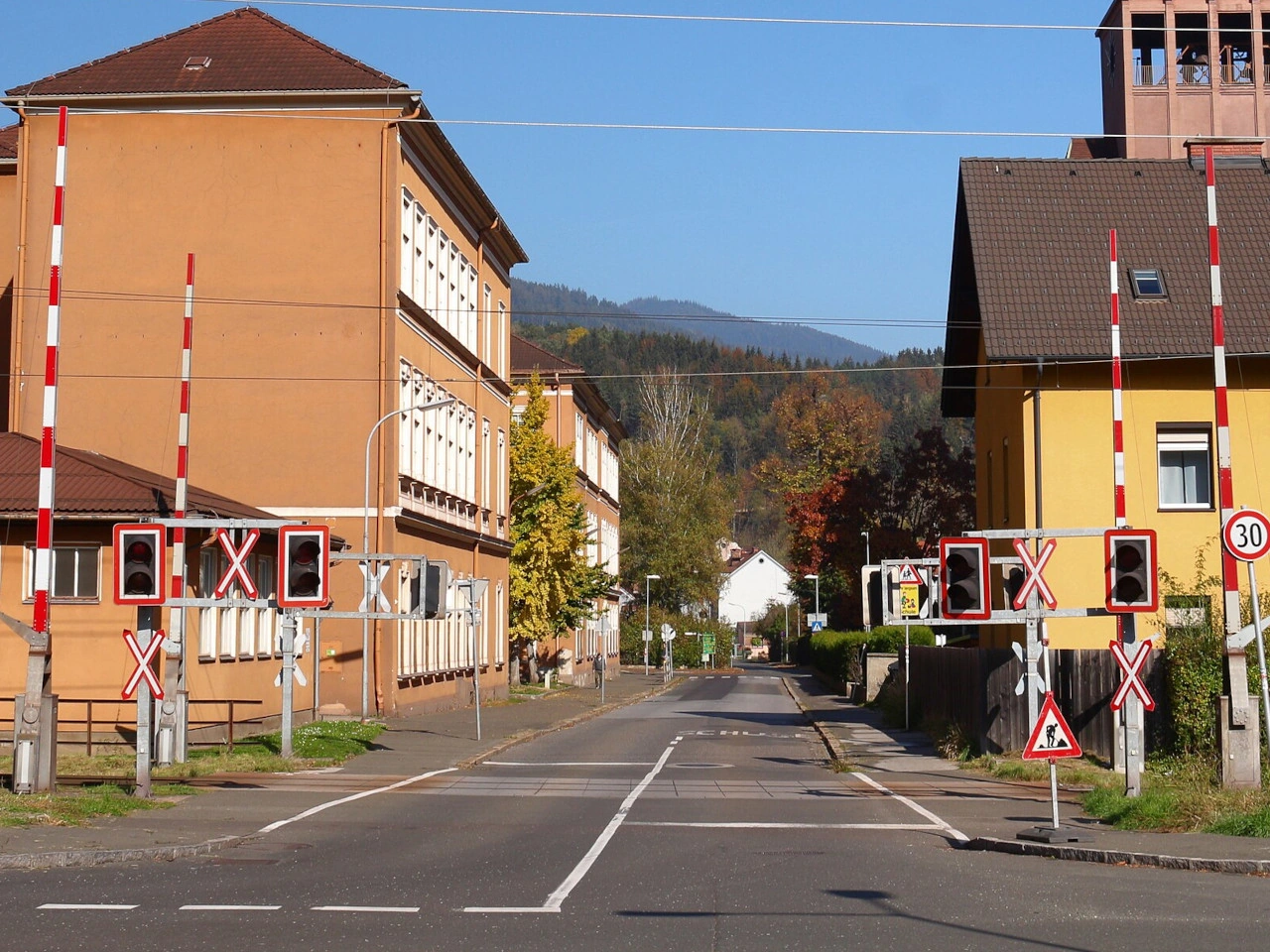
Wikimedia.org • Aciarium • CC BY-SA
When must drivers stop at a railway level crossing in Austria?
Stop for the applicable STOP control, red or yellow warning light, audible warning, closing or not fully open barriers, or a crossing guard’s stop instruction. If yellow appears when stopping safely is no longer possible, continue and clear the crossing. Cross only when the controls permit it and it is safe.
🔗 ris.bka.gv.at • Austria, Eisenbahnkreuzungsverordnung 2012, sections 96–99, RIS consolidation
Must I stop at every unguarded railway crossing in Austria?
Not simply because barriers are absent. At crossings protected by signs, stop at a STOP sign, for an approaching train or one announcing departure, or when visibility is obstructed. Check both directions and cross only when you are certain it is safe.
🔗 ris.bka.gv.at • Austria, Eisenbahnkreuzungsverordnung 2012, sections 96–99, RIS consolidation
What if road traffic is queued beyond a railway crossing in Austria?
Wait before the tracks until there is room to take your entire vehicle off the crossing. Do not follow another vehicle onto the tracks without checking the exit. Keep the tracks clear even if no train is visible.
🔗 ris.bka.gv.at • Austria, Eisenbahnkreuzungsverordnung 2012, sections 96–99, RIS consolidation
25. Mandatory direction
A mandatory-direction sign requires drivers to travel only in the direction or one of the directions indicated by its arrow or arrows. It may require traffic to continue straight ahead, turn, or pass an obstacle on a specified side.
The sign does not itself determine priority or speed. Drivers must still use the appropriate lane, signal when required and give way according to local traffic signs and regulations.
Wikimedia.org • GT1976 • CC BY-SA
What does a mandatory-direction sign require in Austria?
Where a compulsory-direction sign is installed in Austria, follow only the arrow direction or permitted combination of directions. The restriction applies at the location or movement it regulates; it is not an instruction to ignore other traffic controls.
🔗 ris.bka.gv.at • Austrian RIS, StVO — sections 11, 14, 19, 52–54
Can I choose another turn if the mandatory-direction arrow is inconvenient in Austria?
No, unless another applicable sign, lane instruction or authorised traffic direction lawfully permits it. Plan a permitted alternative route; do not make an abrupt or prohibited turn to reach your destination.
🔗 ris.bka.gv.at • Austrian RIS, StVO — sections 11, 14, 19, 52–54
Does a mandatory-direction sign give me priority over pedestrians in Austria?
No. It tells you which way to move, not who goes first. Check traffic lights, other priority signs, pedestrians and cyclists, and give way when required before completing the manoeuvre.
🔗 ris.bka.gv.at • Austrian RIS, StVO — sections 11, 14, 19, 52–54