

Bike pathFlanders
 Traffic rules
 Flanders
8. Bike path
A bike path is a part of a road or a separate route intended primarily or exclusively for people riding bicycles. It may be physically separated from motor traffic, marked on the road surface or identified by traffic signs.
Bike paths may be one-way, two-way or shared with other road users. The permitted users, direction of travel, priority rules and obligation to use the path depend on local traffic signs and regulations.
Wikimedia.org • Jeanhousen • CC BY-SA
What is legally considered a bike path in Belgium?
A Belgian fietspad is a part of the public road reserved for bicycles and two-wheeled class A mopeds by traffic sign D7, sign D9 or the legally prescribed road markings. A fietspad is not part of the carriageway.
 Mandatory path for cyclists.
Signal routier D7 • Piste cyclable obligatoire.
Verkeersbord D7 • Verplicht fietspad.
 Mandatory divided pedestrian and cycle path.
Signal routier D9 • Partie de la voie publique réservée à la circulation des piétons, des bicyclettes et des cyclomoteurs à deux roues classe A.
Verkeersbord D9 • Deel van de openbare weg voorbehouden voor het verkeer van voetgangers, van fietsen en van tweewielige bromfietsen klasse A.
What changes for bike paths under Belgium’s new Road Code?
Belgium’s new Code of the Public Road takes effect on 1 June 2027. The existing traffic sign D7 continues to indicate a mandatory bike path, while a new traffic sign D8 explicitly marks its end. The new Road Code also introduces a non-mandatory bike path: traffic sign R12 marks its beginning and traffic sign R13 its end. Cyclists, speed pedelec riders and drivers of class A mopeds may use a non-mandatory bike path but are not required to do so.
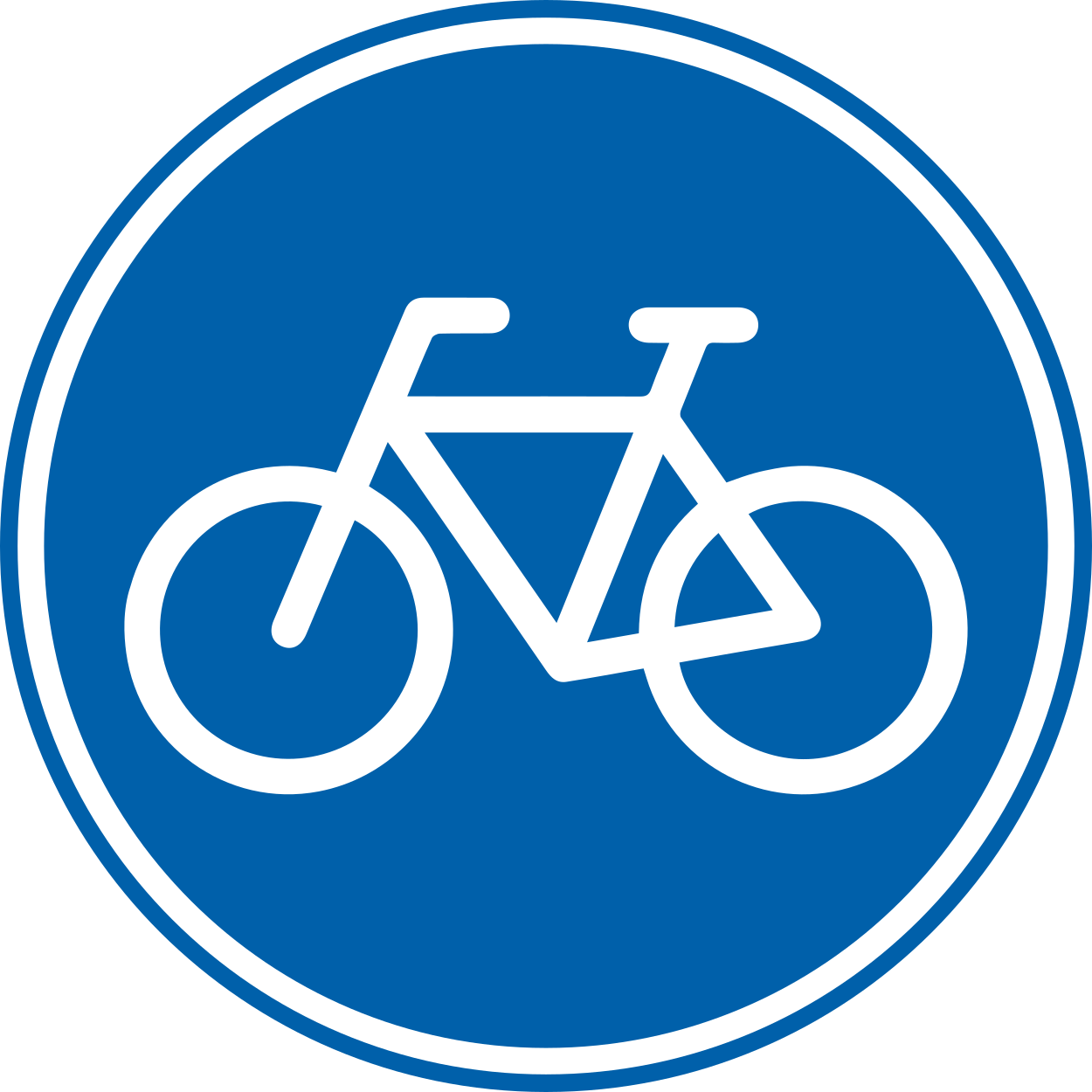 Mandatory path for cyclists.
Signal routier D7 • Piste cyclable. Le signal vaut jusqu’au prochain carrefour inclus.
Verkeersbord D7 • Fietspad. Het verkeersbord geldt tot en met het volgend kruispunt.
 End of mandatory path for cyclists.
Signal routier D8 • Fin de piste cyclable.
Verkeersbord D8 • Einde fietspad.
 Start of an optional cycle path.
Signal routier R12 • Début d’une piste cyclable non obligatoire. La règlementation particulière vaut jusqu’au prochain carrefour inclus.
Verkeersbord R12 • Begin van een niet verplicht fietspad. De bijzondere voorschriften gelden tot en met het volgend kruispunt.
 End of an optional cycle path.
Signal routier R13 • Fin d’une piste cyclable non obligatoire.
Verkeersbord R13 • Einde van een niet verplicht fietspad.
How can you recognise a Belgian bike path?
It may be indicated by traffic sign D7, by the cyclist section of sign D9, or by two parallel white broken lines enclosing a space that is not wide enough for motor traffic.
What does traffic sign D7 mean?
Traffic sign D7 indicates a mandatory bike path. Cyclists and class A moped riders must use it when it is usable and signposted for their direction of travel.
What does traffic sign D9 mean?
Traffic sign D9 indicates a part of the public road divided between pedestrians and cyclists. Each category must use the section assigned to it, normally separated by a continuous white line or a clear difference in surface material.
Is a path indicated by D10 legally a fietspad?
No. Sign D10 indicates a part of the public road shared by pedestrians and cyclists. Cyclists must use it, but it is not included in the legal definition of a Belgian fietspad.
 Mandatory shared pedestrian and cycle path.
Signal routier D10 • Partie de la voie publique réservée à la circulation des piétons et des cyclistes.
Verkeersbord D10 • Deel van de openbare weg voorbehouden voor het verkeer van voetgangers en fietsers.
Must cyclists use a marked bike path on the right?
Yes. Cyclists and class A moped riders must use a usable bike path marked by two parallel broken white lines when it lies on the right in their direction of travel.
May cyclists use a marked bike path on the left?
No. A bike path indicated only by the two parallel broken white lines may not be used when it lies on the left in the cyclist’s direction of travel.
When may cyclists use a bike path on the left?
A path indicated by D7 or D9 may be used from the left side when it is signposted for the cyclist’s direction of travel. A two-way D7 path must therefore be signposted in both directions.
Must cyclists always use a D7 or D9 path on the left?
Not always. When a signed path lies on the left, cyclists and class A moped riders may remain on the right side of the road if special circumstances justify this.
May cyclists leave a mandatory bike path?
Yes. Cyclists and permitted moped riders may leave it to change direction, overtake another user or travel around an obstruction.
May class A mopeds use Belgian bike paths?
Yes. Two-wheeled class A moped riders must generally follow usable bike paths under the same directional rules as cyclists.
May class B mopeds use Belgian bike paths?
Where the speed limit is 50 km/h or lower, class B moped riders may use a D7 or marked bike path provided they do not endanger its other users. Where the speed limit is higher than 50 km/h, they must use an available and usable D7 or marked bike path. Supplementary signs may require or prohibit their use.
May speed pedelecs use Belgian bike paths?
Where the speed limit is 50 km/h or lower, speed-pedelec riders may use D7, D9 and marked bike paths provided they do not endanger other users. Where the speed limit is higher, they must use an available and usable path of those types. Supplementary signs may impose another rule.
May speed pedelecs use a D10 shared path?
No. Under the current Belgian Highway Code, D10 is reserved for pedestrians and ordinary cyclists. Speed pedelecs are not permitted on a path indicated by D10.
May pedestrians walk on a Belgian bike path?
Pedestrians normally use the available pedestrian facilities first. They may use an ordinary bike path only when the higher-priority pedestrian facilities are unavailable or unusable, and must then give way to the other bike-path users. D9 and D10 paths have specific pedestrian provisions.
May motor vehicles cross a Belgian bike path?
Yes, where necessary and permitted, for example when entering a property or turning into another road. A driver crossing a pavement or bike path must give way to the road users legally using it.
Do cyclists always have priority at a Belgian cycle crossing?
No. Cyclists approaching a separately marked cycle crossing must enter it cautiously and take account of approaching vehicles. Drivers must approach at moderate speed and must not endanger or hinder cyclists already completing the crossing.
What happens when a bike path continues across a side road?
A driver who crosses the continuing bike path must give way to its legal users. Drivers turning must also give way to road users continuing along the other parts of the same public road.
May vehicles stop or park on a Belgian bike path?
No. Stopping and parking are prohibited on bike paths. They are also prohibited within five metres of a place where cyclists or moped riders must leave the path for the carriageway or enter it from the carriageway.
May bike-path users hinder one another?
No. Users of a Belgian bike path may not hinder or endanger one another or behave dangerously towards other road users.
Can organised groups of cyclists leave the bike path?
Cycle tourists riding in a legally regulated group of at least 15 participants are not required to use the bike path when they comply with the special group-cycling rules.


