

Pedestrian zoneFlanders
 Traffic rules
 Flanders
10. Pedestrian zone
A pedestrian zone is an area consisting of one or more streets that are reserved primarily for pedestrians. Motor-vehicle access is normally prohibited or restricted to authorised users, particular purposes or specified times.
Pedestrians may usually use the full width of the available road space. Rules concerning cyclists, deliveries, public transport, vehicle speed, stopping and parking depend on local traffic signs and regulations.

Wikimedia.org • Jeanhousen • CC BY-SA
How can you recognise a pedestrian zone in Belgium?
A Belgian pedestrian zone begins at the pedestrian-zone entrance sign and ends at the corresponding end sign. The entrance sign may also display authorised users, access hours and other conditions.
🔗 codex.vlaanderen.be • Belgian Road Code — articles 22sexies and 71.2 (F103/F105)
🔗 wegcode.be • Belgian Road Code of 1 December 1975 — 22sexies and 71.2 (F103/F105)
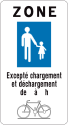 Start of a zone for pedestrians.
English • Traffic sign F103 • Beginning of a pedestrian zone. This sign is placed on the right at every entrance to a pedestrian zone; it may be repeated on the left.
Français • Signal routier F103 • Commencement d'une zone piétonne. Ce signal est placé à droite, à chaque accès d'une zone piétonne; il peut être répété à gauche.
Nederlands • Verkeersbord F103 • Begin van een voetgangerszone. Dit verkeersbord wordt rechts geplaatst aan elke toegang tot een voetgangerszone; het mag links herhaald worden.
Sources
Image via Commons.wikimedia.org
Vascer • Public domain • Source revision 2010-08-01. Wikimedia original unmodified.
🔗 Wegcode.be • Artikel 71. Aanwijzingsborden (NL)
🔗 Codedelaroute.be • Article 71. Signaux d'indication (FR)
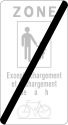 End of the zone for pedestrians.
English • Traffic sign F105 • End of a pedestrian zone. This sign is placed on the right at every exit from a pedestrian zone; it may be repeated on the left.
Français • Signal routier F105 • Fin d'une zone piétonne. Ce signal est placé à droite, à chaque sortie d'une zone piétonne; il peut être répété à gauche.
Nederlands • Verkeersbord F105 • Einde van een voetgangerszone. Dit verkeersbord wordt rechts geplaatst aan elke uitgang van een voetgangerszone; het mag links herhaald worden.
Sources
SVG source: Commons.wikimedia.org
Vascer • Public domain. Original SVG unmodified.
🔗 Wegcode.be • Artikel 71. Aanwijzingsborden (NL)
🔗 Codedelaroute.be • Article 71. Signaux d'indication (FR)
What changes for pedestrian zones under Belgium’s new Road Code?
From 1 June 2027, the new federal Code uses R14 and R15 for the beginning and end of a pedestrian zone. Existing F103 and F105 signs retain the corresponding meaning under the transition rules until 1 January 2045. The federal rule admits cyclists, other cycle users and speed pedelec riders unless signs prohibit them. They must give priority to pedestrians and people playing and stop when necessary. Check the applicable regional rules for speed and any additional access conditions.
🔗 wegcode.be • Code of the Public Road (from 1 June 2027), Provisions applicable from 1 June 2027
🔗 wegcode.be • Vias/Wegcode,2027 federal and regional transition overview
Which vehicles are automatically permitted?
Permitted categories include vehicles used to supervise, inspect, maintain or clean the zone, authorised priority vehicles when required by their mission and vehicles operating regular public-transport services.
🔗 codex.vlaanderen.be • Belgian Road Code — articles 22sexies and 71.2 (F103/F105)
🔗 wegcode.be • Belgian Road Code of 1 December 1975 — 22sexies and 71.2 (F103/F105)
Must authorised drivers give way to pedestrians?
Authorised drivers must leave pedestrians free passage, stop when necessary and must not endanger or hinder them.
🔗 codex.vlaanderen.be • Belgian Road Code — articles 22sexies and 71.2 (F103/F105)
🔗 wegcode.be • Belgian Road Code of 1 December 1975 — 22sexies and 71.2 (F103/F105)
May an authorised vehicle stop to load or unload?
Authorised loading or unloading may take place under the conditions shown on the entrance sign. The vehicle may not remain longer than necessary or turn the stop into prohibited parking.
🔗 codex.vlaanderen.be • Belgian Road Code — articles 22sexies and 71.2 (F103/F105)
🔗 wegcode.be • Belgian Road Code of 1 December 1975 — 22sexies and 71.2 (F103/F105)
How do Belgians refer to a pedestrian zone?
The official Dutch term is voetgangerszone. The French term is zone piétonne. The zone begins and ends at the corresponding pedestrian-zone signs.
🔗 codex.vlaanderen.be • Belgian Road Code — articles 22sexies and 71.2 (F103/F105)
🔗 wegcode.be • Belgian Road Code of 1 December 1975 — 22sexies and 71.2 (F103/F105)


