

MotorwayFlanders
 Traffic rules
 Flanders
2. Motorway
A motorway is a road specially designed and signposted for motor traffic. Motorways normally have separate carriageways for opposing traffic, controlled access through designated entrances and exits, no direct access to neighbouring properties, and no level crossings with other roads, railways or paths.
Special traffic rules apply on motorways. The permitted road users, speed limits, lane rules, tolls and emergency procedures vary between countries, so drivers must follow the local traffic signs and regulations.
How can you recognise a motorway in Belgium?
A motorway begins at the motorway sign showing two carriageways and a bridge. Its special traffic rules apply until the corresponding end-of-motorway sign.
🔗 codex.vlaanderen.be • Belgian Road Code — articles 2.3, 9.8, 10, 11, 21, 51 and 71 (F5/F7)
🔗 wegcode.be • Belgian Road Code of 1 December 1975 — 2.3, 9.8, 10, 11, 21, 51 and 71 (F5/F7)
 Start of a motorway.
English • Traffic sign F5 • Beginning of a motorway or access to a motorway. The special motorway traffic rules apply from the location of the sign.
Français • Signal routier F5 • Commencement d'une autoroute ou accès à une autoroute. Les règles spéciales de circulation sur les autoroutes s'appliquent à partir de l'endroit où le signal est placé.
Nederlands • Verkeersbord F5 • Begin of oprit van een autosnelweg. De bijzondere verkeersregelen op de autosnelwegen gelden vanaf de plaats waar het verkeersbord aangebracht is. Dit verkeersbord wordt rechts geplaatst en mag links herhaald worden.
Sources
SVG source: Commons.wikimedia.org
Vascer • Public domain. Original SVG unmodified.
🔗 Wegcode.be • Artikel 71. Aanwijzingsborden (NL)
🔗 Codedelaroute.be • Article 71. Signaux d'indication (FR)
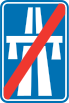 End of the motorway.
English • Traffic sign F7 • End of motorway. This sign is placed on the right and may be repeated on the left.
Français • Signal routier F7 • Fin d'autoroute. Ce signal est placé à droite et peut être répété à gauche.
Nederlands • Verkeersbord F7 • Einde van een autosnelweg. Dit verkeersbord wordt rechts geplaatst en mag links herhaald worden.
Sources
SVG source: Commons.wikimedia.org
Vascer • Public domain. Original SVG unmodified.
🔗 Wegcode.be • Artikel 71. Aanwijzingsborden (NL)
🔗 Codedelaroute.be • Article 71. Signaux d'indication (FR)
What is the speed limit on Belgian motorways?
The general maximum speed is 120 km/h unless traffic signs impose a lower limit. Vehicles and combinations with a maximum authorised mass exceeding 3.5 tonnes and buses are generally limited to 90 km/h. Coaches that meet the applicable seat-belt and speed-limiter requirements may travel at up to 100 km/h.
🔗 codex.vlaanderen.be • Belgian Road Code — articles 2.3, 9.8, 10, 11, 21, 51 and 71 (F5/F7)
🔗 wegcode.be • Belgian Road Code of 1 December 1975 — 2.3, 9.8, 10, 11, 21, 51 and 71 (F5/F7)
Is there a minimum speed on Belgian motorways?
Drivers must normally travel at no less than 70 km/h unless a lower speed is imposed or traffic, weather, visibility, road conditions or another safety reason requires them to slow down. Vehicles and combinations that cannot reach 70 km/h on a level road are not permitted on the motorway.
🔗 codex.vlaanderen.be • Belgian Road Code — articles 2.3, 9.8, 10, 11, 21, 51 and 71 (F5/F7)
🔗 wegcode.be • Belgian Road Code of 1 December 1975 — 2.3, 9.8, 10, 11, 21, 51 and 71 (F5/F7)
Who may not use a Belgian motorway?
Belgian motorways may not be used by pedestrians, cyclists, moped riders, riders or drivers of animals, agricultural vehicles, motorised quadricycles without a passenger compartment and certain other slow or restricted vehicles. Vehicles and combinations unable to reach 70 km/h on a level road are also prohibited.
🔗 codex.vlaanderen.be • Belgian Road Code — articles 2.3, 9.8, 10, 11, 21, 51 and 71 (F5/F7)
🔗 wegcode.be • Belgian Road Code of 1 December 1975 — 2.3, 9.8, 10, 11, 21, 51 and 71 (F5/F7)
How do you form an emergency corridor in Belgium?
When congestion develops on a carriageway with two or more marked lanes, form an emergency corridor between the leftmost lane and the lane immediately to its right. Drivers in the leftmost lane move as far left as possible; drivers in the other lanes move right.
🔗 codex.vlaanderen.be • Belgian Road Code — articles 2.3, 9.8, 10, 11, 21, 51 and 71 (F5/F7)
🔗 wegcode.be • Belgian Road Code of 1 December 1975 — 2.3, 9.8, 10, 11, 21, 51 and 71 (F5/F7)
What should you do after a breakdown on a Belgian motorway?
Move the vehicle away from the traffic lanes when this can be done safely and take the necessary measures to protect other road users. If the vehicle cannot be moved and is stopped where stopping or parking is prohibited, place the warning triangle at least 100 metres behind the vehicle. The driver must wear a retro-reflective safety vest when leaving a broken-down vehicle stopped at such a location.
🔗 codex.vlaanderen.be • Belgian Road Code — articles 2.3, 9.8, 10, 11, 21, 51 and 71 (F5/F7)
🔗 wegcode.be • Belgian Road Code of 1 December 1975 — 2.3, 9.8, 10, 11, 21, 51 and 71 (F5/F7)
How do Belgians refer to a motorway?
The official Dutch term is autosnelweg. The French term is autoroute. These terms identify the road category designated by motorway entrance and end signs.
🔗 codex.vlaanderen.be • Belgian Road Code — articles 2.3, 9.8, 10, 11, 21, 51 and 71 (F5/F7)
🔗 wegcode.be • Belgian Road Code of 1 December 1975 — 2.3, 9.8, 10, 11, 21, 51 and 71 (F5/F7)


