

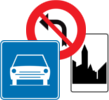
Speed bumpFlanders
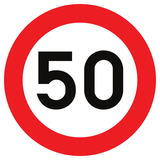 Traffic rules
 Flanders
11. Speed bump
A speed bump is a raised traffic-calming device placed across all or part of a road to make drivers reduce their speed. It is commonly used near homes, schools, crossings, parking areas and other places where low vehicle speeds are important.
Speed bumps vary in shape, height and legal status. Drivers should approach them at a low, controlled speed and follow any warning signs or speed limits that apply.
Wikimedia.org • Jeanhousen • CC BY-SA
How can you recognise a regulated raised device?
It may be announced by warning sign A14 and indicated at its location by sign F87. At an intersection, it may be announced using A14 alone. Raised devices inside a Zone 30 are also covered by the special rules.
 Warning for a speed bump.
Signal routier A14 • Dispositif(s) surélevé(s).
Verkeersbord A14 • Verhoogde inrichting(en).
 Speed bump.
Signal routier F87 • Dispositif(s) surélevé(s).
Verkeersbord F87 • Verhoogde inrichting(en).
What changes for speed bumps under Belgium’s new Road Code?
Belgium’s new Code of the Public Road takes effect on 1 June 2027. Unlike many other Belgian traffic signs, the signs relating to speed bumps keep their existing numbers: traffic sign A14 warns of a raised traffic-calming device, while traffic sign F87 indicates the raised device itself. The new Road Code defines a raised device as an installation placed across the public road to reduce traffic speed. Overtaking and stopping on the carriageway are prohibited on such raised devices.
 Warning for a speed bump.
Signal routier A14 • Dispositif surélevé.
Verkeersbord A14 • Verhoogde inrichting.
 Speed bump.
Signal routier F87 • Dispositif surélevé.
Verkeersbord F87 • Verhoogde inrichting.
What is a speed bump legally called in Belgium?
A Belgian speed bump is a type of raised traffic-calming device, legally described as a raised construction placed across the public road to reduce speed.
Which regulated raised devices exist in Belgium?
Belgian regulations distinguish between a speed bump, which has a rounded sinusoidal profile, and a speed table, which has one or more ramps leading to a flat raised section.
What does Belgian traffic sign A14 mean?
Traffic sign A14 warns drivers that one or more raised traffic-calming devices are ahead.
What does Belgian traffic sign F87 mean?
Traffic sign F87 indicates the location of one or more raised traffic-calming devices.
What is the maximum speed over a Belgian speed bump?
Drivers must approach the regulated raised device with extra caution and moderate speed and must cross it at no more than 30 km/h.
Must you always drive at exactly 30 km/h?
No. Thirty kilometres per hour is the maximum. Drivers must cross more slowly when required by the shape of the device, the vehicle, weather, visibility, pedestrians or other traffic conditions.
When does the Belgian 30 km/h rule apply?
It applies to regulated raised devices announced by A14 and F87, devices at intersections announced by A14, and raised devices situated within a Zone 30 marked by F4a and F4b.
Does the 30 km/h limit continue after the speed bump?
Not by itself. The special 30 km/h limit applies while crossing the raised device. After it, the previous road limit resumes unless a C43 sign, Zone 30 or another rule continues to impose 30 km/h.
Is every raised object legally a 30 km/h speed bump?
No. The special rules apply to raised devices covered by the Belgian legal definition, signposting and technical requirements. Drivers must nevertheless approach every visible obstruction at a safe and adapted speed.
What is the difference between a speed bump and a speed table?
A regulated Belgian speed bump is a local rounded elevation with a sinusoidal profile. A speed table has a longer flat raised section with sloping approaches and may extend across an intersection or crossing area.
How large is a regulated Belgian speed bump?
The standard regulated speed bump has a length of 4.80 metres and a maximum height of 12 centimetres, subject to the technical tolerances and provisions for older installations.
Is a Belgian speed cushion the same as a regulated speed bump?
No. A speed cushion does not extend across the full width of the traffic lane. It is not automatically a regulated 30 km/h raised device, although it may be used within a road or zone where another speed limit applies.
May you overtake on a Belgian raised device?
The left-side overtaking of a team, a two-wheeled motor vehicle or a vehicle with more than two wheels is prohibited on a raised device. All other passing manoeuvres remain subject to the ordinary safety and overtaking rules.
May you stop or park on a Belgian raised device?
No. Stopping and parking on a raised device are prohibited unless a local regulation expressly provides otherwise.
Does a Belgian speed bump give pedestrians priority?
No. The raised device alone does not create pedestrian priority. Pedestrians have priority when a pedestrian crossing, traffic signal or another applicable rule gives it to them.
Does a raised intersection change the priority rules?
No. Drivers must continue to follow the applicable priority signs, traffic signals and priority-from-the-right rules. The raised construction itself does not determine priority.
How should you cross a Belgian speed bump safely?
Reduce speed before the device, keep the vehicle under control and cross it smoothly. Avoid harsh braking, sudden acceleration or swerving onto another part of the road.


