

Dead endFlanders
 Traffic rules
 Flanders
17. Dead end
A dead-end road is a road that does not provide a through route for some or all vehicles. It may end completely, terminate at a barrier or continue as a path that only certain road users may use.
Drivers may normally enter a dead-end road to reach homes, businesses, parking places or other destinations, but they must be prepared to turn around or leave by the same route. Signs may indicate that pedestrians or cyclists can continue beyond the point where motor traffic cannot.

Wikimedia.org • Jean Housen • CC BY-SA
Which Belgian traffic signs indicate a dead-end road?
Traffic sign F45 indicates a dead-end road with no through route, meaning drivers entering it must normally leave again by the same route. Traffic sign F45b indicates a dead-end road for motor traffic where pedestrians and cyclists can continue.
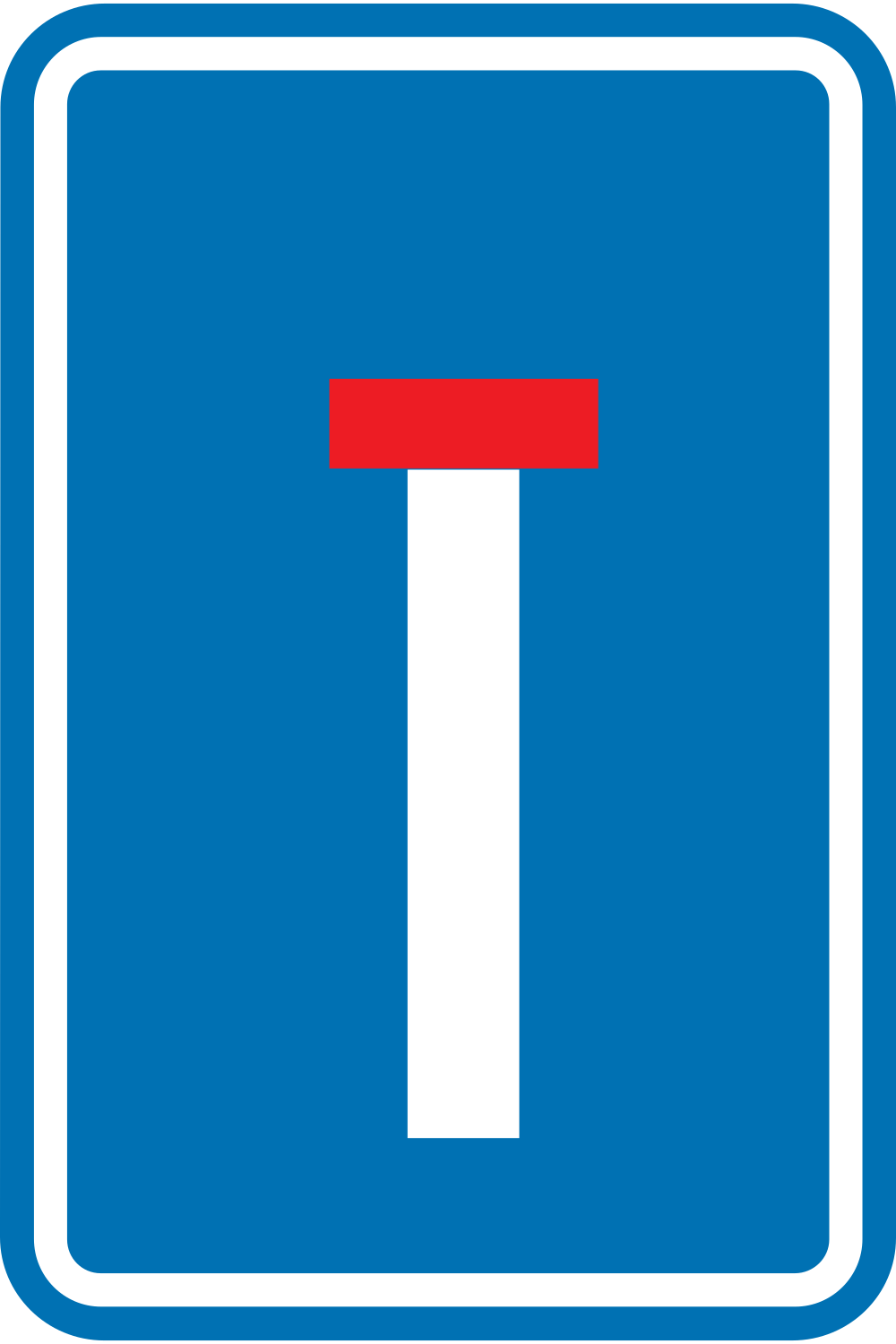 Dead end street.
Signal routier F45 • Voie sans issue.
Verkeersbord F45 • Doodlopende weg.
 Dead end street with a passage for pedestrians and cyclists.
Signal routier F45b • Voie sans issue, excepté pour les piétons et les cyclistes.
Verkeersbord F45b • Doodlopende weg, uitgezonderd voor voetgangers en fietsers.
What changes for dead-end roads under Belgium’s new Road Code?
Belgium’s new Code of the Public Road takes effect on 1 June 2027. The current traffic sign F45 for a dead-end road becomes traffic sign F45a. Traffic sign F45b continues to indicate a dead-end road where pedestrians and cyclists can continue. For both signs, the road-layout symbol may be adapted to the local situation.
 Dead end street.
Signal routier F45a • Voie sans issue. Le symbole peut être adapté en fonction des lieux.
Verkeersbord F45a • Doodlopende weg. Het symbool kan aangepast zijn in functie van de plaatsgesteldheid.
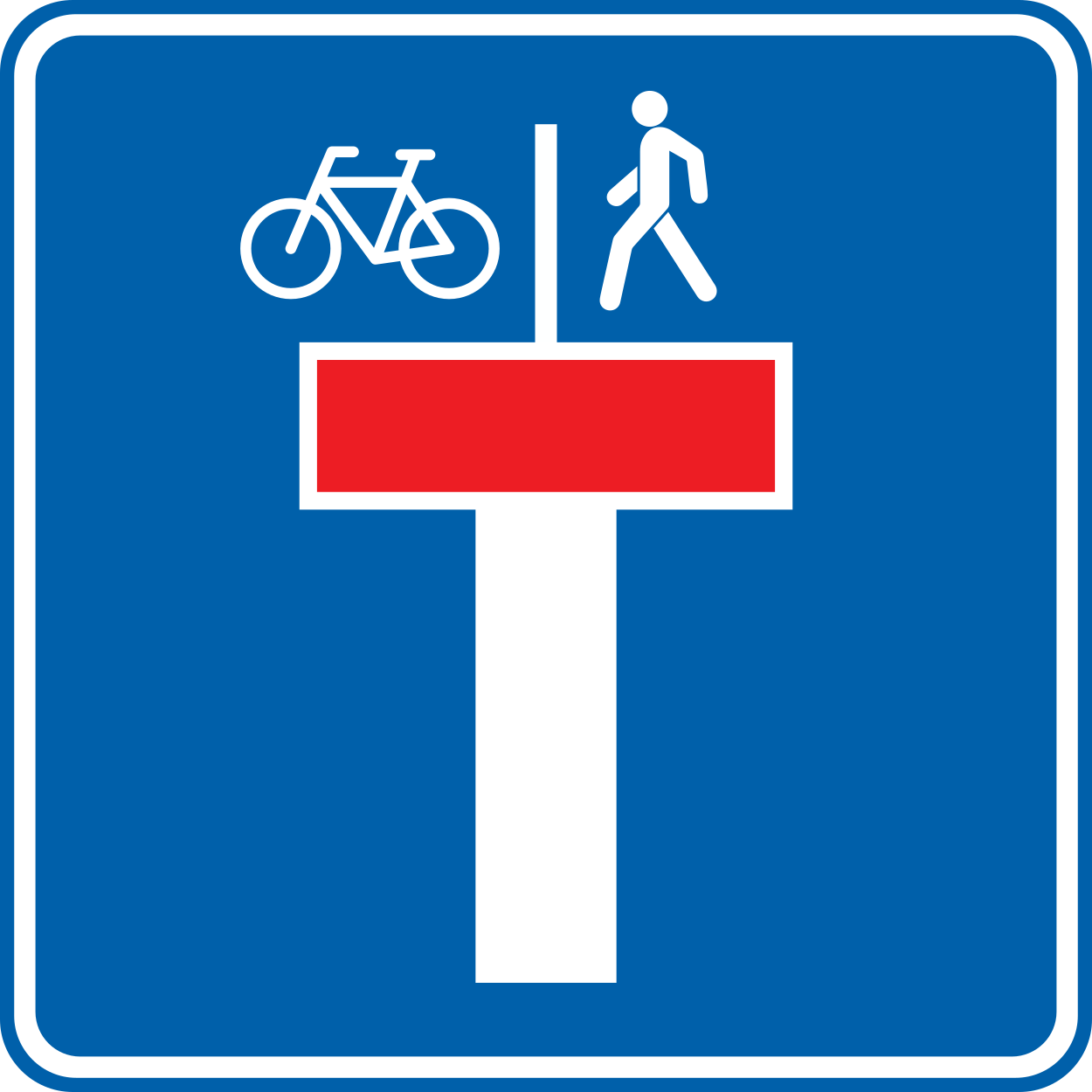 Dead end street with a passage for pedestrians and cyclists.
Signal routier F45b • Voie sans issue, à l’exception des cyclistes et des piétons. Le symbole peut être adapté en fonction des lieux.
Verkeersbord F45b • Doodlopende weg, uitgezonderd voor fietsers en voetgangers. Het symbool kan aangepast zijn in functie van de plaatsgesteldheid.
Does F45 prohibit drivers from entering?
No. F45 is an indication sign, not an access prohibition. Drivers may enter to reach a home, business, parking place or another destination unless an additional sign restricts access.
Can motor vehicles continue beyond an F45b sign?
No through route is available for motor traffic. Motor vehicles may enter the road but must turn around before the point where their passage ends.
May cyclists ride through an F45b dead end?
F45b indicates that a through connection exists for cyclists. Cyclists must still follow the signs and rules applying to the path or road beyond the dead end and may need to dismount where cycling is not permitted.
May pedestrians continue through an F45b dead end?
Yes. The sign specifically indicates that pedestrians can continue beyond the point where motor traffic cannot.
Does F45b permit mopeds or other motor vehicles to continue?
Not by itself. F45b identifies an exception for pedestrians and cyclists. Other vehicle categories require a separate legal permission or traffic sign.
Does F45 indicate whether pedestrians or cyclists can continue?
No. The ordinary F45 sign does not indicate a through connection for pedestrians or cyclists. Road users should observe the actual layout and any additional signs.
Does a Belgian dead-end sign impose a speed limit?
No. The applicable regional, zonal or posted speed limit remains in force. Drivers must still adjust their speed to the road width, visibility and presence of pedestrians or cyclists.
Does a dead-end road automatically have lower priority?
No. Its dead-end status does not determine priority. Drivers must follow priority signs, traffic lights and the ordinary priority rules.
Does a driver leaving a Belgian dead-end road always have to give way?
Not merely because the road is a dead end. The applicable priority depends on traffic signs, the type of road and the normal Belgian priority rules.
May you turn around in a Belgian dead-end road?
Yes, where it is not prohibited and can be done safely. Turning around is a manoeuvre, so the driver must give way to all other road users.
May you reverse in a Belgian dead-end road?
Yes, when necessary and safe. Reversing is a manoeuvre, so the driver must give way to every other road user and must not create danger or unnecessary obstruction.
Must you use the indicators while turning around?
The driver must indicate the intended movement in time when the manoeuvre involves a lateral movement or change of direction and the vehicle is equipped with direction indicators.
May you park in a Belgian dead-end road?
The F45 or F45b sign does not create a general parking prohibition. Drivers must follow the ordinary stopping and parking rules and any local signs or markings.
May you park in the turning area?
Only when parking is permitted and the vehicle does not create danger or unnecessary obstruction. Drivers should leave enough room for other vehicles, refuse trucks and emergency services to turn.
May you block the pedestrian or cycling connection?
No. A parked or stationary vehicle must not obstruct the lawful passage of pedestrians or cyclists or force them into an unsafe position.
What should large-vehicle drivers consider?
A Belgian dead-end road may have limited turning space. Drivers of trucks, buses, caravans or trailers should confirm that they can turn safely before entering.


