

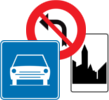
Delivery vehicleFlanders
 Traffic rules
 Flanders
89. Delivery vehicle
A delivery vehicle is a vehicle used to transport and deliver goods, parcels, supplies or other items to homes, businesses or other destinations. Delivery vehicles can include vans, trucks, cars, motorcycles, cargo bicycles and other vehicles depending on the type and quantity of goods being transported.
Delivery vehicles must follow the ordinary traffic rules applying to their vehicle category as well as any specific rules concerning loading and unloading, restricted-access areas, parking, vehicle dimensions and low-emission zones. Permission to make a delivery does not automatically allow a vehicle to stop or park anywhere.

Wikimedia.org • 28704869 • CC BY
What is a delivery vehicle in Belgium?
A delivery vehicle is a vehicle being used to transport or deliver goods. It does not form one separate vehicle category: the normal rules applying to the vehicle itself, such as those for a car, light goods vehicle or truck, continue to apply.
Does loading or unloading count as parking in Belgium?
No, when the vehicle remains stationary only for the time necessary to load or unload goods. In that situation it is legally considered stopped. Remaining longer than necessary is considered parking.
Can you load or unload where an E1 no-parking sign applies?
Yes, provided stopping itself is permitted. E1 prohibits parking, while genuine loading or unloading for only the necessary time is legally considered stopping rather than parking.
Can you load or unload where an E3 sign applies?
No. E3 prohibits both stopping and parking, so a delivery vehicle may not stop there merely to load or unload goods.
How is a loading and unloading place indicated in Belgium?
An E9 parking sign can be supplemented with the loading-and-unloading symbol to indicate that the place is reserved for loading and unloading goods.
Can you wait for a customer in a Belgian loading zone?
If no goods are actually being loaded or unloaded and the vehicle remains stationary longer than necessary for that activity, it is considered parked rather than stopped. The loading space should therefore not be used simply as a waiting place.
Are delivery vehicles considered local traffic in Belgium?
Yes. The Belgian definition of local traffic or local access expressly includes delivery vehicles, together with residents, their visitors and several other specified categories.
Can a delivery vehicle pass a C3 sign marked 'Except local traffic'?
Yes, when the delivery falls within the Belgian definition of local traffic. The driver must nevertheless comply with any additional restrictions or conditions applying to the road.
Can delivery vehicles enter a Belgian pedestrian zone?
Yes, when the signs specifically permit vehicles that need to load or unload and subject to the restrictions shown. Other specific access possibilities also exist in limited circumstances for businesses located within the zone.
How fast may a delivery vehicle travel in a Belgian pedestrian zone?
A delivery vehicle legally admitted to a pedestrian zone must travel at walking speed, leave pedestrians free passage and stop when necessary. It may not endanger or hinder pedestrians.
Can a delivery vehicle park inside a Belgian pedestrian zone?
No. Even when a vehicle is authorised to enter a pedestrian zone for loading or unloading, parking is prohibited there.
Can a delivery vehicle stop on a Belgian cycle path to make a delivery?
No. Stopping and parking on a cycle path are prohibited. A delivery does not provide an exemption from this rule.
Do delivery vans have to comply with the Brussels Low Emission Zone?
Yes. Delivery vans are subject to the Brussels LEZ when they fall within the vehicle categories covered by its rules. Since 1 January 2026, Euro 5 diesel vans no longer meet the normal access criteria, meaning affected diesel vans generally need at least Euro 6 unless a valid exemption or day pass applies.


