Frontera internacionalBruselas

Aprende normas de tráfico con explicaciones claras y ejemplos visuales en nuestro libro ilustrado, diseñado para que estudiar sea sencillo y ameno.


48. Frontera internacional

Una frontera internacional es el límite legal entre dos países. Una señal fronteriza puede identificar el país al que se entra y recordar a los conductores que pueden aplicarse normas de tráfico, límites de velocidad, señales, requisitos del vehículo y normas documentales diferentes.

La propia señal de frontera normalmente no obliga a detenerse. Los controles de pasaporte, inmigración o aduanas pueden realizarse en un puesto fronterizo, pero algunas fronteras internacionales pueden cruzarse sin controles rutinarios en virtud de acuerdos regionales.
Frontera internacional
Which countries share a land border with Belgium?

Belgium shares land borders with France, Luxembourg, Germany and the Netherlands.

Are Belgium’s land borders inside the Schengen area?

Yes. Belgium and all four neighbouring countries participate in the Schengen area.

Are there normally passport checkpoints at Belgium’s land borders?

No. Routine checks on people are normally absent at internal Schengen borders.

Can temporary border checks still occur?

Yes. A Schengen country may temporarily reintroduce internal border controls under the conditions established by the Schengen rules.

Should travellers still carry an identity document?

Yes. Travellers should carry the valid passport or identity card required for their nationality and journey, particularly because police checks or temporary border controls may occur.

Are Belgium and its neighbouring countries in the EU customs union?

Yes. Goods normally move between them without internal customs duties or routine customs formalities.

Can Belgian customs still conduct checks near an internal border?

Yes. Customs and police may still check excise goods, commercial transport, restricted products, fraud and other legal requirements.

Is Schengen the same as the EU customs union?

No. Schengen concerns controls on people crossing borders. The customs union concerns goods, tariffs and customs procedures.

Does Belgium currently have an official numbered border sign?

Under the Highway Code in force before 1 June 2027, there is no numbered national traffic sign specifically identifying entry into Belgium. Border-identification boards may nevertheless already be used in practice.

Which Belgian border sign takes effect on 1 June 2027?

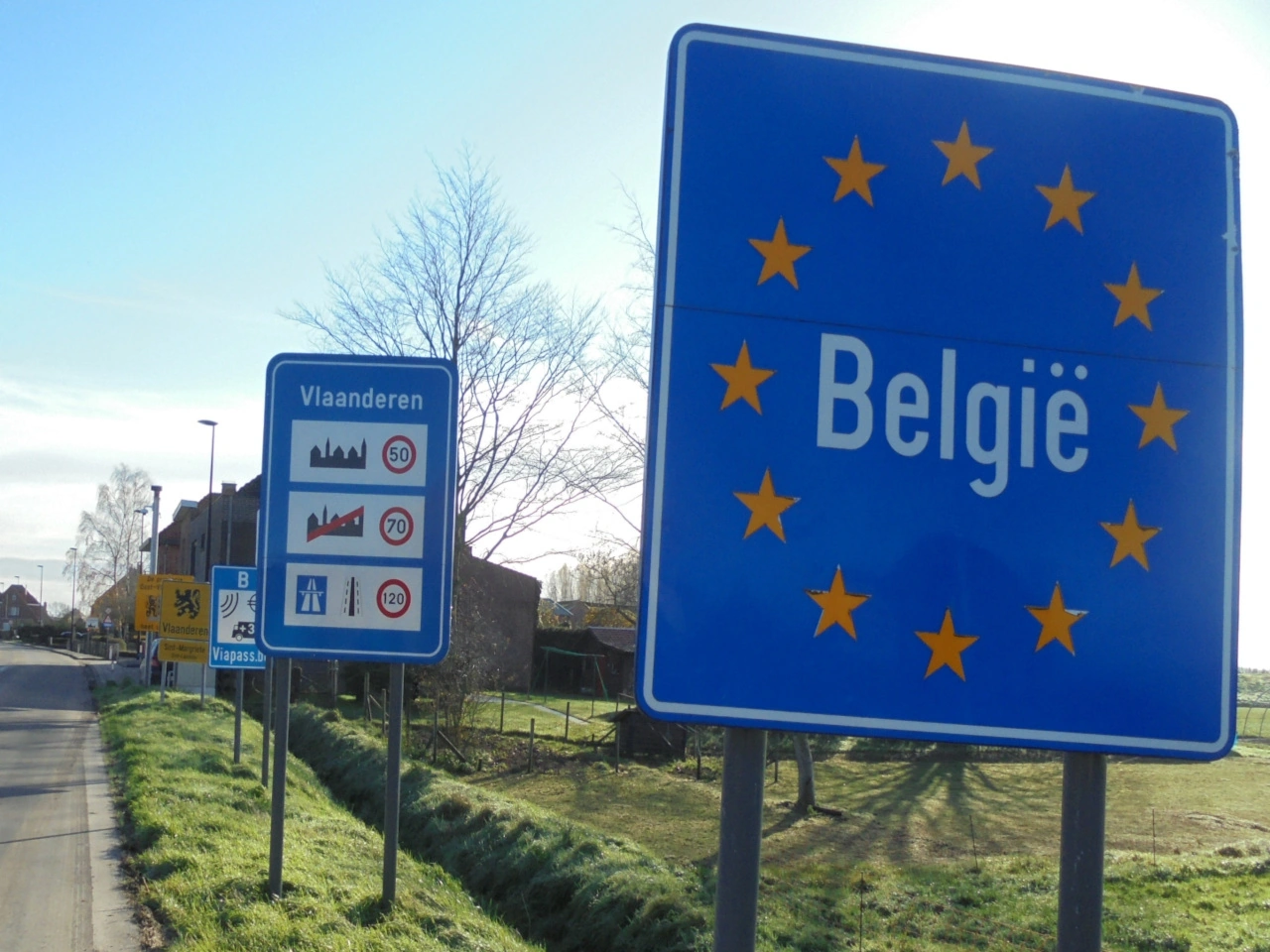
The new Code of the Public Road introduces traffic sign F100 to indicate the border and entry into Belgium.

How can you recognise Belgian sign F100?

F100 is a blue rectangular indication sign displaying the name of Belgium surrounded by the yellow stars associated with Europe.

Does F100 require drivers to stop?

No. It is an indication sign identifying entry into Belgium. A separate signal, barrier or officer must require a stop.

Does F100 function as a customs sign?

No. It identifies the national border and does not itself introduce a customs declaration or inspection requirement.

Does F100 function as passport control?

No. The sign identifies the country. Any passport or identity check is conducted separately by the competent authorities.

When do Belgian traffic rules begin to apply?

Belgian traffic law applies from the moment a road user crosses into Belgian territory, whether or not F100 or a control point is present.

Does the F100 sign impose a Belgian speed limit?

No. The applicable Belgian regional, road-category, zonal, posted and vehicle-specific speed rules apply independently of F100.

Do general speed limits differ within Belgium?

Yes. Some general limits differ between the Brussels-Capital, Flemish and Walloon Regions. Drivers must therefore check the region and all applicable signs.

Does crossing into Belgium change the driving side?

No. Belgium and all its neighbouring countries use right-hand traffic.

Which vehicle documents should a driver carry in Belgium?

A driver should carry the required driving licence, vehicle-registration documents and legally required insurance evidence, together with the travel documents required for the journey.

Does a foreign driving licence automatically remain valid in Belgium?

This depends on the issuing country, licence type, validity, residence status and applicable recognition rules. EU and EEA licences are generally recognised while valid.

Can Belgium require specific vehicle equipment?

Yes. Belgian requirements concerning items such as the warning triangle and retro-reflective safety vest apply independently of the rules in the country from which the vehicle arrived.

Must foreign vehicles obey Belgian low-emission zones?

Yes. Foreign registration does not automatically exempt a vehicle from applicable low-emission-zone access and registration requirements.

Can road toll or charging rules change after entering Belgium?

Yes. Drivers of certain vehicles may be subject to Belgian road-charging, low-emission or local access systems even when no payment was required in the neighbouring country.

May police or customs officers stop a vehicle after it crosses an open border?

Yes. The absence of a permanent checkpoint does not prevent lawful roadside police, customs or transport controls.

Must you obey temporary border signs and barriers?

Yes. Follow every temporary lane sign, traffic light, barrier and instruction from police or customs personnel.

Does an international border change priority?

No. The boundary itself does not determine priority. Drivers must follow the traffic lights, priority signs and Belgian priority rules applying to the road.

Does it change the road category?

Not automatically. The same physical road may continue across the border, but its legal classification and applicable rules may differ after entering Belgium.

Can pedestrians and cyclists cross Belgium’s internal land borders?

Generally, yes, where the road or path permits them. They must still respect all access restrictions, motorway prohibitions and temporary controls.

What should you do if a border crossing is closed?

Do not pass the closure. Follow the signed diversion or instructions from the authorities and use another authorised crossing.

Will F100 replace customs or country-information boards?

No. F100 identifies the border. Separate signs may still provide information about customs, traffic rules, environmental zones or other national requirements.

1 Bruselas 2 Autopista 3 Vía rápida 4 Zona residencial 5 Zona urbana 6 Zona 7 Límite de velocidad 8 Carril bici 9 Calle ciclista 10 Zona peatonal 11 Resalto 12 Aduana 13 Sentido único 14 Muelle 15 Pendiente 16 Carril bus 17 Calle sin salida 18 Señal de STOP 19 Ceda el paso 20 Glorieta 21 Vía con prioridad 22 Estrechamiento de calzada 23 Prioridad sobre el tráfico en sentido contrario 24 Ceda el paso al tráfico en sentido contrario 25 Paso de peatones 26 Paso a nivel 27 Dirección obligatoria 28 Prohibición de giro 29 Zona escolar 30 Cruce de animales 31 Desprendimiento de rocas 32 Curva 33 Panel direccional 34 Circulación en sentido contrario 35 Obras 36 Límite de altura 37 Límite de anchura 38 Límite de peso 39 Señal de control de velocidad 40 Barreras selectivas 41 Señal de dirección en intersección 42 Prioridad en la próxima intersección 43 Semáforos 44 Semáforos peatonales 45 Permiso de conducir 46 Marcador de ubicación 47 Espejo de tráfico 48 Frontera internacional 49 Ruta ciclista 50 Estacionamiento 51 Prohibido estacionar 52 Kiss and Ride 53 Parquímetro 54 Gestión del tráfico 55 Marcha atrás 56 Intersección sin regulación 57 Estado de la calzada 58 Circunvalación 59 Autopista ciclista 60 Matrícula 61 Estación de carga 62 Peligros 63 Giro con semáforo rojo 64 Documento de identidad 65 Riesgo de incendio 66 Peatón 67 Ciclomotor 68 Turismo 69 Camión 70 Autobús 71 Policía 72 Ambulancia 73 Semáforos para tranvías 74 Norma europea de emisiones 75 Bache 76 Plaza 77 Camino 78 Partículas 79 Contaminación del aire 80 Hora punta 81 Código de circulación 82 Canaleta de la calle 83 Bicicleta de carga 84 Vehículo forestal 85 Vehículo de construcción 86 Camión articulado 87 Trolebús 88 Speed pedelec 89 Vehículo de reparto 90 Motor al ralentí 91 Grúa 92 Tracción a las cuatro ruedas 93 Prohibido el paso de vehículos 94 Bicicleta 95 Equipamiento de motocicleta 96 Automotor ferroviario 97 Vía férrea 98 Transporte público 99 Caravana 100 Remolque ...