GlorietaBruselas
20. Glorieta
Una glorieta es una intersección en la que el tráfico circula alrededor de una isla central en una dirección establecida. Las entradas y salidas pueden tener uno o varios carriles y estar controladas por señales, marcas o semáforos.
Las normas de prioridad en las glorietas varían entre países y según la señalización. Los conductores deben colocarse correctamente, ceder el paso cuando sea obligatorio, señalizar según las normas locales y comprobar la presencia de ciclistas y peatones antes de salir.
What is legally considered a roundabout in Belgium?
A Belgian rotonde is a road where traffic travels in one direction around a constructed central island. It is indicated by traffic sign D5, and its entrances are controlled by signs B1 or B5.
Sentido obligatorio de la glorieta.
Signal routier D5 • Sens giratoire obligatoire.
Verkeersbord D5 • Verplicht rondgaand verkeer.
Ceda el paso.
Signal routier B1 • Céder la priorité.
Verkeersbord B1 • Voorrang verlenen.
Detenerse y ceder el paso.
Signal routier B5 • Marquer l’arrêt et céder la priorité.
Verkeersbord B5 • Stoppen en voorrang verlenen.
What changes for roundabouts under Belgium’s new Road Code?
Belgium’s new Code of the Public Road takes effect on 1 June 2027. Traffic sign D5 keeps its existing number and continues to indicate a roundabout with compulsory circulation in the direction shown by the arrows. The new Road Code sets out specific rules for lane use on roundabouts: on a roundabout with several lanes, drivers who are not taking the first exit may use a lane other than the right-hand lane. Drivers entering a roundabout must give way to traffic already on the roundabout, and direction indicators are required when leaving the roundabout, not when entering it.
Sentido obligatorio de la glorieta.
Signal routier D5 • Rond-point. Sens giratoire obligatoire dans le sens indiqué par les flèches.
Verkeersbord D5 • Rotonde. Verplicht rondgaand verkeer in de door de pijlen aangeduide richting.
Which Belgian sign indicates a roundabout?
Traffic sign D5 requires traffic to circulate around the central island in the direction shown by the arrows.
Which direction do vehicles travel on a Belgian roundabout?
Vehicles travel anticlockwise, keeping the central island on their left.
Who has priority on a Belgian roundabout?
Drivers already travelling on the roundabout have priority over drivers entering through an access road controlled by B1 or B5.
Must you stop before entering?
At sign B1, stop only when necessary to give way. At sign B5, you must always stop completely before giving way.
Does priority from the right apply on a Belgian roundabout?
No. A driver travelling on a legally signposted roundabout does not have to give way to a driver entering from the right.
Is every circular junction legally a roundabout?
No. A circular road arrangement without the required D5 and entry-priority signs may be governed by ordinary priority rules. Drivers must check the actual signs rather than rely only on the road’s shape.
Must you use an indicator when entering a Belgian roundabout?
No. Under the current Belgian Highway Code, entering a roundabout is considered a change of direction for which the indicators do not have to be used.
Must you use an indicator when leaving?
Yes. You must use the right direction indicator in time when leaving the roundabout and switch it off once the movement has been completed.
Does using the indicator give you priority?
No. Signalling only communicates your intention. You must still give way when changing lanes or crossing the path of another road user.
Must you keep as far right as possible on a Belgian roundabout?
No. On a roundabout, drivers do not have to remain as close as possible to the right-hand edge unless a part of the road is specifically reserved for them.
Which lane may you use?
When the roundabout has marked lanes, you must follow the lane markings and may use the lane that best suits your destination.
May you use the inner lane?
Yes. You may use an inner lane when the markings permit it. Before moving to an outer lane or leaving, you must check that the movement can be made safely.
Who has priority when you change lanes?
Changing lanes is a manoeuvre. You must give way to all road users already travelling in the lane you want to enter.
May you leave directly from an inner lane?
Only when the lane markings expressly guide that lane towards the exit. Otherwise, you must first move safely into the appropriate outer lane without cutting across another driver’s path.
What should you do if you are in the wrong lane?
Do not force your way across another lane. Continue around the roundabout and reposition safely before attempting to leave again.
What speed limit applies on a Belgian roundabout?
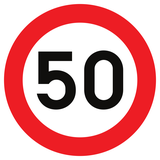
There is no special general speed limit solely because it is a roundabout. The applicable regional, zonal or posted limit remains in force, but drivers must reduce their speed sufficiently for the layout and traffic conditions.
Do cyclists on the roundabout have priority?
A cyclist travelling lawfully on the roundabout carriageway has priority over traffic entering through B1 or B5. Drivers must remain alert because cyclists may be less visible beside or ahead of a vehicle.
Who has priority on a bike path around the roundabout?
This depends on the signs, markings and design of the cycle route. A driver crossing a continuing bike path must give way to its lawful users. At a separate cycle crossing, cyclists may have to give way before entering when B1 signs or give-way markings apply to them.
Must drivers give way to cyclists when leaving?
Yes, when the driver crosses a bike path used lawfully by the cyclist. Drivers must also give way to road users continuing along another part of the same public road when changing direction.
Must cyclists signal when leaving?
Cyclists should, when possible, indicate their intention to leave by extending the right arm. They must keep both hands available when signalling would make control unsafe.
Must you give way to pedestrians when leaving?
A driver changing direction must give way to pedestrians crossing the road being entered. At a marked pedestrian crossing, drivers must also give way to pedestrians who are on it or about to enter it.
May you stop or park on a Belgian roundabout?
The D5 sign does not by itself create a separate parking prohibition. However, the ordinary stopping and parking rules remain applicable. Parking on a carriageway divided into traffic lanes is prohibited unless an authorised parking place is provided, and no vehicle may create danger or unnecessary obstruction.
May you reverse or make a U-turn?
No. You must follow the mandatory direction around the central island. If you miss an exit, continue around the roundabout rather than reversing or turning against traffic.

Normas de tráfico
Bruselas