Límite de velocidadBruselas

Aprende normas de tráfico con explicaciones claras y ejemplos visuales en nuestro libro ilustrado, diseñado para que estudiar sea sencillo y ameno.


7. Límite de velocidad

Un límite de velocidad es la velocidad máxima legal permitida en una carretera, carril o dentro de una zona designada. Puede estar establecido por la legislación general de tráfico o indicado mediante señales fijas, variables o temporales.

Un límite de velocidad es un máximo, no una velocidad objetivo. Los conductores deben circular más despacio cuando el tráfico, la visibilidad, el tiempo, el estado de la carretera, los usuarios vulnerables o el estado del vehículo hagan insegura la velocidad máxima permitida.

How is a speed limit indicated in Belgium?

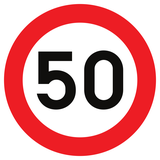
A local maximum speed is normally indicated by traffic sign C43, a circular sign displaying the permitted speed. It is prohibited to drive faster than the number shown. The end of a speed restriction imposed by sign C43 may be indicated by traffic sign C45.

Inicio de límite de velocidad. Inicio de límite de velocidad.

Signal routier C43 • A partir du signal jusqu'au prochain carrefour inclus, ou jusqu’à chaque signal C43 avec ou sans validité zonale, ou jusqu’au signal indiquant le début ou la fin d’une agglomération, d’une zone résidentielle, d’une zone de rencontre ou d’une zone piétonne, interdiction de circuler à une vitesse supérieure à celle qui est indiquée.

Verkeersbord C43 • Vanaf het verkeersbord tot en met het volgend kruispunt, of tot elk verkeersbord C43 met of zonder zonale geldigheid, of tot het verkeersbord dat het begin of het einde van een bebouwde kom, van een woonerf of erf, of van een voetgangerszone aanduidt, verbod te rijden met een grotere snelheid dan deze die is aangeduid.

Fin del límite de velocidad. Fin del límite de velocidad.

Signal routier C45 • Fin de la limitation de vitesse imposée par le signal C43.

Verkeersbord C45 • Einde van de snelheidsbeperking opgelegd door het verkeersbord C43.

Is a Belgian speed limit a target speed?

No. It is the maximum permitted speed. Drivers must adjust their speed to other road users, weather, visibility, traffic density, the condition of the road and the condition and load of the vehicle.

Must you sometimes drive below the speed limit?

Yes. A driver must always be able to stop before a foreseeable obstruction. Travelling at the displayed limit may therefore still be too fast in rain, fog, darkness, congestion or near vulnerable road users.

What are the general speed limits inside Belgian built-up areas?

The general limit is 30 km/h in the Brussels-Capital Region and 50 km/h in the Flemish and Walloon Regions. Traffic signs or special road rules may impose or permit another speed.

What is the general limit outside built-up areas in Flanders?

For cars and other vehicles with a maximum authorised mass not exceeding 3.5 tonnes, the general limit on ordinary roads is 70 km/h. A C43 sign may impose or permit another limit. Physically divided roads with at least two lanes in each direction may allow up to 120 km/h.

What is the general limit outside built-up areas in Wallonia?

For cars and other vehicles with a maximum authorised mass not exceeding 3.5 tonnes, the general limit on ordinary roads is 90 km/h. The limit is 70 km/h on a middle carriageway. Traffic signs and vehicle-specific rules may impose a lower limit.

What is the general limit outside built-up areas in Brussels?

On ordinary roads outside built-up areas, the general maximum speed is 70 km/h. Physically divided roads with at least two lanes in each direction may legally allow up to 120 km/h, although lower signed limits are widely used.

What is the maximum speed on Belgian motorways?

The general maximum for vehicles and combinations with a maximum authorised mass not exceeding 3.5 tonnes is 120 km/h. Lower signed, variable or vehicle-specific limits take precedence.

Do heavier vehicles have lower speed limits?

Yes. Vehicle-specific limits apply to buses, coaches, heavy vehicles and certain other vehicles. For example, vehicles and combinations exceeding 3.5 tonnes and buses are generally limited to 90 km/h on motorways.

Which limit applies when several speed rules apply?

Drivers must respect the lowest applicable maximum arising from the traffic sign, road type, vehicle category or special road regulation.

When does a Belgian C43 speed limit begin?

The restriction begins at the C43 sign. Drivers must therefore reduce their speed before passing the sign.

When does an ordinary C43 speed limit end?

An ordinary C43 limit applies until the next intersection, another C43 sign, a zonal speed sign, or a sign marking the beginning or end of a built-up area, woonerf, erf or pedestrian zone. It may also be ended by sign C45.

What does traffic sign C45 mean?

Traffic sign C45 indicates the end of the speed restriction imposed by a preceding C43 sign. The general or otherwise applicable speed limit then resumes.

What does traffic sign C46 mean?

Traffic sign C46 indicates the end of all local prohibitions applying to moving vehicles, including an applicable local speed restriction.

Does an intersection end a Belgian speed zone?

No. A zonal speed limit continues across intersections until the corresponding end-of-zone sign is passed.

Can a lower local limit apply inside a speed zone?

Yes. A C43 sign may impose a lower limit on a particular section. From the next intersection, the original zonal limit applies again without the zone sign being repeated.

Can a higher local limit apply inside a Belgian speed zone?

No. A C43 sign displaying a speed higher than the zonal speed may not be placed inside that speed zone.

What speed applies in a Belgian woonerf or erf?

The maximum speed is 20 km/h. Drivers must also avoid endangering or hindering pedestrians, who may use the entire public road.

What speed applies in a Belgian Zone 30?

The maximum speed is 30 km/h from the Zone 30 entrance sign until the corresponding end sign.

What speed applies in a Belgian cycling zone?

The maximum speed is 30 km/h. Motor vehicles may not overtake cyclists or speed-pedelec riders within the cycling zone.

What speed applies at a raised traffic-calming device?

Drivers must approach a legally designated raised device cautiously and cross it at no more than 30 km/h.

Can a speed-limit sign apply only to one lane?

Yes. When a regulatory sign is positioned above a lane, its instruction applies only to that lane or indicated part of the public road.

Can a speed limit apply only to certain vehicles?

Yes. A supplementary panel may limit a C43 restriction to vehicles exceeding a displayed maximum authorised mass or to another indicated category.

Are electronic speed-limit signs legally binding?

Yes. Regulatory signs displayed through variable-message or lane-control systems retain their legal meaning. Drivers must obey the active displayed limit.

May you exceed the speed limit while overtaking?

No. Belgian law does not provide a general exception allowing drivers to exceed the maximum speed while overtaking.

May you drive abnormally slowly?

Drivers may travel slowly for a valid safety or traffic reason, but they may not obstruct the normal movement of other drivers by travelling abnormally slowly without justification.

1 Bruselas 2 Autopista 3 Vía rápida 4 Zona residencial 5 Zona urbana 6 Zona 7 Límite de velocidad 8 Carril bici 9 Calle ciclista 10 Zona peatonal 11 Resalto 12 Aduana 13 Sentido único 14 Muelle 15 Pendiente 16 Carril bus 17 Calle sin salida 18 Señal de STOP 19 Ceda el paso 20 Glorieta 21 Vía con prioridad 22 Estrechamiento de calzada 23 Prioridad sobre el tráfico en sentido contrario 24 Ceda el paso al tráfico en sentido contrario 25 Paso de peatones 26 Paso a nivel 27 Dirección obligatoria 28 Prohibición de giro 29 Zona escolar 30 Cruce de animales 31 Desprendimiento de rocas 32 Curva 33 Panel direccional 34 Circulación en sentido contrario 35 Obras 36 Límite de altura 37 Límite de anchura 38 Límite de peso 39 Señal de control de velocidad 40 Barreras selectivas 41 Señal de dirección en intersección 42 Prioridad en la próxima intersección 43 Semáforos 44 Semáforos peatonales 45 Permiso de conducir 46 Marcador de ubicación 47 Espejo de tráfico 48 Frontera internacional 49 Ruta ciclista 50 Estacionamiento 51 Prohibido estacionar 52 Kiss and Ride 53 Parquímetro 54 Gestión del tráfico 55 Marcha atrás 56 Intersección sin regulación 57 Estado de la calzada 58 Circunvalación 59 Autopista ciclista 60 Matrícula 61 Estación de carga 62 Peligros 63 Giro con semáforo rojo 64 Documento de identidad 65 Riesgo de incendio 66 Peatón 67 Ciclomotor 68 Turismo 69 Camión 70 Autobús 71 Policía 72 Ambulancia 73 Semáforos para tranvías 74 Norma europea de emisiones 75 Bache 76 Plaza 77 Camino 78 Partículas 79 Contaminación del aire 80 Hora punta 81 Código de circulación 82 Canaleta de la calle 83 Bicicleta de carga 84 Vehículo forestal 85 Vehículo de construcción 86 Camión articulado 87 Trolebús 88 Speed pedelec 89 Vehículo de reparto 90 Motor al ralentí 91 Grúa 92 Tracción a las cuatro ruedas 93 Prohibido el paso de vehículos 94 Bicicleta 95 Equipamiento de motocicleta 96 Automotor ferroviario 97 Vía férrea 98 Transporte público 99 Caravana 100 Remolque ...