Prioridad en la próxima intersecciónBruselas

Aprende normas de tráfico con explicaciones claras y ejemplos visuales en nuestro libro ilustrado, diseñado para que estudiar sea sencillo y ameno.


42. Prioridad en la próxima intersección

Prioridad en la próxima intersección significa que los conductores que circulan por una determinada carretera tienen prioridad frente al tráfico que entra desde carreteras que la cruzan en la siguiente intersección. Esta disposición suele indicarse mediante señales orientadas tanto al tráfico prioritario como al que debe ceder el paso.

A diferencia de una vía con prioridad continuada, esta prioridad solo se aplica en la intersección indicada. Los conductores deben seguir aproximándose con precaución y respetar semáforos, agentes autorizados, cruces, normas de giro y otras señales aplicables.
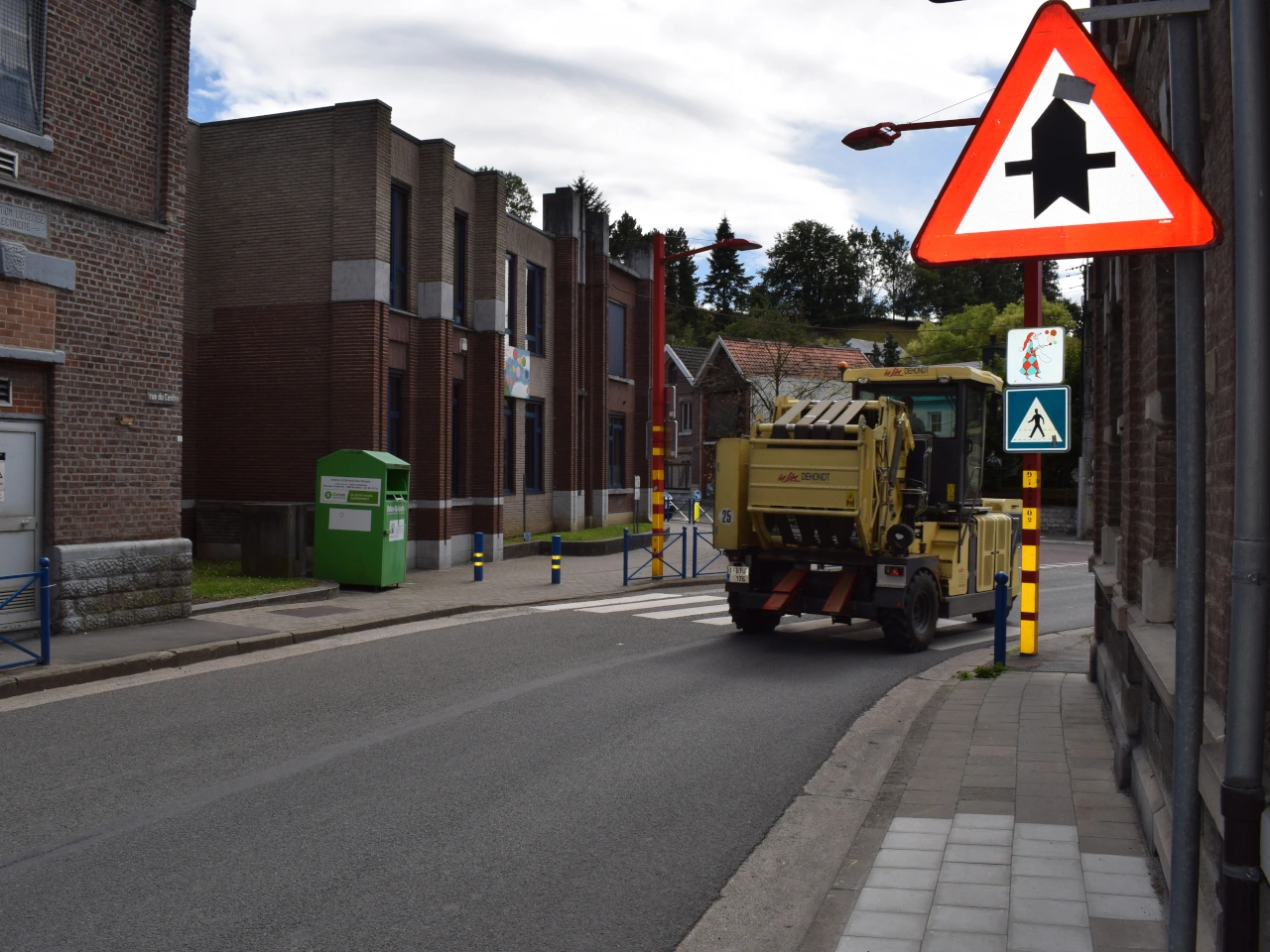
Prioridad en la próxima intersección
Which Belgian sign gives priority at the next junction?

Traffic sign B15 indicates that drivers have priority at the next junction.

Prioridad en la intersección. Prioridad en la intersección.

Signal routier B15 • Priorité de passage. La barre horizontale du symbole peut être modifiée de façon à représenter plus clairement la disposition des lieux.

Verkeersbord B15 • Voorrang. De horizontale streep van het symbool mag worden gewijzigd om duidelijker plaatsgesteldheid weer te geven.

Prioridad en la intersección. Prioridad en la intersección.

Signal routier B15 • Priorité de passage. La barre horizontale du symbole peut être modifiée de façon à représenter plus clairement la disposition des lieux.

Verkeersbord B15 • Voorrang. De horizontale streep van het symbool mag worden gewijzigd om duidelijker plaatsgesteldheid weer te geven.

Prioridad en la intersección. Prioridad en la intersección.

Signal routier B15 • Priorité de passage. La barre horizontale du symbole peut être modifiée de façon à représenter plus clairement la disposition des lieux.

Verkeersbord B15 • Voorrang. De horizontale streep van het symbool mag worden gewijzigd om duidelijker plaatsgesteldheid weer te geven.

What is the difference between B15 and B9?

B15 gives priority at one junction. B9 indicates a continuing priority road whose status remains in force until sign B11.

Is a road marked with B15 legally a priority road?

No. It has priority at the indicated junction but is not a continuing B9 priority road.

Can B9 and B15 be used along the same priority route?

Belgian placement rules distinguish the two systems. B9 is used for a continuing priority road, while B15 is used for priority at an individual junction.

How can you recognise Belgian sign B15?

B15 is a triangular priority sign showing a thick vertical line crossed by one or more thinner lines. The thick line represents the route with priority.

Can the B15 diagram be adapted to the junction?

Yes. The horizontal or side lines may be modified so that the symbol more clearly represents the actual road layout.

Does B15 always mean the priority route continues straight ahead?

No. A supplementary diagram may indicate that the route with priority turns left or right at the junction.

What signs do drivers on the side roads normally face?

Drivers who must give way normally face traffic sign B1 or B5.

What does B1 require?

B1 requires drivers to give way. They must stop only when necessary.

What does B5 require?

B5 requires drivers to stop completely and give way.

Must B15 be paired with B1 or B5?

Normally, yes. Belgian placement rules require B1 or B5 on the road followed by drivers who must give way, except where traffic from that road is prohibited in the relevant direction.

Where is B15 placed?

B15 is placed in the immediate vicinity of the junction where its drivers have priority.

Does B15 give priority at later junctions?

No. Its effect concerns the next junction only. Priority at a later junction must be established separately.

Does a junction end the effect of B15?

Yes. Once the indicated junction has been passed, the B15 priority arrangement has been completed.

Does priority from the right apply to side-road traffic?

No. Drivers facing B1 or B5 must give way to traffic on the B15 road, including traffic approaching from their left.

Does B15 give you priority over traffic from both sides?

Yes. Drivers entering from the controlled side roads must give way regardless of whether they approach from the left or right.

Does B15 give you priority over oncoming traffic when turning left?

No. A driver turning left must still give way to oncoming drivers travelling straight ahead or turning right, unless another traffic control provides otherwise.

Must you signal when the B15 priority route turns?

Yes, when your movement constitutes a change of direction. Signal in time even though you retain priority over traffic entering from the side roads.

Does using the indicator give you priority?

No. You must still complete the movement safely and respect oncoming traffic, pedestrians, cyclists and other road users with priority.

Does B15 give priority over pedestrians?

No. Drivers must still respect pedestrian crossings and give way to pedestrians crossing the road they enter when turning.

What if a bike path continues across a side road?

A driver crossing a continuing bike path must give way to its lawful users. B15 does not remove that duty.

Can a B15 panel warn of two-way cycle traffic?

Yes. A supplementary panel may indicate the route of the priority road or warn that cyclists and certain mopeds may approach in both directions.

Must cyclists obey B15?

Yes. Cyclists travelling on the road controlled by B15 benefit from its priority arrangement, subject to all other applicable cycle-path, crossing and turning rules.

Does B15 impose a speed limit?

No. The applicable regional, zonal, posted and vehicle-specific speed limits remain in force.

May you approach B15 at the maximum speed without slowing?

Only when that remains safe. Drivers must adapt their speed to visibility, traffic, road layout and foreseeable hazards and remain able to stop before an obstruction.

May you enter the junction when it is blocked?

No. Having priority does not allow a driver to enter when congestion would probably leave the vehicle stopped inside the junction.

Does B15 prohibit overtaking?

No. The ordinary overtaking rules, road markings and separate prohibition signs remain applicable.

Does B15 prohibit parking?

No. Unlike the specific rule for B9 roads outside built-up areas, B15 itself does not create a general parking prohibition.

Does B15 apply while traffic lights are operating?

No, when functioning traffic lights control the same road at that junction. Drivers must then follow the traffic signals.

What if the traffic light flashes orange-yellow?

An orange-yellow flashing light requires additional caution but does not change the priority arrangement. The B15 sign remains applicable.

What if an authorised person directs traffic?

Follow the authorised person’s instructions. These take precedence over traffic lights, signs, road markings and ordinary traffic rules.

What is the difference between B15 and B17?

B15 gives priority at the next junction. B17 warns that priority from the right applies at the next junction.

Why is B15 used?

Belgian placement rules allow B15 where retaining priority from the right would interfere with the safe or efficient flow of traffic because of traffic conditions or the road layout.

Will B15 remain under Belgium’s new road code?

Yes. From 1 June 2027, B15 retains the meaning priority at the next junction.

1 Bruselas 2 Autopista 3 Vía rápida 4 Zona residencial 5 Zona urbana 6 Zona 7 Límite de velocidad 8 Carril bici 9 Calle ciclista 10 Zona peatonal 11 Resalto 12 Aduana 13 Sentido único 14 Muelle 15 Pendiente 16 Carril bus 17 Calle sin salida 18 Señal de STOP 19 Ceda el paso 20 Glorieta 21 Vía con prioridad 22 Estrechamiento de calzada 23 Prioridad sobre el tráfico en sentido contrario 24 Ceda el paso al tráfico en sentido contrario 25 Paso de peatones 26 Paso a nivel 27 Dirección obligatoria 28 Prohibición de giro 29 Zona escolar 30 Cruce de animales 31 Desprendimiento de rocas 32 Curva 33 Panel direccional 34 Circulación en sentido contrario 35 Obras 36 Límite de altura 37 Límite de anchura 38 Límite de peso 39 Señal de control de velocidad 40 Barreras selectivas 41 Señal de dirección en intersección 42 Prioridad en la próxima intersección 43 Semáforos 44 Semáforos peatonales 45 Permiso de conducir 46 Marcador de ubicación 47 Espejo de tráfico 48 Frontera internacional 49 Ruta ciclista 50 Estacionamiento 51 Prohibido estacionar 52 Kiss and Ride 53 Parquímetro 54 Gestión del tráfico 55 Marcha atrás 56 Intersección sin regulación 57 Estado de la calzada 58 Circunvalación 59 Autopista ciclista 60 Matrícula 61 Estación de carga 62 Peligros 63 Giro con semáforo rojo 64 Documento de identidad 65 Riesgo de incendio 66 Peatón 67 Ciclomotor 68 Turismo 69 Camión 70 Autobús 71 Policía 72 Ambulancia 73 Semáforos para tranvías 74 Norma europea de emisiones 75 Bache 76 Plaza 77 Camino 78 Partículas 79 Contaminación del aire 80 Hora punta 81 Código de circulación 82 Canaleta de la calle 83 Bicicleta de carga 84 Vehículo forestal 85 Vehículo de construcción 86 Camión articulado 87 Trolebús 88 Speed pedelec 89 Vehículo de reparto 90 Motor al ralentí 91 Grúa 92 Tracción a las cuatro ruedas 93 Prohibido el paso de vehículos 94 Bicicleta 95 Equipamiento de motocicleta 96 Automotor ferroviario 97 Vía férrea 98 Transporte público 99 Caravana 100 Remolque ...