


Pedestrian crossingNew Zealand
 Traffic rules
 New Zealand
16. Pedestrian crossing
A pedestrian crossing is a designated place where pedestrians may cross a road. It is commonly indicated by road markings, traffic signs, signals or a combination of these measures.
Drivers must approach with appropriate caution and give way when required by local law. Pedestrians must also observe approaching traffic and follow any pedestrian signals or instructions from authorised traffic controllers.
Wikimedia.org • Krzysztof Golik • CC BY-SA
When must drivers give way at a pedestrian crossing in New Zealand?
At a New Zealand zebra crossing, give way to people on the crossing or waiting to cross. When a raised traffic island separates its halves, the give-way duty is assessed for the relevant half.
🔗 legislation.govt.nz • New Zealand, Land Transport (Road User) Rule 2004, clause 10.1
Are all pedestrian crossings controlled the same way in New Zealand?
A kea crossing is a school patrol crossing activated by a STOP sign. A courtesy crossing is not necessarily a legally marked zebra crossing; drivers must distinguish them.
🔗 nzta.govt.nz • NZ Transport Agency, zebra, kea and courtesy crossings
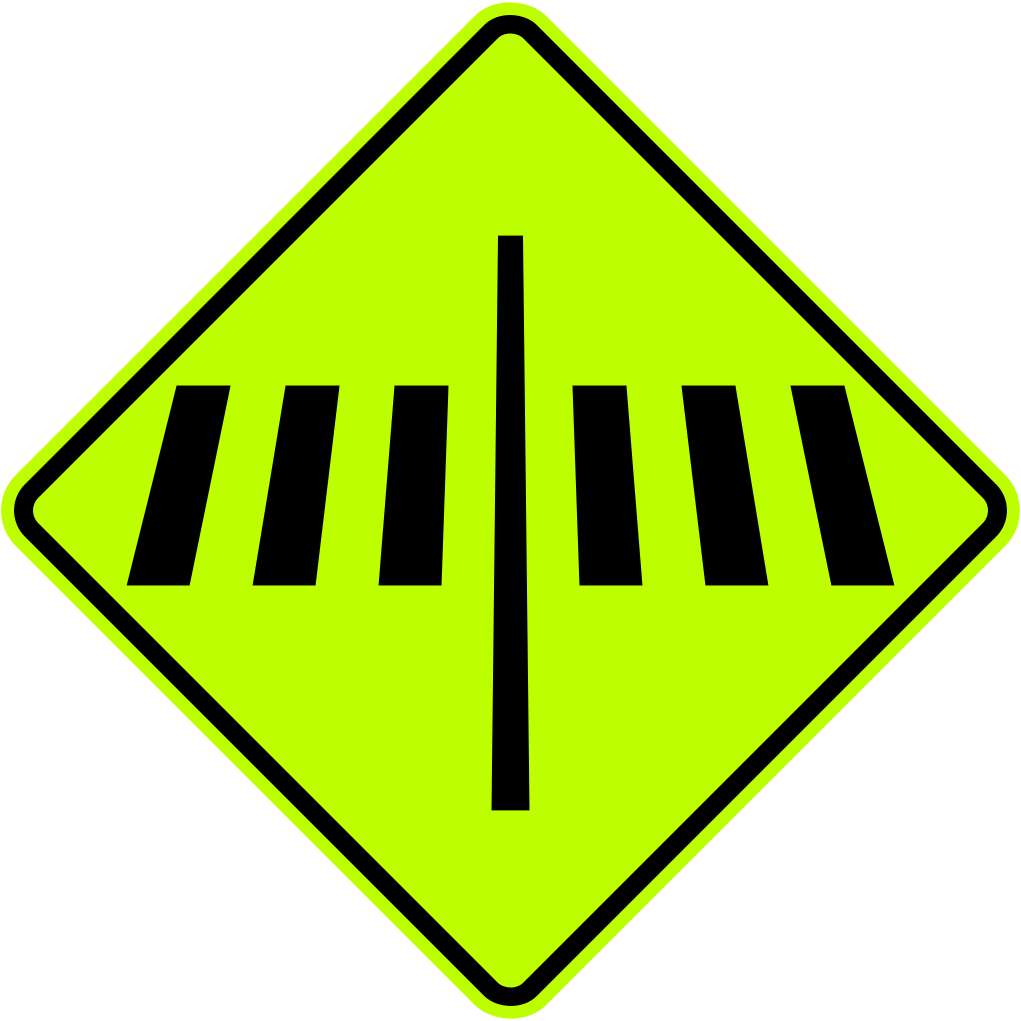 Warning for a pedestrian crossing.
English • W16-2 • Pedestrian crossing ahead. A pedestrian crossing is ahead. Reduce speed and prepare to give way as required at the crossing.
Sources
🔗 Commons.wikimedia.org
🔗 Nzta.govt.nz • NZTA sign specifications • W16-2
Image via Commons.wikimedia.org
New Zealand Transport Agency • NZTA-Sign-Spec • Source revision 2024-11-08. Wikimedia original unmodified.
May I enter a pedestrian crossing if the road beyond it is blocked in New Zealand?
Wait before the crossing if stationary traffic would block your passage through it. Do not pass a vehicle stopped or slowing for people on a pedestrian crossing. Keep pedestrian passage clear and check for people hidden by other vehicles.
🔗 legislation.govt.nz • New Zealand, Land Transport (Road User) Rule 2004, clause 10.1; 🔗 nzta.govt.nz • New Zealand Transport Agency, Road Code, Passing
What should I do if a pedestrian is still crossing when the traffic signal changes in New Zealand?
Allow the pedestrian to finish crossing safely. A green vehicle signal is not permission to drive into someone who is still in the crossing; watch particularly for pedestrians obscured by turning or queued vehicles.
🔗 legislation.govt.nz • New Zealand, Land Transport (Road User) Rule 2004, clause 3.2
Must New Zealand pedestrians use a crossing facility within 20 metres?
Yes. This includes a pedestrian crossing, footbridge, underpass or traffic signal.
🔗 nzta.govt.nz • New Zealand, NZTA General Road Code, general pedestrian guidelines
What does New Zealand’s Road Code advise when crossing between parked vehicles?
Move out as far as the headlight of the parked car nearest traffic, check for moving vehicles and wait for a gap.
🔗 nzta.govt.nz • New Zealand, NZTA General Road Code, general pedestrian guidelines
When may New Zealand drivers proceed after a school patrol extends its Stop signs?
Vehicles from both directions must remain stopped until all the signs are withdrawn.
Is New Zealand’s white diamond approach marking compulsory at every zebra crossing?
No. NZTA’s Traffic Note 1 gives the road controlling authority discretion over the white diamond, which is specified at least 50 metres before the crossing.


