

United StatesUnited States
 Traffic rules
 United States
1. United States
The United States spans most of North America between Canada and Mexico, with additional states in Alaska and the Pacific. Traffic drives on the right. The Interstate Highway System links major cities and regions across enormous distances, while driving conditions range from dense urban freeways to deserts, mountain passes and sparsely populated rural highways. Winter snow and ice can be severe in northern and mountainous regions, while other areas face hazards such as extreme heat, heavy rain or hurricanes. Distances are shown in miles and speed limits in miles per hour (mph), rather than kilometres.
Most everyday traffic rules are established by the individual states and local authorities, so speed limits, child-restraint laws, motorcycle helmet requirements and mobile-phone restrictions can differ considerably. There is no nationwide vignette; most roads are free, while individual toll roads, bridges and express lanes use operator-specific payment systems. Traffic signs broadly follow the federal MUTCD standard and written signs are predominantly in English.
AI-generated by Rijbewijs-online.be • WCIT • CC BY-SA
What alcohol limits apply to drivers in the United States?
General rule: For drivers aged 21 or older, the per-se BAC limit is 0.08% in every state except Utah, where it is 0.05%. A driver can still be prosecuted for impairment at a lower BAC where the circumstances support it.
Lower limits and exceptions: All states have zero-tolerance laws for drivers under 21. These laws use very low permitted alcohol concentrations, generally below 0.02%, with the exact threshold depending on the state.
Commercial drivers: Federal rules use a BAC threshold of 0.04% for drivers operating commercial motor vehicles that require a commercial driver's licence.
🔗 ecfr.gov • US Federal Regulations, 49 CFR 382.201, Commercial motor-vehicle alcohol threshold
🔗 nhtsa.gov • NHTSA, under 21 zero-tolerance law enforcement
What speed limits apply to passenger cars in the United States?
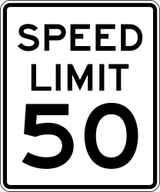
State and local limits: There is no nationwide urban, rural or motorway speed limit. Each state establishes statutory and posted limits, and cities or other authorities may set additional local limits. Always follow the posted speed-limit signs.
Are seat belts compulsory in the United States?
Seat-belt laws are established by the states. Every state except New Hampshire has an adult seat-belt law, although the occupants covered and whether police can stop a vehicle solely for a seat-belt violation vary by state.
🔗 nhtsa.gov • NHTSA, state seat-belt and child-restraint laws
🔗 gc.nh.gov • New Hampshire General Court, current RSA 265:107-a
Can you use a mobile phone while driving in the United States?
Mobile-phone laws are state-specific. Many states prohibit handheld phone use, texting or both, and learner or young drivers often face stricter restrictions. Check the applicable state law and avoid handling a phone while driving.
Which driving documents do visitors need in the United States?
Foreign licence: Usually, but the requirements are determined by the state in which you are driving. Visitors should carry their valid foreign licence and check each state's motor-vehicle authority for its recognition and time-limit rules.
International Driving Permit: Not in every state. Some states require or recommend an International Driving Permit in addition to the original foreign licence. An IDP must be obtained before travelling; the United States does not issue one to foreign visitors after arrival.
🔗 usa.gov • US Government, driving as a foreign visitor, State rules, foreign licences and IDPs
How should children be secured in a car in the United States?
Check the state’s child-restraint law. NHTSA recommends choosing a seat for the child’s age and size, keeping children rear-facing until they outgrow the seat’s limit, then using the appropriate forward-facing seat and booster. Children should remain in the rear seats through age 12.
🔗 nhtsa.gov • US NHTSA, child-seat and booster-seat recommendations
Are motorcycle helmets compulsory throughout the United States?
Helmet-use laws differ by state: some cover all riders and passengers, while others apply only to certain ages or categories. Check the states on your route. Wearing a compliant helmet on every ride provides protection regardless of the local legal minimum.

