


Built-up areaBelgium
 Traffic rules
 Belgium
5. Built-up area
A built-up area is an area containing concentrated buildings, streets and regular local activity. Drivers should expect more pedestrians, cyclists, intersections, parked vehicles, public transport and vehicles entering or leaving properties.
Many countries apply special traffic rules and lower default speed limits within built-up areas. The area may be identified by entrance and exit signs, street lighting or other legal criteria, so drivers must follow local signs and regulations.
Wikimedia.org • Janter • CC BY-SA
How can you recognise a built-up area in Belgium?
A Belgian built-up area begins at traffic sign F1a or F1b, which normally displays the name of the place together with a built-up-area symbol. It ends at traffic sign F3a or F3b. After the end sign, the speed limits and other rules applicable outside built-up areas take effect unless another sign indicates otherwise.
 Start of a built-up area.
Signal routier F1b • Commencement d'une agglomération. Ce signal est placé à droite, à chaque accès d'une agglomération; il peut être répété à gauche.
Verkeersbord F1b • Begin van een bebouwde kom. Dit verkeersbord wordt rechts geplaatst op elke toegangsweg tot een bebouwde kom; het mag links herhaald worden.
 End of the built-up area.
Signal routier F3b • Fin d'une agglomération. Ce signal est placé à droite, à chaque sortie d'une agglomération; il peut être répété à gauche.
Verkeersbord F3b • Einde van een bebouwde kom. Dit verkeersbord wordt rechts geplaatst op elke uitvalsweg van een bebouwde kom; het mag links herhaald worden.
What changes for built-up areas under Belgium’s new Road Code?
Belgium’s new Code of the Public Road takes effect on 1 June 2027. The current traffic signs F1a and F1b marking the beginning of a built-up area are replaced by traffic sign R25, while the current traffic signs F3a and F3b marking the end are replaced by traffic sign R27. The new signs may be vertical or horizontal and may appear with or without the name of the built-up area and with or without an indication of the applicable speed limit.
 Start of a built-up area.
Signal routier R25 • Début d’une agglomération. Le nom de l’agglomération peut être indiqué sur le signal, en haut au milieu. La vitesse maximale qui s’y applique peut être indiquée à titre informatif sur le signal en bas à droite.
Verkeersbord R25 • Begin van een bebouwde kom. De naam van de bebouwde kom kan, bovenaan in het midden, op het verkeersbord aangeduid zijn. De maximale snelheid die er geldt, kan rechtsonder als aanwijzing op het verkeersbord aangeduid zijn.
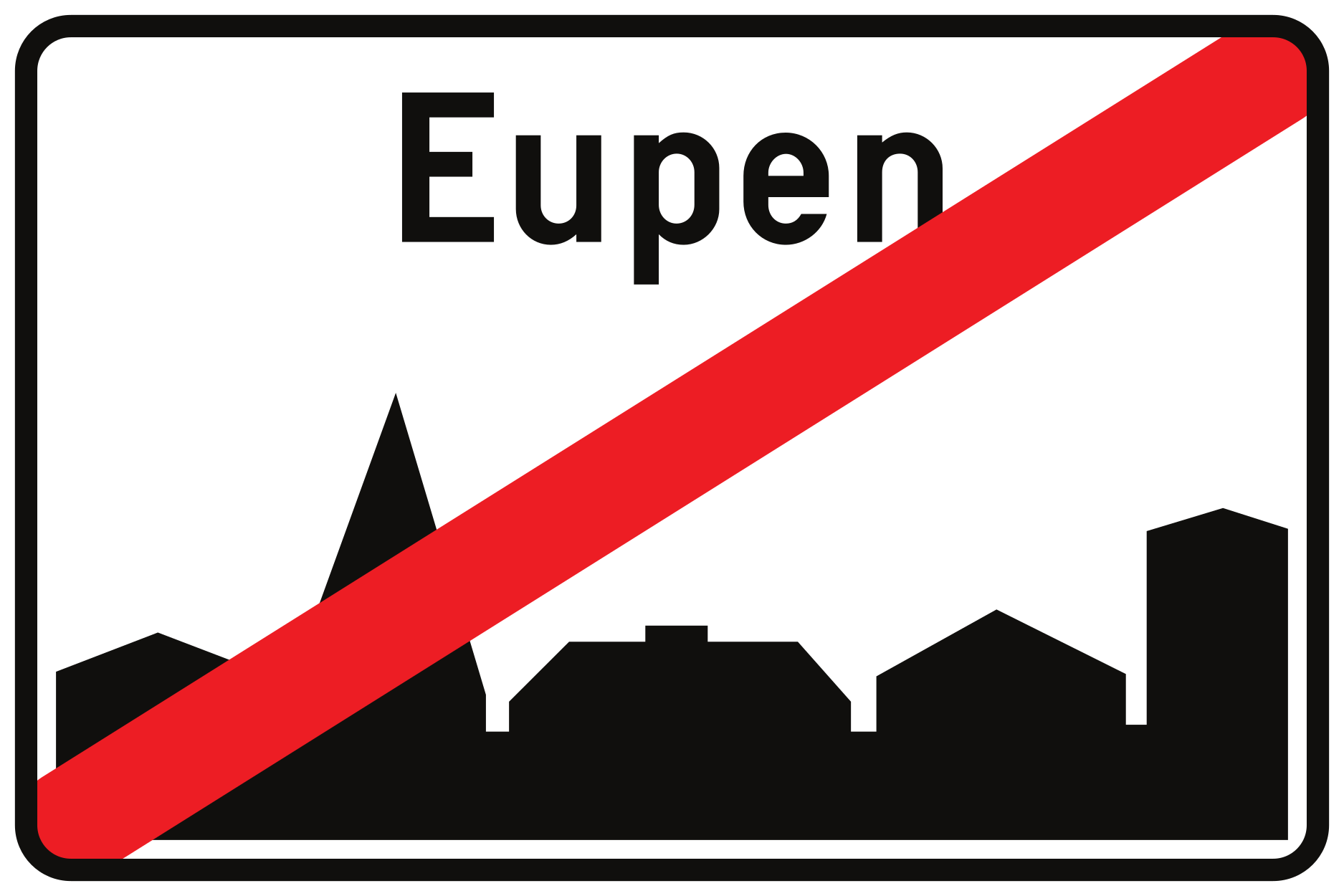 End of the built-up area.
Signal routier R27 • Fin d’une agglomération.
Verkeersbord R27 • Einde van een bebouwde kom.
Do buildings alone make a road part of a Belgian built-up area?
No. Under Belgian traffic law, a built-up area is an area with buildings whose entrances are marked by F1a or F1b signs and whose exits are marked by F3a or F3b signs. Drivers should therefore rely on the official signs rather than the appearance of the road alone.
What is the speed limit in a Belgian built-up area?
The general maximum speed is 30 km/h in the Brussels-Capital Region and 50 km/h in the Flemish and Walloon Regions. A traffic sign may impose or permit another speed, and lower vehicle-specific limits may still apply.
Is every road in Brussels limited to 30 km/h?
No. The general limit inside Brussels built-up areas is 30 km/h, but traffic sign C43 may indicate a lower or higher limit on a particular road.
Can another speed limit apply inside a Belgian built-up area?
Yes. Traffic sign C43 may impose or permit another maximum speed. A signed speed zone, Zone 30, school environment, woonerf or erf may also apply its own limit.
What happens to a local speed limit after an intersection?
When an ordinary C43 sign indicates another speed inside a built-up area, the general limit normally applies again after the next intersection: 30 km/h in Brussels and 50 km/h in Flanders and Wallonia. A zonal speed limit continues until its end-of-zone sign.
What speed applies after leaving a Zone 30, school environment, woonerf or erf?
If you remain inside the built-up area, the normal built-up-area limit applies again: 30 km/h in Brussels or 50 km/h in Flanders and Wallonia, unless another sign indicates a different limit.
Is a built-up area the same as a Zone 30 or woonerf?
No. A built-up area may contain roads with different speed limits. A Zone 30 imposes a maximum speed of 30 km/h, while a woonerf or erf has a 20 km/h limit and additional pedestrian, playing and parking rules.
Must you allow a bus to leave its stop?
Yes. Inside a built-up area, a driver travelling in the same direction must allow a bus or trolleybus to leave its stop when its driver indicates the intention to move off. You must slow down and stop if necessary.
How much space must you leave when passing a cyclist?
Inside a built-up area, a car or motorcycle driver must leave at least one metre between the vehicle and a cyclist or rider of a two-wheeled moped. Outside a built-up area, the minimum distance is 1.5 metres.
How much space must you leave when passing a pedestrian on the road?
Inside a built-up area, a driver must leave at least one metre when passing a pedestrian who is legally using the carriageway. Outside a built-up area, the minimum distance is 1.5 metres. If the required distance cannot be maintained, the driver may travel only at walking pace and must stop if necessary.
May cyclists ride two abreast inside a built-up area?
Yes. Cyclists and speed-pedelec riders using the carriageway may ride two abreast unless this makes it impossible for traffic travelling in the opposite direction to pass. The additional obligation to ride single file when a vehicle approaches from behind applies outside built-up areas.
May you stop or park on a raised verge inside a built-up area?
Stopping and parking on a pavement are prohibited. Inside a built-up area, stopping or parking on a raised verge is also prohibited unless local regulations expressly allow it.
Where should you place a warning triangle inside a built-up area?
The warning triangle is normally placed at least 30 metres behind the vehicle on an ordinary road. Inside a built-up area, when that distance cannot be maintained, it may be placed closer to the vehicle or, when necessary, on the vehicle.


