


No parkingBelgium
 Traffic rules
 Belgium
51. No parking
No parking indicates that vehicles may not be left parked at the location or along the section of road covered by the restriction. Depending on local law, a driver may still be allowed to stop briefly to pick up or drop off passengers or to load or unload goods, provided stopping itself is not prohibited.
A no-parking restriction may apply continuously or only during specified times, days, vehicle categories or sections of road. Its exact extent and exceptions are determined by the traffic sign, supplementary panels, road markings and local traffic regulations.
Wikimedia.org • Aktron • CC BY
Which sign means no parking in Belgium?
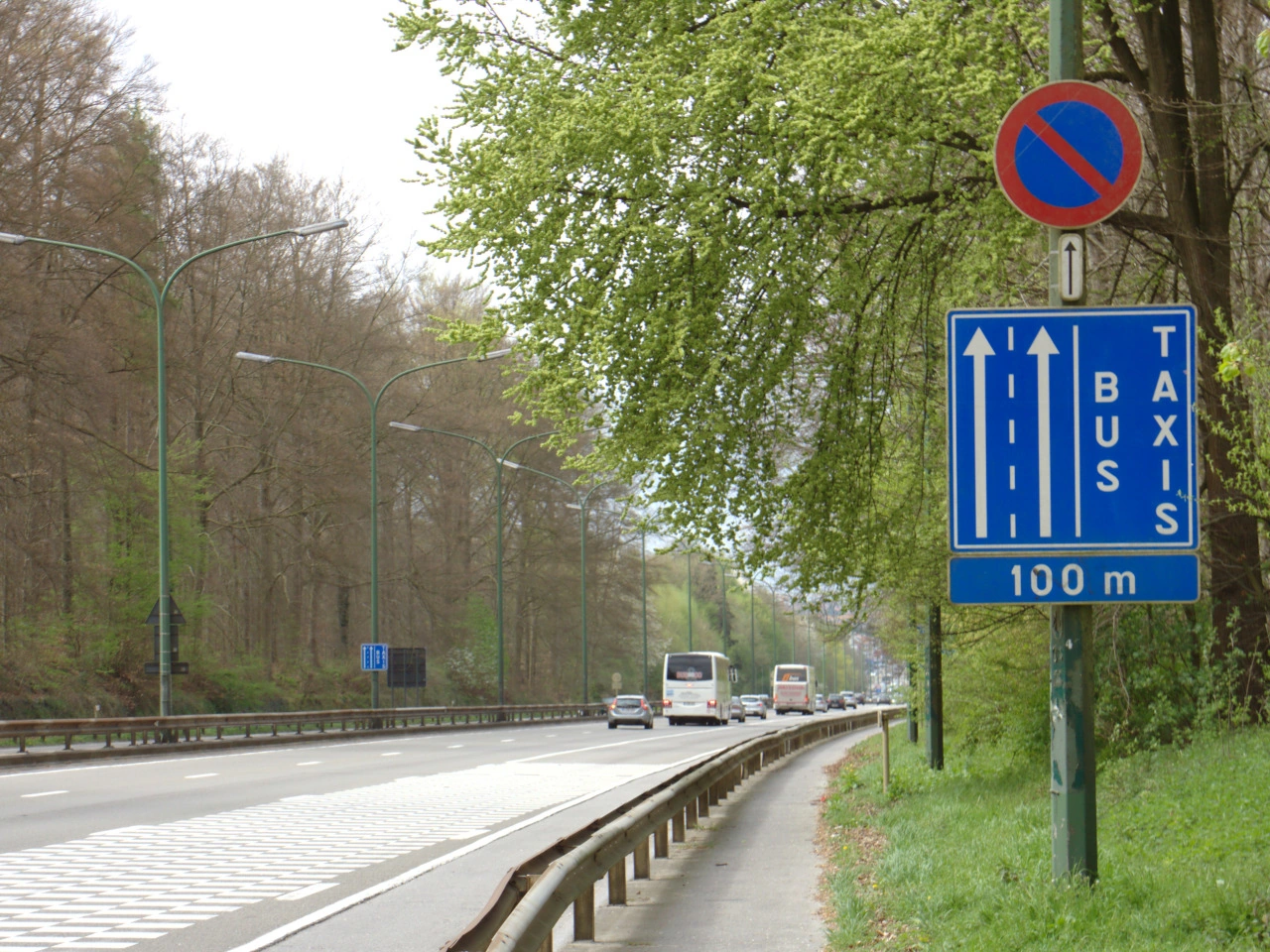
The Belgian E1 sign, a blue circular sign with a red border and a single red diagonal bar, means parking prohibited. It must not be confused with the E3 sign, which prohibits both stopping and parking.
 Parking prohibited.
Signal routier E1 • Stationnement interdit.
Verkeersbord E1 • Parkeerverbod.
 Parking and stopping prohibited.
Signal routier E3 • Arrêt et stationnement interdits.
Verkeersbord E3 • Stilstaan en parkeren verboden.
May you stop where an E1 no-parking sign applies?
Yes, if stopping is otherwise permitted. Under Belgian law, a vehicle that remains stationary only for the time necessary for passengers to get in or out or for goods to be loaded or unloaded is considered stopped rather than parked.
May you pick up or drop off passengers beside an E1 sign?
Yes, provided you remain there only for the time necessary for passengers to get in or out and stopping is not prohibited for another reason. Waiting for passengers beyond that necessary time constitutes parking.
May you load or unload goods beside an E1 sign?
Yes, genuine loading or unloading is considered stopping rather than parking when the vehicle remains stationary only for the time necessary to perform it. Other stopping prohibitions must still be respected.
Can you wait in the car beside an E1 sign?
Simply remaining behind the wheel does not make parking legal. If the vehicle stays stationary for longer than necessary for passengers to board or leave or for goods to be loaded or unloaded, it is considered parked.
May you refuel or charge a vehicle where parking is prohibited?
No, where the E1 prohibition applies. Belgian law specifically considers both refuelling and charging the battery of an electric or hybrid-electric vehicle to be parking.
How far does an E1 sign apply in Belgium?
An ordinary E1 sign applies on the side of the public road where it is placed, from the sign to the next intersection. Supplementary signs can indicate that the restriction begins or ends at another point or applies over a specified distance.
Does an E1 sign apply to the verge in Belgium?
Yes. The E1 parking prohibition normally applies to both the carriageway and the verge on the side where the sign is placed. Specific supplementary signs can also extend its effect to the pavement for the road-user categories indicated.
Can an E1 prohibition apply only during certain hours?
Yes. A supplementary inscription may specify the period during which the parking prohibition applies, such as particular hours or days. Outside that period, the E1 restriction does not apply, although other parking rules still do.
Can an E1 sign apply only to certain vehicles?
Yes. A supplementary inscription or authorised symbol may indicate the vehicle category to which the parking prohibition applies.
What do arrows below an E1 sign mean?
Supplementary arrow signs can indicate the beginning or end of the parking restriction. Another type of supplementary sign can indicate that the restriction applies over a stated distance or that the sign is repeating an existing restriction.
What does a zonal no-parking sign mean in Belgium?
A zonal parking prohibition applies throughout the entire area between the zone-entry and zone-exit signs. Unlike an ordinary E1 sign, it is not automatically terminated by each intersection. A specifically signposted different parking arrangement can apply at particular places within the zone.


