


Turn prohibitionBelgium
 Traffic rules
 Belgium
28. Turn prohibition
A turn prohibition prevents drivers from turning in the direction indicated by a traffic sign. It may prohibit a left turn, a right turn or a U-turn at an intersection or along a specified section of road.
Drivers must continue along a permitted route and follow any lane arrows or mandatory-direction signs. A turn prohibition does not itself determine priority or speed, and any exemption for cyclists, public transport or other road users must be expressly indicated.
Wikimedia.org • Jean Housen • CC BY-SA
Which Belgian signs prohibit turning?
Traffic signs C31a and C31b prohibit drivers from turning at the next intersection in the direction shown by the crossed arrow.
 Turning left prohibited.
Signal routier C31a • Au prochain carrefour, interdiction de tourner dans le sens indiqué par la flèche.
Verkeersbord C31a • Verbod aan het volgend kruispunt af te slaan in de richting door de pijl aangegeven.
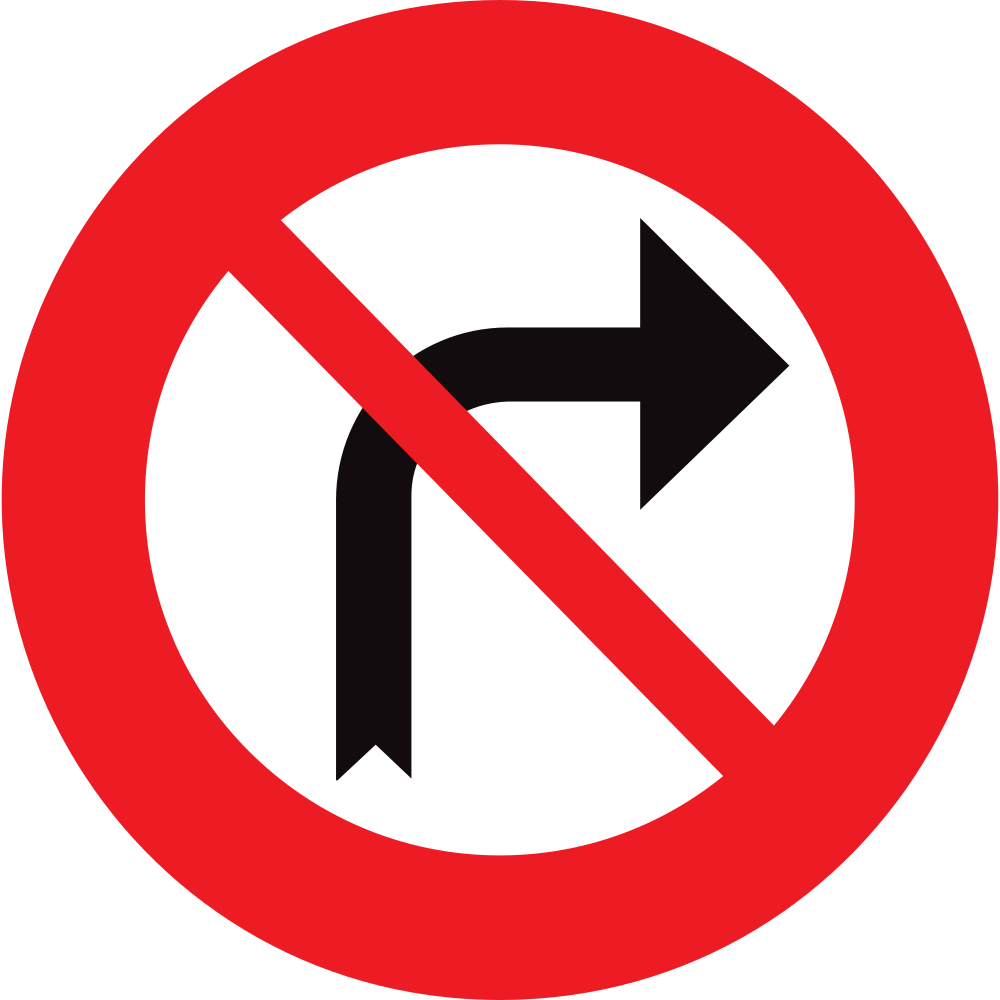 Turning right prohibited.
Signal routier C31b • Au prochain carrefour, interdiction de tourner dans le sens indiqué par la flèche.
Verkeersbord C31b • Verbod aan het volgend kruispunt af te slaan in de richting door de pijl aangegeven.
What does Belgian sign C31a mean?
Traffic sign C31a prohibits drivers from turning left at the next intersection.
What does Belgian sign C31b mean?
Traffic sign C31b prohibits drivers from turning right at the next intersection.
When does a Belgian C31 prohibition apply?
The prohibition applies at the next intersection encountered after the sign.
Does C31 apply at every later intersection?
No. It applies to the next intersection only. A new sign is required to prohibit the same turn at a later intersection.
May C31 be announced before the intersection?
Yes. The sign may be placed in advance of the intersection so drivers can choose the correct lane or another route in time.
Does C31 apply to a driveway before the intersection?
Not normally. C31 prohibits the indicated turn at the next intersection. An entrance to private property is not itself an intersection between public roads, although another sign or marking may prohibit access.
What if both left and right turns are prohibited?
Belgian placement rules require an upward-pointing D1 mandatory-direction sign instructing drivers to continue straight ahead. Separate C31 signs are not used to prohibit both turns at the same intersection.
May C31 and D1 be used together for the same restriction?
No. They may not be combined merely to impose the same direction requirement twice.
Does a Belgian green light permit a prohibited turn?
No. A green light allows you to proceed, but you must still follow C31 and may travel only in a permitted direction.
Does C31 determine priority?
No. When continuing or making another permitted turn, drivers must still follow traffic lights, priority signs and the ordinary priority rules.
Does C31 impose a speed limit?
No. The applicable regional, zonal, posted and vehicle-specific speed limits remain in force.
Can C31 apply to only one traffic lane?
Yes. When the sign is positioned above a lane or another clearly defined part of the public road, the prohibition applies only to that lane or part.
Must you obey lane arrows as well as C31?
Yes. Drivers must choose a lane that permits their intended direction and follow one of the directions indicated by the lane-selection arrows.
May cyclists be exempted from C31?
Yes. Supplementary panel M2 indicates that the prohibition does not apply to cyclists.
May class A mopeds also be exempted?
Yes. Supplementary panel M3 may indicate that the prohibition does not apply to cyclists and riders of two-wheeled class A mopeds.
May speed pedelecs be exempted?
Yes. Panel M11 exempts speed-pedelec riders, while M12 exempts cyclists, class A moped riders and speed-pedelec riders.
Can cyclists follow a direction prohibited to motor vehicles?
Yes, when the supplementary sign expressly exempts them. Motorists must therefore check for cyclists approaching or turning from a direction closed to general traffic.
Can C31 be used instead of a mandatory-direction sign because of a cyclist exception?
Yes. Where only cyclists or specified moped riders are exempted, Belgian placement rules may require or permit C31 instead of D1 or D3 so the exception can be displayed clearly.
Can C31 have zonal validity?
No. Belgian placement rules exclude C31 from the prohibition signs that may be given zonal validity.
Which Belgian sign prohibits U-turns?
Traffic sign C33 prohibits drivers from turning around.
Where does a C33 U-turn prohibition apply?
The prohibition begins at the sign and continues up to and including the next intersection.
May you make a U-turn before reaching the next intersection?
No. C33 prohibits turning around anywhere in the section from the sign through the next intersection.
Does C31 automatically prohibit a U-turn?
No. C31 regulates turning at the next intersection, while C33 separately prohibits turning around. A U-turn may nevertheless be illegal because of another sign, a continuous line, the road type or unsafe conditions.
Can C33 be used to indicate one-way traffic?
No. Belgian placement rules expressly prohibit using C33 to indicate that a carriageway carries one-way traffic.
Can C33 have zonal validity?
No. C33 is excluded from the signs that may be used as zonal prohibitions.
Is making a U-turn a manoeuvre in Belgium?
Yes. Turning around is legally classified as a manoeuvre. The driver must therefore give way to every other road user before performing it where it is permitted.
May you cross a broken centre line to turn?
Yes, where the movement is otherwise permitted and safe. A broken line may be crossed to turn left or make a U-turn.
May you cross a continuous line to turn?
No. Drivers may not cross a continuous white line or drive to its left when it separates opposing traffic.
What duties apply when making a permitted right turn?
The driver must signal in time, normally remain close to the right-hand edge, turn at moderate speed and give way to road users and pedestrians who have priority.
What duties apply when making a permitted left turn?
The driver must signal in time, position the vehicle correctly, give way to oncoming drivers, turn at moderate speed and enter the new road correctly.
Must turning drivers give way to cyclists and pedestrians?
Yes. A driver changing direction must give way to drivers and pedestrians continuing along other parts of the same public road and to pedestrians crossing the road being entered.
Does using an indicator give you priority?
No. It only communicates your intention. You must still respect all applicable priority and crossing rules.
What if an authorised person directs you to turn?
Follow the authorised person’s instruction. Such instructions take precedence over traffic lights, signs, road markings and ordinary traffic rules.
What changes under Belgium’s new road code?
From 1 June 2027, the no-turn signs are renumbered C32a and C32b. The number C31 will instead identify prohibited access for motorhomes. Sign C33 remains the prohibition on turning around from the sign through the next intersection.


