


Traffic rulesBelgium
 Traffic rules
 Belgium
1. Belgium
Belgium is a small country in Western Europe, bordered by France, Luxembourg, Germany and the Netherlands. Traffic drives on the right, and drivers should be particularly aware that some traffic rules differ between Flanders, Wallonia and the Brussels-Capital Region. General speed limits and low-emission-zone rules are examples of regulations that can vary by region, while cyclists, pedestrians, trams and other public transport are an important part of everyday traffic.
Belgium has three official languages: Dutch, French and German. Road signs containing place names or other text generally use the language of the area, while signs in the Brussels-Capital Region may appear in both Dutch and French. This can be important for foreign drivers because some Belgian cities have different names in different languages.
AI-generated by Rijbewijs-online.be • WCIT • CC BY-SA
Which side of the road do you drive on in Belgium?
Drive on the right and normally overtake on the left.
Which emergency numbers should you call in Belgium?
Call 112 for an ambulance or the fire brigade. Call 101 for urgent police assistance.
What is the legal alcohol limit for drivers in Belgium?
The maximum blood-alcohol level is 0.5 g/l for most drivers. A lower limit of 0.2 g/l applies to specified professional drivers.
What is the general speed limit in Belgian built-up areas?
The general limit is 50 km/h in built-up areas in Flanders and Wallonia and 30 km/h in the Brussels-Capital Region, unless signs indicate another limit.
What is the general speed limit outside built-up areas in Belgium?
For cars, the general limit on ordinary roads outside built-up areas is 70 km/h in Flanders and the Brussels-Capital Region and 90 km/h in Wallonia, unless another limit applies or signs indicate otherwise.
What is the motorway speed limit in Belgium?
For cars, the general maximum speed on motorways is 120 km/h, unless a lower limit is shown.
Is there a minimum speed on Belgian motorways?
Under the current traffic regulations, drivers must normally travel at least 70 km/h on a motorway, unless a lower speed is required by a traffic sign or by traffic and safety conditions.
What is the speed limit in Belgian residential zones?
The maximum speed in a residential zone or home zone is 20 km/h. Pedestrians may use the entire public road, and drivers must not endanger or obstruct them.
What is the speed limit in Belgian school zones?
Where a school environment is marked as a Zone 30, the maximum speed is 30 km/h.
Are seat belts mandatory in Belgium?
Seat belts are mandatory for drivers and passengers on seats equipped with them, subject to specific legal exemptions.
When must children use a child restraint in Belgium?
Children younger than 18 and shorter than 135 cm must generally be transported in an appropriate child restraint system. Specific exceptions apply in certain vehicles and circumstances.
Who must wear a helmet in Belgium?
Helmets are mandatory for motorcycle riders, moped riders and speed-pedelec riders. Speed-pedelec riders may use an appropriate moped helmet or bicycle helmet that meets the required protection rules.
Can you use a mobile phone while driving in Belgium?
Unless the vehicle is stationary or parked, a driver may not use, hold or manipulate a mobile electronic device with a screen unless it is fixed to the vehicle in a suitable holder.
When must you give way to traffic approaching from the right?
At an intersection where priority is not otherwise regulated, drivers must generally give way to a driver approaching from the right. Important exceptions include roundabouts and traffic coming from a prohibited direction.
What must drivers do at pedestrian crossings?
At a pedestrian crossing not controlled by traffic lights or an authorised officer, drivers must approach at a moderate speed and give way to pedestrians who are on the crossing or are about to enter it.
What rules apply in Belgian bicycle zones?
The maximum speed in a bicycle zone is 30 km/h, and motor vehicles may not overtake cyclists.
When must drivers create an emergency corridor?
When congestion forms on a road with at least two lanes travelling in the same direction, drivers must create an emergency corridor. Traffic in the left lane moves as far left as possible, while traffic in the other lane or lanes moves to the right.
How should drivers merge when a lane closes?
In very slow traffic, drivers on a lane that ends or is blocked should continue to near the narrowing before merging. Drivers in the continuing lane must then allow vehicles to merge alternately.
What do red and amber traffic lights mean in Belgium?
Red means stop. A steady amber light also means stop, unless the driver is already so close that stopping safely is no longer possible.
What equipment must you carry in a car in Belgium?
A car must carry a warning triangle, reflective safety vest, fire extinguisher and first-aid kit.
Which rules apply in Belgian low-emission zones?
Low-emission zones operate in Brussels, Antwerp and Ghent. Access depends on the vehicle and the local rules, and foreign-registered vehicles may need to be registered before entering.
Do traffic rules differ between the Belgian regions?
Yes. Some rules, particularly general speed limits and local access rules, differ between Flanders, Wallonia and the Brussels-Capital Region. Posted traffic signs and the rules applicable at the location must always be followed.

2. Motorway
A motorway is a road specially designed and signposted for motor traffic. Motorways normally have separate carriageways for opposing traffic, controlled access through designated entrances and exits, no direct access to neighbouring properties, and no level crossings with other roads, railways or paths.
Special traffic rules apply on motorways. The permitted road users, speed limits, lane rules, tolls and emergency procedures vary between countries, so drivers must follow the local traffic signs and regulations.

Wikimedia.org • Raimond Spekking • CC BY-SA
How can you recognise a motorway in Belgium?
A motorway begins at traffic sign F5 and ends at traffic sign F7. From sign F5, the special rules for motorway traffic apply until sign F7 is reached.
 Start of a motorway.
Signal routier F5 • Commencement d'une autoroute ou accès à une autoroute. Les règles spéciales de circulation sur les autoroutes s'appliquent à partir de l'endroit où le signal est placé.
Verkeersbord F5 • Begin of oprit van een autosnelweg. De bijzondere verkeersregelen op de autosnelwegen gelden vanaf de plaats waar het verkeersbord aangebracht is. Dit verkeersbord wordt rechts geplaatst en mag links herhaald worden.
 End of the motorway.
Signal routier F7 • Fin d'autoroute. Ce signal est placé à droite et peut être répété à gauche.
Verkeersbord F7 • Einde van een autosnelweg. Dit verkeersbord wordt rechts geplaatst en mag links herhaald worden.
What changes for motorways under Belgium’s new Road Code?
Belgium’s new Code of the Public Road takes effect on 1 June 2027. The motorway signs are renumbered: the current traffic sign F5 for the beginning of a motorway becomes traffic sign R29, while traffic sign F7 for the end of a motorway becomes traffic sign R31. The main motorway rules remain largely familiar, including the general maximum speed of 120 km/h and the special access and driving rules that apply on motorways. During the transition period, drivers may encounter both the current and new motorway signs.
 Start of a motorway.
Signal routier R29 • Début d’une autoroute.
Verkeersbord R29 • Begin van een autosnelweg.
 End of the motorway.
Signal routier R31 • Fin d’une autoroute.
Verkeersbord R31 • Einde van een autosnelweg.
What is the speed limit on Belgian motorways?
The general maximum speed is 120 km/h unless traffic signs impose a lower limit. Vehicles and combinations with a maximum authorised mass exceeding 3.5 tonnes and buses are generally limited to 90 km/h. Coaches that meet the applicable seat-belt and speed-limiter requirements may travel at up to 100 km/h.
Is there a minimum speed on Belgian motorways?
Drivers must normally travel at no less than 70 km/h unless a lower speed is imposed or traffic, weather, visibility, road conditions or another safety reason requires them to slow down. Vehicles and combinations that cannot reach 70 km/h on a level road are not permitted on the motorway.
Who may not use a Belgian motorway?
Belgian motorways may not be used by pedestrians, cyclists, moped riders, riders or drivers of animals, agricultural vehicles, motorised quadricycles without a passenger compartment and certain other slow or restricted vehicles. Vehicles and combinations unable to reach 70 km/h on a level road are also prohibited.
Which lane should you use on a Belgian motorway?
Drivers must normally remain as close as possible to the right-hand side of the carriageway and return to the right when conditions allow. Other lanes may be used for overtaking or when required by traffic signs, congestion or the intended destination.
Which lanes may heavy vehicles and buses use?
On a motorway with three or more lanes in the same direction, buses, coaches and vehicles or combinations exceeding 3.5 tonnes may normally use only the two rightmost lanes, unless lane-direction signs indicate otherwise.
How do you form an emergency corridor in Belgium?
Drivers must form an emergency corridor as soon as congestion develops. Vehicles in the leftmost lane move as far left as possible. Vehicles in every other lane move as far right as possible. The corridor is formed between the leftmost lane and the lane immediately beside it.
May you drive on the emergency lane?
No. Ordinary drivers may not use the emergency lane to overtake congestion, reach an exit or continue their journey. Its use is reserved for authorised emergency vehicles, recovery vehicles and certain authorised services in the circumstances provided by law.
What should you do after a breakdown on a Belgian motorway?
Move the vehicle away from the traffic lanes when this can be done safely and take the necessary measures to protect other road users. If the vehicle cannot be moved and is stopped where stopping or parking is prohibited, place the warning triangle at least 100 metres behind the vehicle. The driver must wear a retro-reflective safety vest when leaving a broken-down vehicle stopped at such a location.
May you stop or park on a Belgian motorway?
Stopping and parking are prohibited except in designated parking areas or when stopping is required by traffic, an emergency or another unavoidable circumstance. The emergency lane is not an ordinary parking or waiting area.
May you reverse or make a U-turn on a Belgian motorway?
No. Reversing, making a U-turn, driving against the direction of traffic and using connections through the central reservation are prohibited. If you miss an exit, continue to the next suitable exit.
3. Expressway
An expressway is a road intended to carry through traffic efficiently, usually at higher speeds than ordinary roads. Expressways often have limited access, multiple lanes, separated carriageways or grade-separated junctions, but their design and legal status vary between countries.
An expressway is not always a motorway. It may have intersections, traffic lights or direct access, and the permitted road users, speed limits and special rules depend on local signs and regulations.
How can you recognise an expressway in Belgium?
A Belgian expressway, legally called an autoweg, begins at traffic sign F9. The special autoweg rules continue until traffic sign F11 indicates its end.
 Start of an expressway.
Signal routier F9 • Route pour automobiles. Les règles spéciales de circulation sur les routes pour automobiles s'appliquent à partir de l'endroit où le signal est placé.
Verkeersbord F9 • Autoweg. De bijzondere verkeersregelen op de autowegen gelden vanaf de plaats waar het verkeersbord is aangebracht. Dit verkeersbord wordt rechts geplaatst en mag links herhaald worden.
 End of the expressway.
Signal routier F11 • Fin de route pour automobiles. Ce signal est placé à droite et peut être répété à gauche.
Verkeersbord F11 • Einde van een autoweg. Dit verkeersbord wordt rechts geplaatst en mag links herhaald worden.
What changes for expressways under Belgium’s new Road Code?
Belgium’s new Code of the Public Road takes effect on 1 June 2027. The expressway signs are renumbered: the current traffic sign F9 for the beginning of an expressway becomes traffic sign R33, while traffic sign F11 for the end of an expressway becomes traffic sign R35. The special rules for expressways continue to apply between the beginning and end signs. During the transition period, drivers may encounter both the current and new expressway signs.
 Start of an expressway.
Signal routier R33 • Début d’une route pour automobiles. La réglementation particulière vaut jusqu’au prochain carrefour.
Verkeersbord R33 • Begin van een autoweg. De bijzondere voorschriften gelden tot het volgend kruispunt.
 End of the expressway.
Signal routier R35 • Fin d’une route pour automobiles.
Verkeersbord R35 • Einde van een autoweg.
What is the difference between an expressway and a motorway in Belgium?
A Belgian motorway is indicated by signs F5 and F7 and is subject to the full motorway rules. An autoweg is indicated by signs F9 and F11 and may have ordinary intersections, traffic lights or direct entrances. Its road design does not have to meet motorway standards.
Start of a motorway.
Signal routier F5 • Commencement d'une autoroute ou accès à une autoroute. Les règles spéciales de circulation sur les autoroutes s'appliquent à partir de l'endroit où le signal est placé.
Verkeersbord F5 • Begin of oprit van een autosnelweg. De bijzondere verkeersregelen op de autosnelwegen gelden vanaf de plaats waar het verkeersbord aangebracht is. Dit verkeersbord wordt rechts geplaatst en mag links herhaald worden.
Start of an expressway.
Signal routier F9 • Route pour automobiles. Les règles spéciales de circulation sur les routes pour automobiles s'appliquent à partir de l'endroit où le signal est placé.
Verkeersbord F9 • Autoweg. De bijzondere verkeersregelen op de autowegen gelden vanaf de plaats waar het verkeersbord is aangebracht. Dit verkeersbord wordt rechts geplaatst en mag links herhaald worden.
Who may use a Belgian expressway?
Only motor vehicles and their trailers may use a Belgian autoweg. Mopeds, agricultural vehicles, fairground vehicle combinations and motorised quadricycles without a passenger compartment are prohibited. Pedestrians, cyclists and animals may not use the autoweg itself.
What is the speed limit on a Belgian expressway?
The F9 autoweg sign does not impose one fixed speed limit. Inside a built-up area, the general limit is normally 30 km/h in Brussels and 50 km/h in Flanders and Wallonia unless signs indicate otherwise. Outside built-up areas, a physically divided road with at least two lanes in each direction may allow up to 120 km/h. On other roads, the general limit is normally 70 km/h in Brussels and Flanders and 90 km/h in Wallonia, although traffic signs and vehicle-specific limits may impose another speed.
Is there a minimum speed on Belgian expressways?
There is no expressway-specific minimum speed of 70 km/h. That rule applies to motorways, not autowegen. Drivers may nevertheless not obstruct normal traffic by driving abnormally slowly without a valid reason.
Can a Belgian expressway have intersections or traffic lights?
Yes. A Belgian autoweg may contain level intersections, roundabouts and traffic lights. Drivers must observe the applicable priority signs, signals and general intersection rules.
Do drivers entering a Belgian expressway automatically have to give way?
There is no special priority rule solely because a road is an autoweg. Drivers must follow the traffic signs, road markings and normal priority rules at the entrance or intersection.
Which lane should you use on a Belgian expressway?
Drivers must normally keep as close as possible to the right-hand side of the carriageway and return to the right after overtaking. Lane arrows, destination signs and other local traffic signs may require a different lane.
May you stop or park on a Belgian expressway?
Voluntary stopping and parking are prohibited except on parking strips indicated by traffic sign E9a. An unavoidable stop caused by congestion, a breakdown or another emergency must be handled according to the applicable safety procedures.
May you reverse or make a U-turn on a Belgian expressway?
No. Making a U-turn, reversing, driving against the direction of traffic and using connections through a central reservation are prohibited. If you miss a turn or exit, continue until you can change direction legally.
May you tow a broken-down vehicle on a Belgian expressway?
A vehicle may not be towed on an autoweg using only an emergency or auxiliary coupling. A professional recovery vehicle or another legally permitted towing method must be used.
May you drive on the emergency lane?
No. Where an autoweg has an emergency lane, ordinary drivers may not use it to overtake congestion or continue their journey. It is reserved for authorised emergency vehicles, recovery vehicles and specified services in legally permitted circumstances.
How do you form an emergency corridor on a Belgian expressway?
When congestion forms on a carriageway with at least two lanes, drivers must create an emergency corridor. Vehicles in the leftmost lane move as far left as possible, while vehicles in all other lanes move as far right as possible.
What should you do after a breakdown on a Belgian expressway?
Move the vehicle away from traffic when possible and activate the hazard warning lights. If the vehicle cannot be moved from a place where stopping or parking is prohibited, place the warning triangle at least 30 metres behind the vehicle. The driver must wear a retro-reflective safety vest when leaving a broken-down vehicle stopped at such a location.
4. Residential area
A residential area is a street or group of streets where housing and access to local properties are the main functions. Drivers should expect pedestrians, cyclists, children, parked vehicles and vehicles entering or leaving driveways.
Some countries identify particular residential areas with traffic signs and apply special low-speed and residential-area rules. The speed limit, pedestrian rights, parking rules and permitted road users therefore depend on local signs and regulations.
Wikimedia.org • Jeanhousen • CC BY-SA
How can you recognise a residential area in Belgium?
A legally designated Belgian residential area begins at traffic sign F12a. Its special rules continue throughout the area until traffic sign F12b indicates the end.
 Start of a residential area.
Signal routier F12a • Commencement d'une zone résidentielle ou d'une zone de rencontre. Les règles spéciales de circulation dans les zones résidentielles ou les zones de rencontre s'appliquent à partir de l'endroit où le signal est placé. Ce signal est placé à droite de chaque accès à une zone résidentielle ou une zone de rencontre; il peut être répété à gauche.
Verkeersbord F12a • Begin van een woonerf of van een erf. De bijzondere verkeersregelen in de woonerven of erven gelden vanaf de plaats waar het verkeersbord aangebracht is. Dit verkeersbord wordt rechts geplaatst aan elke toegang tot een woonerf of erf; het mag links herhaald worden.
 End of the residential area.
Signal routier F12b • Fin d'une zone résidentielle. Ce signal est placé à droite de chaque sortie d'une zone résidentielle ou d'une zone de rencontre; il peut être répété à gauche.
Verkeersbord F12b • Einde van een woonerf of van een erf. Dit verkeersbord wordt rechts geplaatst aan elke uitgang van een woonerf of erf; het mag links herhaald worden.
What changes for residential areas under Belgium’s new Road Code?
Belgium’s new Code of the Public Road takes effect on 1 June 2027. The residential-area signs are renumbered: the current traffic sign F12a for the beginning of a residential area becomes traffic sign R5, while traffic sign F12b for the end of a residential area becomes traffic sign R7. The special traffic rules for residential areas continue to apply between the beginning and end signs. During the transition period, drivers may encounter both the current and new signs.
 Start of a residential area.
Signal routier R5 • Début d’une zone de rencontre. La vitesse maximale qui s’y applique peut être indiquée à titre informatif sur le signal en bas à droite.
Verkeersbord R5 • Begin van een erf. De maximale snelheid die er geldt, kan rechtsonder als aanwijzing op het verkeersbord aangeduid zijn.
 End of the residential area.
Signal routier R7 • Fin d’une zone de rencontre.
Verkeersbord R7 • Einde van een erf.
Is every residential neighbourhood in Belgium a woonerf?
No. The special rules apply only to roads included in an officially designated woonerf or erf marked by sign F12a. An ordinary residential street remains subject to the normal road rules and any other posted zone restrictions.
What is the difference between a woonerf and an erf?
In a woonerf, the residential function is predominant. An erf has similar road characteristics, but may also contain shops, workshops, tourism, education or recreational activities. The traffic rules are the same in both areas.
What is the speed limit in a Belgian woonerf or erf?
The maximum speed is 20 km/h. Drivers must still travel more slowly when necessary to avoid endangering or hindering pedestrians.
Where may pedestrians walk in a Belgian woonerf or erf?
Pedestrians may use the entire width of the public road. They are not limited to a pavement, although they may not obstruct traffic unnecessarily.
Are children allowed to play in a Belgian woonerf or erf?
Yes. Playing is permitted throughout the area. Drivers must therefore be especially cautious around children and be prepared to slow down or stop immediately.
Must drivers give way to pedestrians?
Drivers may not endanger or hinder pedestrians and must stop when necessary. Pedestrians may use the whole road, but they may not obstruct vehicle traffic without a reason.
May cyclists and motor vehicles use a Belgian woonerf or erf?
Yes. Cyclists and motor vehicles may normally enter unless additional traffic signs prohibit or restrict them. All drivers must respect the 20 km/h limit and must not endanger or hinder pedestrians.
Where may you park in a Belgian woonerf or erf?
Parking is permitted only in spaces marked by road markings or a differently coloured surface bearing the letter P, or in places where a traffic sign expressly permits parking.
May you park on either side of the road?
Yes. In a woonerf or erf, a stationary or parked vehicle may be positioned on either the right or left side relative to its direction of travel, provided parking is allowed at that location.
Is stopping prohibited in a Belgian woonerf or erf?
The special rule restricts parking, not every brief stop. General stopping rules still apply, and a vehicle may not be stopped where it creates danger or unnecessarily obstructs other road users.
Is a Belgian woonerf the same as a Zone 30?
No. A Zone 30 mainly imposes a maximum speed of 30 km/h. In a woonerf or erf, the limit is 20 km/h, pedestrians may use the whole public road, playing is permitted and parking is restricted to authorised places.
When do the special residential-area rules end?
The special rules remain applicable throughout the area until the driver passes the F12b end sign. After that sign, the speed limit and other rules of the surrounding road or zone apply again.
5. Built-up area
A built-up area is an area containing concentrated buildings, streets and regular local activity. Drivers should expect more pedestrians, cyclists, intersections, parked vehicles, public transport and vehicles entering or leaving properties.
Many countries apply special traffic rules and lower default speed limits within built-up areas. The area may be identified by entrance and exit signs, street lighting or other legal criteria, so drivers must follow local signs and regulations.
Wikimedia.org • Janter • CC BY-SA
How can you recognise a built-up area in Belgium?
A Belgian built-up area begins at traffic sign F1a or F1b, which normally displays the name of the place together with a built-up-area symbol. It ends at traffic sign F3a or F3b. After the end sign, the speed limits and other rules applicable outside built-up areas take effect unless another sign indicates otherwise.
 Start of a built-up area.
Signal routier F1b • Commencement d'une agglomération. Ce signal est placé à droite, à chaque accès d'une agglomération; il peut être répété à gauche.
Verkeersbord F1b • Begin van een bebouwde kom. Dit verkeersbord wordt rechts geplaatst op elke toegangsweg tot een bebouwde kom; het mag links herhaald worden.
 End of the built-up area.
Signal routier F3b • Fin d'une agglomération. Ce signal est placé à droite, à chaque sortie d'une agglomération; il peut être répété à gauche.
Verkeersbord F3b • Einde van een bebouwde kom. Dit verkeersbord wordt rechts geplaatst op elke uitvalsweg van een bebouwde kom; het mag links herhaald worden.
What changes for built-up areas under Belgium’s new Road Code?
Belgium’s new Code of the Public Road takes effect on 1 June 2027. The current traffic signs F1a and F1b marking the beginning of a built-up area are replaced by traffic sign R25, while the current traffic signs F3a and F3b marking the end are replaced by traffic sign R27. The new signs may be vertical or horizontal and may appear with or without the name of the built-up area and with or without an indication of the applicable speed limit.
 Start of a built-up area.
Signal routier R25 • Début d’une agglomération. Le nom de l’agglomération peut être indiqué sur le signal, en haut au milieu. La vitesse maximale qui s’y applique peut être indiquée à titre informatif sur le signal en bas à droite.
Verkeersbord R25 • Begin van een bebouwde kom. De naam van de bebouwde kom kan, bovenaan in het midden, op het verkeersbord aangeduid zijn. De maximale snelheid die er geldt, kan rechtsonder als aanwijzing op het verkeersbord aangeduid zijn.
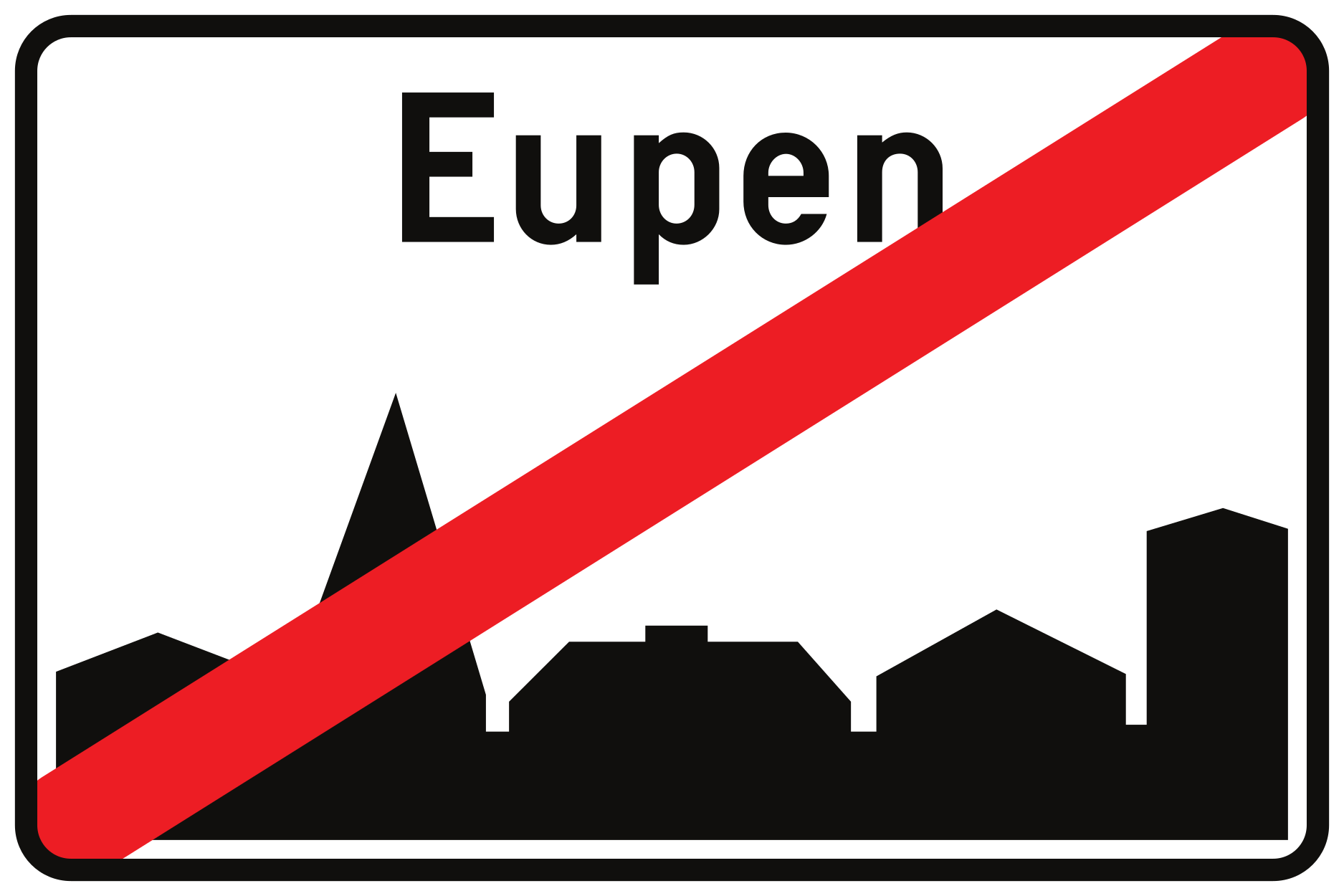 End of the built-up area.
Signal routier R27 • Fin d’une agglomération.
Verkeersbord R27 • Einde van een bebouwde kom.
Do buildings alone make a road part of a Belgian built-up area?
No. Under Belgian traffic law, a built-up area is an area with buildings whose entrances are marked by F1a or F1b signs and whose exits are marked by F3a or F3b signs. Drivers should therefore rely on the official signs rather than the appearance of the road alone.
What is the speed limit in a Belgian built-up area?
The general maximum speed is 30 km/h in the Brussels-Capital Region and 50 km/h in the Flemish and Walloon Regions. A traffic sign may impose or permit another speed, and lower vehicle-specific limits may still apply.
Is every road in Brussels limited to 30 km/h?
No. The general limit inside Brussels built-up areas is 30 km/h, but traffic sign C43 may indicate a lower or higher limit on a particular road.
Can another speed limit apply inside a Belgian built-up area?
Yes. Traffic sign C43 may impose or permit another maximum speed. A signed speed zone, Zone 30, school environment, woonerf or erf may also apply its own limit.
What happens to a local speed limit after an intersection?
When an ordinary C43 sign indicates another speed inside a built-up area, the general limit normally applies again after the next intersection: 30 km/h in Brussels and 50 km/h in Flanders and Wallonia. A zonal speed limit continues until its end-of-zone sign.
What speed applies after leaving a Zone 30, school environment, woonerf or erf?
If you remain inside the built-up area, the normal built-up-area limit applies again: 30 km/h in Brussels or 50 km/h in Flanders and Wallonia, unless another sign indicates a different limit.
Is a built-up area the same as a Zone 30 or woonerf?
No. A built-up area may contain roads with different speed limits. A Zone 30 imposes a maximum speed of 30 km/h, while a woonerf or erf has a 20 km/h limit and additional pedestrian, playing and parking rules.
Must you allow a bus to leave its stop?
Yes. Inside a built-up area, a driver travelling in the same direction must allow a bus or trolleybus to leave its stop when its driver indicates the intention to move off. You must slow down and stop if necessary.
How much space must you leave when passing a cyclist?
Inside a built-up area, a car or motorcycle driver must leave at least one metre between the vehicle and a cyclist or rider of a two-wheeled moped. Outside a built-up area, the minimum distance is 1.5 metres.
How much space must you leave when passing a pedestrian on the road?
Inside a built-up area, a driver must leave at least one metre when passing a pedestrian who is legally using the carriageway. Outside a built-up area, the minimum distance is 1.5 metres. If the required distance cannot be maintained, the driver may travel only at walking pace and must stop if necessary.
May cyclists ride two abreast inside a built-up area?
Yes. Cyclists and speed-pedelec riders using the carriageway may ride two abreast unless this makes it impossible for traffic travelling in the opposite direction to pass. The additional obligation to ride single file when a vehicle approaches from behind applies outside built-up areas.
May you stop or park on a raised verge inside a built-up area?
Stopping and parking on a pavement are prohibited. Inside a built-up area, stopping or parking on a raised verge is also prohibited unless local regulations expressly allow it.
Where should you place a warning triangle inside a built-up area?
The warning triangle is normally placed at least 30 metres behind the vehicle on an ordinary road. Inside a built-up area, when that distance cannot be maintained, it may be placed closer to the vehicle or, when necessary, on the vehicle.
6. Zone
A traffic zone is an area in which a traffic rule applies throughout all included roads or road sections. The rule normally begins at a zone-entry sign and remains applicable until the corresponding end-of-zone sign is passed.
Zones may regulate speed, parking, access, vehicle categories, emissions or other traffic behaviour. The signs used, the roads covered and the effect of intersections or local exceptions depend on local traffic law.
Wikimedia.org • Alain Rouiller • CC BY-SA
How can you recognise a traffic zone in Belgium?
A Belgian traffic zone is normally indicated by a rectangular zonal sign displaying the applicable prohibition, speed restriction or parking rule. For example, a Zone 30 begins at traffic sign F4a and ends at traffic sign F4b. Other zonal regulations use the relevant prohibition sign from the C series or parking and stopping sign from the E series within a zonal panel. The corresponding end-zone sign indicates where the zonal regulation ends.
 Start of a zone with speed limit.
Signal routier F4a • Commencement d'une zone dans laquelle la vitesse est limitée à 30 km à l'heure. Ce signal est placé à droite de chaque accès à une zone dans laquelle la vitesse est limitée à 30 km à l'heure; il peut être répété à gauche.
Verkeersbord F4a • Begin van een zone met een snelheidsbeperking van 30 km per uur. Dit verkeersbord wordt rechts geplaatst aan elke toegang tot een zone met een snelheidsbeperking van 30 km per uur; het mag links herhaald worden.
 End of the zone with speed limit.
Signal routier F4b • Fin d'une zone dans laquelle la vitesse est limitée à 30 km à l'heure. Ce signal est placé à droite de chaque sortie d'une zone dans laquelle la vitesse est limitée à 30 km à l'heure; il peut être répété à gauche.
Verkeersbord F4b • Einde van een zone met een snelheidsbeperking van 30 km per uur. Dit verkeersbord wordt rechts geplaatst aan elke uitgang van een zone met een snelheidsbeperking van 30 km per uur; het mag links herhaald worden.
What changes for traffic zones under Belgium’s new Road Code?
Belgium’s new Code of the Public Road takes effect on 1 June 2027. Zonal traffic signs receive their own numbering: traffic sign Z1 marks the beginning of a zone and traffic sign Z3 marks the end. The traffic sign whose rule applies throughout the zone is displayed within these signs. A Z5 sign may be used as a reminder of the zonal regulation. For example, a speed zone may be indicated by Z1-C43 at the beginning and Z3-C43 at the end.
 Start of a zone with speed limit.
Signal routier Z1-C43 • Début d’une zone de vitesse.
Verkeersbord Z1-C43 • Begin van een snelheidszone.
 End of the zone with speed limit.
Signal routier Z3-C43 • Fin d’une zone de vitesse.
Verkeersbord Z3-C43 • Einde van een snelheidszone.
Which Belgian traffic signs can have zonal validity?
Zonal validity may be given to certain prohibition signs and signs concerning parking. Not every Belgian traffic sign may be used as a zonal sign.
Where does a Belgian zonal rule apply?
The regulation applies throughout the entire area enclosed by the zone signs. It may therefore cover several roads, road sections and intersections.
Does an intersection end a Belgian traffic zone?
No. Passing an intersection does not normally end a zonal regulation. The rule continues until the corresponding end-zone sign or another legally applicable change is reached.
How does a Belgian traffic zone end?
The zone ends when you pass the corresponding end-zone sign. The rules applicable to the surrounding road, built-up area or another zone then take effect.
What is a Belgian speed zone?
A speed zone is an area in which the maximum speed displayed on a zonal C43 sign applies from the beginning of the zone until its end.
Which zonal speed limits may be used in Belgium?
A zonal speed limit of 30 km/h may be introduced. Zonal limits of 50 km/h and 70 km/h may also be used outside built-up areas under the conditions prescribed by Belgian regulations.
How is a Belgian Zone 30 indicated?
A Zone 30 begins at traffic sign F4a and ends at traffic sign F4b. The maximum permitted speed throughout the zone is 30 km/h.
Can a lower speed limit apply inside a Belgian speed zone?
Yes. An ordinary C43 sign may impose a lower speed on a particular road section. From the next intersection, the original zonal speed applies again without the zone sign having to be repeated.
Can a higher speed limit be displayed inside a Belgian speed zone?
No. An ordinary C43 sign displaying a speed higher than the zonal speed may not be placed within the speed zone.
What happens after leaving a woonerf, erf or school environment inside a speed zone?
The original zonal speed limit applies again after leaving the woonerf, erf or school environment. The original zone sign does not normally need to be repeated.
Can another speed zone exist inside a Belgian speed zone?
Yes. A different speed zone may be created within a larger zone. Where the original zone continues afterwards, its entrance sign must be displayed again when legally required.
How does a Belgian parking zone work?
A zonal parking rule applies throughout the defined area. A different parking regulation may nevertheless be indicated for a particular location by local parking signs or road markings.
Can two zonal rules apply at the same time?
Yes. Belgian signs may introduce up to two zonal regulations together at an entrance, subject to the prescribed exceptions and placement rules.
Must a Belgian zone sign be repeated after every intersection?
No. The sign does not normally need to be repeated after each intersection. A reminder sign may nevertheless be placed with the word Herhaling.
Are small Zone 30 signs attached to poles legally binding?
Small stickers or recognition signs displaying the zonal speed may be attached to lighting or traffic poles as reminders. They are informational reminders and do not create a speed restriction by themselves.
Does a Belgian Zone 30 automatically change the priority rules?
No. Entering a Zone 30 does not by itself change priority at intersections. Drivers must continue to follow priority signs, traffic signals and the normal priority rules.
Does a zonal rule apply to every vehicle?
Not necessarily. Text, symbols or additional panels may specify that a zonal rule applies only to certain vehicles, road users, times or conditions.
7. Speed limit
A speed limit is the maximum legal speed permitted on a road, lane or within a designated area. It may be established by general traffic law or indicated by fixed, variable or temporary traffic signs.
A speed limit is a maximum, not a target speed. Drivers must travel more slowly whenever traffic, visibility, weather, road conditions, vulnerable road users or the condition of the vehicle make the maximum permitted speed unsafe.
Wikimedia.org • Jeanhousen • CC BY-SA
How is a speed limit indicated in Belgium?
A local maximum speed is normally indicated by traffic sign C43, a circular sign displaying the permitted speed. It is prohibited to drive faster than the number shown. The end of a speed restriction imposed by sign C43 may be indicated by traffic sign C45.
 Start of a speed limit.
Signal routier C43 • A partir du signal jusqu'au prochain carrefour inclus, ou jusqu’à chaque signal C43 avec ou sans validité zonale, ou jusqu’au signal indiquant le début ou la fin d’une agglomération, d’une zone résidentielle, d’une zone de rencontre ou d’une zone piétonne, interdiction de circuler à une vitesse supérieure à celle qui est indiquée.
Verkeersbord C43 • Vanaf het verkeersbord tot en met het volgend kruispunt, of tot elk verkeersbord C43 met of zonder zonale geldigheid, of tot het verkeersbord dat het begin of het einde van een bebouwde kom, van een woonerf of erf, of van een voetgangerszone aanduidt, verbod te rijden met een grotere snelheid dan deze die is aangeduid.
 End of the speed limit.
Signal routier C45 • Fin de la limitation de vitesse imposée par le signal C43.
Verkeersbord C45 • Einde van de snelheidsbeperking opgelegd door het verkeersbord C43.
Is a Belgian speed limit a target speed?
No. It is the maximum permitted speed. Drivers must adjust their speed to other road users, weather, visibility, traffic density, the condition of the road and the condition and load of the vehicle.
Must you sometimes drive below the speed limit?
Yes. A driver must always be able to stop before a foreseeable obstruction. Travelling at the displayed limit may therefore still be too fast in rain, fog, darkness, congestion or near vulnerable road users.
What are the general speed limits inside Belgian built-up areas?
The general limit is 30 km/h in the Brussels-Capital Region and 50 km/h in the Flemish and Walloon Regions. Traffic signs or special road rules may impose or permit another speed.
What is the general limit outside built-up areas in Flanders?
For cars and other vehicles with a maximum authorised mass not exceeding 3.5 tonnes, the general limit on ordinary roads is 70 km/h. A C43 sign may impose or permit another limit. Physically divided roads with at least two lanes in each direction may allow up to 120 km/h.
What is the general limit outside built-up areas in Wallonia?
For cars and other vehicles with a maximum authorised mass not exceeding 3.5 tonnes, the general limit on ordinary roads is 90 km/h. The limit is 70 km/h on a middle carriageway. Traffic signs and vehicle-specific rules may impose a lower limit.
What is the general limit outside built-up areas in Brussels?
On ordinary roads outside built-up areas, the general maximum speed is 70 km/h. Physically divided roads with at least two lanes in each direction may legally allow up to 120 km/h, although lower signed limits are widely used.
What is the maximum speed on Belgian motorways?
The general maximum for vehicles and combinations with a maximum authorised mass not exceeding 3.5 tonnes is 120 km/h. Lower signed, variable or vehicle-specific limits take precedence.
Do heavier vehicles have lower speed limits?
Yes. Vehicle-specific limits apply to buses, coaches, heavy vehicles and certain other vehicles. For example, vehicles and combinations exceeding 3.5 tonnes and buses are generally limited to 90 km/h on motorways.
Which limit applies when several speed rules apply?
Drivers must respect the lowest applicable maximum arising from the traffic sign, road type, vehicle category or special road regulation.
When does a Belgian C43 speed limit begin?
The restriction begins at the C43 sign. Drivers must therefore reduce their speed before passing the sign.
When does an ordinary C43 speed limit end?
An ordinary C43 limit applies until the next intersection, another C43 sign, a zonal speed sign, or a sign marking the beginning or end of a built-up area, woonerf, erf or pedestrian zone. It may also be ended by sign C45.
What does traffic sign C45 mean?
Traffic sign C45 indicates the end of the speed restriction imposed by a preceding C43 sign. The general or otherwise applicable speed limit then resumes.
What does traffic sign C46 mean?
Traffic sign C46 indicates the end of all local prohibitions applying to moving vehicles, including an applicable local speed restriction.
Does an intersection end a Belgian speed zone?
No. A zonal speed limit continues across intersections until the corresponding end-of-zone sign is passed.
Can a lower local limit apply inside a speed zone?
Yes. A C43 sign may impose a lower limit on a particular section. From the next intersection, the original zonal limit applies again without the zone sign being repeated.
Can a higher local limit apply inside a Belgian speed zone?
No. A C43 sign displaying a speed higher than the zonal speed may not be placed inside that speed zone.
What speed applies in a Belgian woonerf or erf?
The maximum speed is 20 km/h. Drivers must also avoid endangering or hindering pedestrians, who may use the entire public road.
What speed applies in a Belgian Zone 30?
The maximum speed is 30 km/h from the Zone 30 entrance sign until the corresponding end sign.
What speed applies in a Belgian cycling zone?
The maximum speed is 30 km/h. Motor vehicles may not overtake cyclists or speed-pedelec riders within the cycling zone.
What speed applies at a raised traffic-calming device?
Drivers must approach a legally designated raised device cautiously and cross it at no more than 30 km/h.
Can a speed-limit sign apply only to one lane?
Yes. When a regulatory sign is positioned above a lane, its instruction applies only to that lane or indicated part of the public road.
Can a speed limit apply only to certain vehicles?
Yes. A supplementary panel may limit a C43 restriction to vehicles exceeding a displayed maximum authorised mass or to another indicated category.
Are electronic speed-limit signs legally binding?
Yes. Regulatory signs displayed through variable-message or lane-control systems retain their legal meaning. Drivers must obey the active displayed limit.
May you exceed the speed limit while overtaking?
No. Belgian law does not provide a general exception allowing drivers to exceed the maximum speed while overtaking.
May you drive abnormally slowly?
Drivers may travel slowly for a valid safety or traffic reason, but they may not obstruct the normal movement of other drivers by travelling abnormally slowly without justification.
8. Bike path
A bike path is a part of a road or a separate route intended primarily or exclusively for people riding bicycles. It may be physically separated from motor traffic, marked on the road surface or identified by traffic signs.
Bike paths may be one-way, two-way or shared with other road users. The permitted users, direction of travel, priority rules and obligation to use the path depend on local traffic signs and regulations.
Wikimedia.org • Jeanhousen • CC BY-SA
What is legally considered a bike path in Belgium?
A Belgian fietspad is a part of the public road reserved for bicycles and two-wheeled class A mopeds by traffic sign D7, sign D9 or the legally prescribed road markings. A fietspad is not part of the carriageway.
 Mandatory path for cyclists.
Signal routier D7 • Piste cyclable obligatoire.
Verkeersbord D7 • Verplicht fietspad.
 Mandatory divided pedestrian and cycle path.
Signal routier D9 • Partie de la voie publique réservée à la circulation des piétons, des bicyclettes et des cyclomoteurs à deux roues classe A.
Verkeersbord D9 • Deel van de openbare weg voorbehouden voor het verkeer van voetgangers, van fietsen en van tweewielige bromfietsen klasse A.
What changes for bike paths under Belgium’s new Road Code?
Belgium’s new Code of the Public Road takes effect on 1 June 2027. The existing traffic sign D7 continues to indicate a mandatory bike path, while a new traffic sign D8 explicitly marks its end. The new Road Code also introduces a non-mandatory bike path: traffic sign R12 marks its beginning and traffic sign R13 its end. Cyclists, speed pedelec riders and drivers of class A mopeds may use a non-mandatory bike path but are not required to do so.
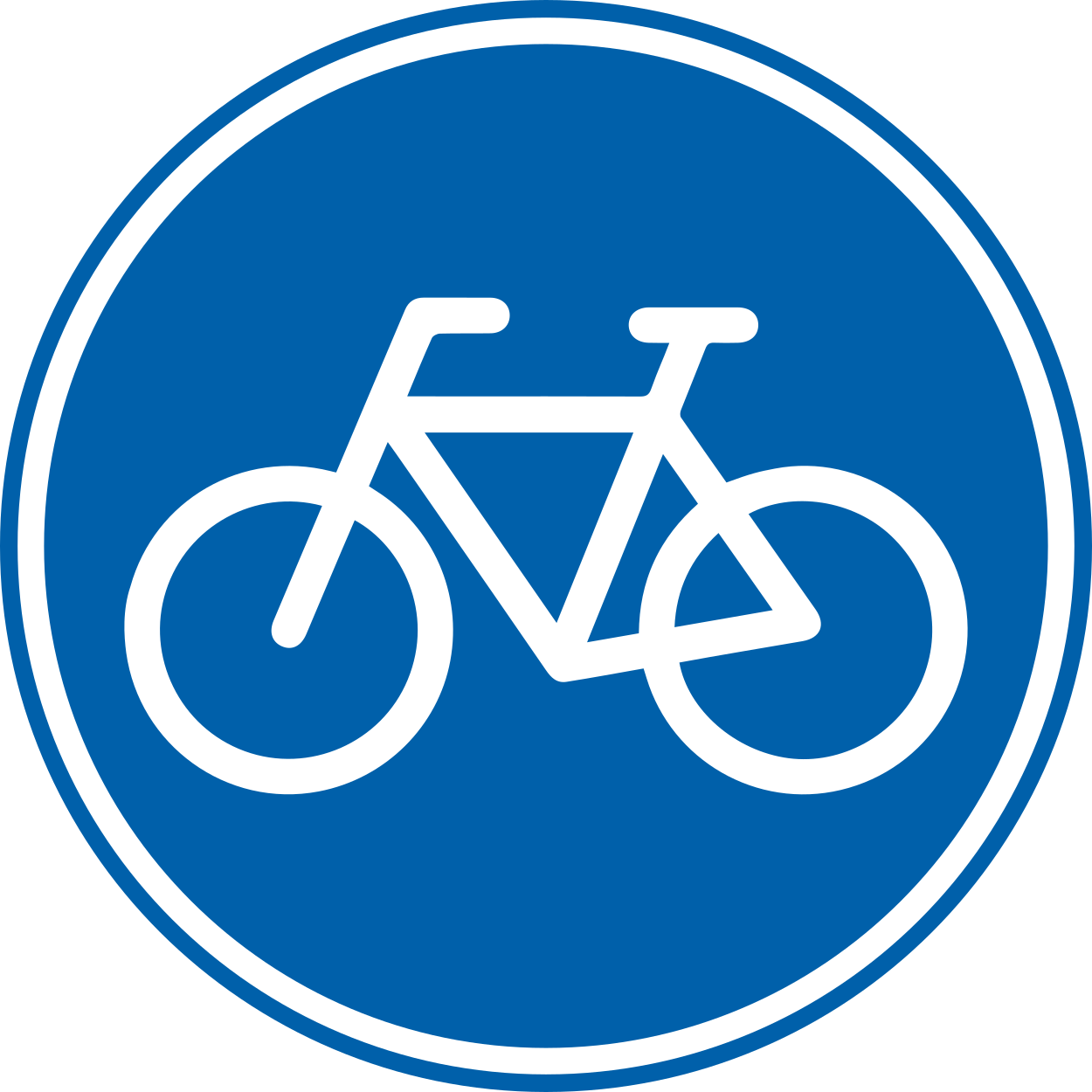 Mandatory path for cyclists.
Signal routier D7 • Piste cyclable. Le signal vaut jusqu’au prochain carrefour inclus.
Verkeersbord D7 • Fietspad. Het verkeersbord geldt tot en met het volgend kruispunt.
 End of mandatory path for cyclists.
Signal routier D8 • Fin de piste cyclable.
Verkeersbord D8 • Einde fietspad.
 Start of an optional cycle path.
Signal routier R12 • Début d’une piste cyclable non obligatoire. La règlementation particulière vaut jusqu’au prochain carrefour inclus.
Verkeersbord R12 • Begin van een niet verplicht fietspad. De bijzondere voorschriften gelden tot en met het volgend kruispunt.
 End of an optional cycle path.
Signal routier R13 • Fin d’une piste cyclable non obligatoire.
Verkeersbord R13 • Einde van een niet verplicht fietspad.
How can you recognise a Belgian bike path?
It may be indicated by traffic sign D7, by the cyclist section of sign D9, or by two parallel white broken lines enclosing a space that is not wide enough for motor traffic.
What does traffic sign D7 mean?
Traffic sign D7 indicates a mandatory bike path. Cyclists and class A moped riders must use it when it is usable and signposted for their direction of travel.
What does traffic sign D9 mean?
Traffic sign D9 indicates a part of the public road divided between pedestrians and cyclists. Each category must use the section assigned to it, normally separated by a continuous white line or a clear difference in surface material.
Is a path indicated by D10 legally a fietspad?
No. Sign D10 indicates a part of the public road shared by pedestrians and cyclists. Cyclists must use it, but it is not included in the legal definition of a Belgian fietspad.
 Mandatory shared pedestrian and cycle path.
Signal routier D10 • Partie de la voie publique réservée à la circulation des piétons et des cyclistes.
Verkeersbord D10 • Deel van de openbare weg voorbehouden voor het verkeer van voetgangers en fietsers.
Must cyclists use a marked bike path on the right?
Yes. Cyclists and class A moped riders must use a usable bike path marked by two parallel broken white lines when it lies on the right in their direction of travel.
May cyclists use a marked bike path on the left?
No. A bike path indicated only by the two parallel broken white lines may not be used when it lies on the left in the cyclist’s direction of travel.
When may cyclists use a bike path on the left?
A path indicated by D7 or D9 may be used from the left side when it is signposted for the cyclist’s direction of travel. A two-way D7 path must therefore be signposted in both directions.
Must cyclists always use a D7 or D9 path on the left?
Not always. When a signed path lies on the left, cyclists and class A moped riders may remain on the right side of the road if special circumstances justify this.
May cyclists leave a mandatory bike path?
Yes. Cyclists and permitted moped riders may leave it to change direction, overtake another user or travel around an obstruction.
May class A mopeds use Belgian bike paths?
Yes. Two-wheeled class A moped riders must generally follow usable bike paths under the same directional rules as cyclists.
May class B mopeds use Belgian bike paths?
Where the speed limit is 50 km/h or lower, class B moped riders may use a D7 or marked bike path provided they do not endanger its other users. Where the speed limit is higher than 50 km/h, they must use an available and usable D7 or marked bike path. Supplementary signs may require or prohibit their use.
May speed pedelecs use Belgian bike paths?
Where the speed limit is 50 km/h or lower, speed-pedelec riders may use D7, D9 and marked bike paths provided they do not endanger other users. Where the speed limit is higher, they must use an available and usable path of those types. Supplementary signs may impose another rule.
May speed pedelecs use a D10 shared path?
No. Under the current Belgian Highway Code, D10 is reserved for pedestrians and ordinary cyclists. Speed pedelecs are not permitted on a path indicated by D10.
May pedestrians walk on a Belgian bike path?
Pedestrians normally use the available pedestrian facilities first. They may use an ordinary bike path only when the higher-priority pedestrian facilities are unavailable or unusable, and must then give way to the other bike-path users. D9 and D10 paths have specific pedestrian provisions.
May motor vehicles cross a Belgian bike path?
Yes, where necessary and permitted, for example when entering a property or turning into another road. A driver crossing a pavement or bike path must give way to the road users legally using it.
Do cyclists always have priority at a Belgian cycle crossing?
No. Cyclists approaching a separately marked cycle crossing must enter it cautiously and take account of approaching vehicles. Drivers must approach at moderate speed and must not endanger or hinder cyclists already completing the crossing.
What happens when a bike path continues across a side road?
A driver who crosses the continuing bike path must give way to its legal users. Drivers turning must also give way to road users continuing along the other parts of the same public road.
May vehicles stop or park on a Belgian bike path?
No. Stopping and parking are prohibited on bike paths. They are also prohibited within five metres of a place where cyclists or moped riders must leave the path for the carriageway or enter it from the carriageway.
May bike-path users hinder one another?
No. Users of a Belgian bike path may not hinder or endanger one another or behave dangerously towards other road users.
Can organised groups of cyclists leave the bike path?
Cycle tourists riding in a legally regulated group of at least 15 participants are not required to use the bike path when they comply with the special group-cycling rules.
9. Cycling street
A cycling street is a street designed or legally designated to give cyclists a prominent position in mixed traffic. Motor vehicles may usually enter, but they must adapt their speed and driving behaviour to the presence of cyclists.
Depending on the country, cyclists may be permitted to use more of the carriageway and motor vehicles may be prohibited from overtaking them. The speed limit, priority rules, permitted vehicles and beginning and end of the street depend on local traffic signs and regulations.
Wikimedia.org • Spotter2 • CC BY-SA
How can you recognise a Belgian cycling zone?
A Belgian cycling zone begins at traffic sign F111 and ends at traffic sign F113. The word indicating the cycling zone on these signs is optional.
 Start of a zone for cyclists.
Signal routier F111 • Début d'une zone cyclable. La mention « Zone cyclable » sur le signal est facultative.
Verkeersbord F111 • Begin van de fietszone. De vermelding « Fietszone » op het verkeersbord is facultatief.
 End of the zone for cyclists.
Signal routier F113 • Fin d'une zone cyclable.
Verkeersbord F113 • Einde van een fietszone.
What changes for cyclist streets under Belgium’s new Road Code?
Belgium’s new Code of the Public Road takes effect on 1 June 2027. The current traffic sign F111 marking the beginning of a cycling zone becomes traffic sign R17, while traffic sign F113 marking the end becomes traffic sign R19. The new signs refer to a cycling zone, and the applicable maximum speed may be displayed on the sign. Cyclists may use the full width of the carriageway when it is open only in their direction and the right-hand half when traffic is permitted in both directions. Existing F111 and F113 signs with zonal validity or the wording indicating a cyclist street may remain valid until 1 January 2035.
 Start of a zone for cyclists.
Signal routier R17 • Début d'une zone cyclable. La mention « Zone cyclable » peut être indiquée sur le dessus du signal. La vitesse maximale qui s’y applique peut être indiquée à titre informatif sur le signal en bas à droite.
Verkeersbord R17 • Begin van een fietszone. De vermelding “Fietszone” kan bovenaan op het verkeersbord aangeduid zijn. De maximale snelheid die er geldt, kan rechtsonder als aanwijzing op het verkeersbord aangeduid zijn.
 End of the zone for cyclists.
Signal routier R19 • Fin d'une zone cyclable.
Verkeersbord R19 • Einde van een fietszone.
What is a cycling street called in Belgium?
The current Belgian legal term is fietszone, or cycling zone. The older term fietsstraat, meaning bicycle street, may still appear on existing traffic signs.
Are older Belgian fietsstraat signs still valid?
Yes. Existing F111 and F113 signs bearing the older term Fietsstraat may remain in use until 1 January 2035 and continue to indicate a cycling zone.
Can a Belgian cycling zone include several streets?
Yes. A fietszone may consist of one or more public roads on which the special rules concerning cyclists apply.
What is the speed limit in a Belgian cycling zone?
The maximum speed is 30 km/h. This limit applies to every driver, including cyclists and speed-pedelec riders.
May motor vehicles enter a Belgian cycling zone?
Yes. Motor vehicles are permitted unless additional traffic signs restrict access. Their drivers must respect the 30 km/h limit and the prohibition on overtaking cyclists.
May motor vehicles overtake cyclists in a Belgian cycling zone?
No. Motor vehicles may not overtake cyclists within the cycling zone, even when the road appears wide enough to maintain the normal passing distance.
May a motor vehicle overtake when no cyclist is present?
The special prohibition concerns the overtaking of cyclists. Motor vehicles may pass other vehicles only where the ordinary overtaking rules allow it and the manoeuvre can be completed safely.
May cyclists overtake motor vehicles?
Yes. The special overtaking prohibition applies to motor vehicles overtaking cyclists. Cyclists may overtake another vehicle when this is otherwise legal and safe.
May cyclists overtake one another?
Yes. Cyclists may overtake other cyclists when sufficient space and visibility are available and the manoeuvre does not endanger other road users.
Where may cyclists ride on a one-way street in a Belgian cycling zone?
When the carriageway is open to traffic only in the cyclists’ direction, cyclists may use the entire width of the carriageway.
Where may cyclists ride on a two-way street?
When the carriageway is open in both directions, cyclists may use the right-hand half of the carriageway in their direction of travel.
May cyclists ride side by side in a Belgian cycling zone?
Yes. Their right to use the entire carriageway on a one-way street, or its right-hand half on a two-way street, allows cyclists to ride side by side within that space when it is safe.
Do the same rules apply to speed pedelecs?
Yes. For the Belgian cycling-zone rules, drivers of cycles and speed pedelecs are treated as cyclists.
Do cyclists automatically have priority in a cycling zone?
No. The ordinary priority rules remain applicable. Cyclists must obey traffic lights, give-way and stop signs, priority-from-the-right rules and pedestrian crossings.
Does entering a cycling zone change the priority at intersections?
No. Traffic sign F111 introduces the cycling-zone rules but does not by itself make the road a priority road or give cyclists priority over crossing traffic.
May pedestrians use the entire carriageway?
No. A cycling zone is not a woonerf, pedestrian zone or shared pedestrian area. Pedestrians must follow the normal rules concerning pavements, verges, crossings and use of the carriageway.
May you stop or park in a Belgian cycling zone?
The cycling-zone rules do not create a general stopping or parking prohibition. Drivers must follow the ordinary parking rules and any signs or markings and may not obstruct traffic or endanger cyclists.
Does red road surfacing create a cycling zone?
No. Red surfacing, bicycle symbols and road markings may make the zone more visible, but the legal cycling-zone rules begin with traffic sign F111.
When do the Belgian cycling-zone rules end?
The special rules end when the driver passes traffic sign F113. The ordinary speed, positioning and overtaking rules then apply unless another sign introduces a different regulation.
10. Pedestrian zone
A pedestrian zone is an area consisting of one or more streets that are reserved primarily for pedestrians. Motor-vehicle access is normally prohibited or restricted to authorised users, particular purposes or specified times.
Pedestrians may usually use the full width of the available road space. Rules concerning cyclists, deliveries, public transport, vehicle speed, stopping and parking depend on local traffic signs and regulations.

Wikimedia.org • Jeanhousen • CC BY-SA
How can you recognise a pedestrian zone in Belgium?
A Belgian pedestrian zone begins at traffic sign F103 and ends at traffic sign F105. The entrance sign may also display authorised users, access hours and other conditions.
 Start of a zone for pedestrians.
Signal routier F103 • Commencement d'une zone piétonne. Ce signal est placé à droite, à chaque accès d'une zone piétonne; il peut être répété à gauche.
Verkeersbord F103 • Begin van een voetgangerszone. Dit verkeersbord wordt rechts geplaatst aan elke toegang tot een voetgangerszone; het mag links herhaald worden.
 End of the zone for pedestrians.
Signal routier F105 • Fin d'une zone piétonne. Ce signal est placé à droite, à chaque sortie d'une zone piétonne; il peut être répété à gauche.
Verkeersbord F105 • Einde van een voetgangerszone. Dit verkeersbord wordt rechts geplaatst aan elke uitgang van een voetgangerszone; het mag links herhaald worden.
What changes for pedestrian zones under Belgium’s new Road Code?
Belgium’s new Code of the Public Road takes effect on 1 June 2027. The current traffic sign F103 marking the beginning of a pedestrian zone becomes traffic sign R14, while traffic sign F105 marking the end becomes traffic sign R15. Under the new rules, cyclists, other cycle users and speed pedelec riders are allowed to enter a pedestrian zone unless traffic signs prohibit them from doing so. They must adapt their behaviour to pedestrians and, when pedestrian traffic is too dense, dismount and continue on foot.
 Start of a zone for pedestrians.
Signal routier R14 • Début d’une zone piétonne. La vitesse maximale qui s’y applique peut être indiquée à titre informatif sur le signal en bas à droite.
Verkeersbord R14 • Begin van een voetgangerszone. De maximale snelheid die er geldt, kan rechtsonder als aanwijzing op het verkeersbord aangeduid zijn.
 End of the zone for pedestrians.
Signal routier R15 • Fin d’une zone piétonne.
Verkeersbord R15 • Einde van een voetgangerszone.
Who may normally enter a Belgian pedestrian zone?
By default, only pedestrians may enter. Vehicles and cyclists may enter only when they belong to a legally permitted category or when the entrance sign expressly permits their access.
Which vehicles are automatically permitted?
Permitted categories include vehicles used to supervise, inspect, maintain or clean the zone, authorised priority vehicles when required by their mission and vehicles operating regular public-transport services.
May residents drive into a Belgian pedestrian zone?
Living in the zone does not automatically provide vehicle access. A driver may enter when the vehicle’s garage is located inside the zone and can be reached only through it, subject to the required access card.
May cyclists enter a Belgian pedestrian zone?
Only when cyclist access is indicated on the F103 entrance sign. The sign may restrict cycling to particular hours or days.
Must cyclists dismount when the zone is crowded?
Yes. Cyclists must dismount when the density of pedestrian traffic makes it difficult for them to continue riding safely.
May delivery vehicles enter?
Delivery vehicles may enter when the F103 sign permits loading or unloading and must respect the displayed hours, days and access conditions. Certain businesses may also receive access in cases of absolute necessity under the legally prescribed permit rules.
May taxis enter?
Taxis may enter when the entrance sign permits them and when they have a specific destination inside the zone to collect or drop off passengers. Any displayed time restrictions must be respected.
May emergency vehicles enter?
Yes. Priority vehicles may enter when the nature of their official assignment justifies doing so.
May buses or trams enter?
Vehicles operating regular public-transport services may enter a Belgian pedestrian zone. Pedestrians should therefore remain attentive even though the area is primarily reserved for them.
May medical and home-care vehicles enter?
Vehicles used in the practice of a medical profession or for home care may enter under the applicable access-card requirements.
Which authorised users need an access card?
An official free-passage card is required for several categories, including eligible garage users, certain business deliveries, vehicles carrying out work, medical or home-care vehicles and specified tourist or horse-drawn transport.
Where may pedestrians walk?
Pedestrians may use the full width of the public road throughout the pedestrian zone.
How fast may authorised vehicles travel?
Every authorised driver must travel at walking pace. Belgian law does not express this rule as a fixed numerical speed limit.
Must authorised drivers give way to pedestrians?
Authorised drivers must leave pedestrians free passage, stop when necessary and must not endanger or hinder them.
May children play in a Belgian pedestrian zone?
Yes. Playing is legally permitted, although authorised vehicles, cyclists and public transport may still be present.
May you park in a Belgian pedestrian zone?
No. Parking is prohibited throughout the pedestrian zone, including for vehicles that are otherwise authorised to enter.
May an authorised vehicle stop to load or unload?
Authorised loading or unloading may take place under the conditions shown on the entrance sign. The vehicle may not remain longer than necessary or turn the stop into prohibited parking.
Does cyclist access turn the area into a cycling zone?
No. It remains a pedestrian zone. Pedestrians retain the use of the full road width, and cyclists must adapt to pedestrian traffic and dismount when necessary.
Does an intersection end a Belgian pedestrian zone?
No. A pedestrian zone may include one or more connected public roads. Its rules continue until traffic sign F105 indicates the exit.
When do the Belgian pedestrian-zone rules end?
The special rules end when a road user passes traffic sign F105. The rules of the surrounding road or another signed area then apply.
11. Speed bump
A speed bump is a raised traffic-calming device placed across all or part of a road to make drivers reduce their speed. It is commonly used near homes, schools, crossings, parking areas and other places where low vehicle speeds are important.
Speed bumps vary in shape, height and legal status. Drivers should approach them at a low, controlled speed and follow any warning signs or speed limits that apply.
Wikimedia.org • Jeanhousen • CC BY-SA
How can you recognise a regulated raised device?
It may be announced by warning sign A14 and indicated at its location by sign F87. At an intersection, it may be announced using A14 alone. Raised devices inside a Zone 30 are also covered by the special rules.
 Warning for a speed bump.
Signal routier A14 • Dispositif(s) surélevé(s).
Verkeersbord A14 • Verhoogde inrichting(en).
 Speed bump.
Signal routier F87 • Dispositif(s) surélevé(s).
Verkeersbord F87 • Verhoogde inrichting(en).
What changes for speed bumps under Belgium’s new Road Code?
Belgium’s new Code of the Public Road takes effect on 1 June 2027. Unlike many other Belgian traffic signs, the signs relating to speed bumps keep their existing numbers: traffic sign A14 warns of a raised traffic-calming device, while traffic sign F87 indicates the raised device itself. The new Road Code defines a raised device as an installation placed across the public road to reduce traffic speed. Overtaking and stopping on the carriageway are prohibited on such raised devices.
 Warning for a speed bump.
Signal routier A14 • Dispositif surélevé.
Verkeersbord A14 • Verhoogde inrichting.
 Speed bump.
Signal routier F87 • Dispositif surélevé.
Verkeersbord F87 • Verhoogde inrichting.
What is a speed bump legally called in Belgium?
A Belgian speed bump is a type of raised traffic-calming device, legally described as a raised construction placed across the public road to reduce speed.
Which regulated raised devices exist in Belgium?
Belgian regulations distinguish between a speed bump, which has a rounded sinusoidal profile, and a speed table, which has one or more ramps leading to a flat raised section.
What does Belgian traffic sign A14 mean?
Traffic sign A14 warns drivers that one or more raised traffic-calming devices are ahead.
What does Belgian traffic sign F87 mean?
Traffic sign F87 indicates the location of one or more raised traffic-calming devices.
What is the maximum speed over a Belgian speed bump?
Drivers must approach the regulated raised device with extra caution and moderate speed and must cross it at no more than 30 km/h.
Must you always drive at exactly 30 km/h?
No. Thirty kilometres per hour is the maximum. Drivers must cross more slowly when required by the shape of the device, the vehicle, weather, visibility, pedestrians or other traffic conditions.
When does the Belgian 30 km/h rule apply?
It applies to regulated raised devices announced by A14 and F87, devices at intersections announced by A14, and raised devices situated within a Zone 30 marked by F4a and F4b.
Does the 30 km/h limit continue after the speed bump?
Not by itself. The special 30 km/h limit applies while crossing the raised device. After it, the previous road limit resumes unless a C43 sign, Zone 30 or another rule continues to impose 30 km/h.
Is every raised object legally a 30 km/h speed bump?
No. The special rules apply to raised devices covered by the Belgian legal definition, signposting and technical requirements. Drivers must nevertheless approach every visible obstruction at a safe and adapted speed.
What is the difference between a speed bump and a speed table?
A regulated Belgian speed bump is a local rounded elevation with a sinusoidal profile. A speed table has a longer flat raised section with sloping approaches and may extend across an intersection or crossing area.
How large is a regulated Belgian speed bump?
The standard regulated speed bump has a length of 4.80 metres and a maximum height of 12 centimetres, subject to the technical tolerances and provisions for older installations.
Is a Belgian speed cushion the same as a regulated speed bump?
No. A speed cushion does not extend across the full width of the traffic lane. It is not automatically a regulated 30 km/h raised device, although it may be used within a road or zone where another speed limit applies.
May you overtake on a Belgian raised device?
The left-side overtaking of a team, a two-wheeled motor vehicle or a vehicle with more than two wheels is prohibited on a raised device. All other passing manoeuvres remain subject to the ordinary safety and overtaking rules.
May you stop or park on a Belgian raised device?
No. Stopping and parking on a raised device are prohibited unless a local regulation expressly provides otherwise.
Does a Belgian speed bump give pedestrians priority?
No. The raised device alone does not create pedestrian priority. Pedestrians have priority when a pedestrian crossing, traffic signal or another applicable rule gives it to them.
Does a raised intersection change the priority rules?
No. Drivers must continue to follow the applicable priority signs, traffic signals and priority-from-the-right rules. The raised construction itself does not determine priority.
How should you cross a Belgian speed bump safely?
Reduce speed before the device, keep the vehicle under control and cross it smoothly. Avoid harsh braking, sudden acceleration or swerving onto another part of the road.
12. Customs
Customs is the government authority responsible for controlling goods entering or leaving a country or customs territory. In road traffic, a customs checkpoint is a place where drivers may be required to stop so officers can inspect the vehicle, luggage, cargo and relevant documents.
Customs controls may take place at borders, ports, ferry terminals, airports or inland control locations. Drivers must follow all traffic signs, lane signals, barriers and instructions from customs officers. Declaration requirements depend on the countries involved and on the type, value, quantity and intended use of the goods being carried.

Wikimedia.org • François GOGLINS • CC BY-SA
Which authority is responsible for customs in Belgium?
Customs controls are performed by the Belgian General Administration of Customs and Excise, which forms part of the Federal Public Service Finance.
What does Belgian customs control?
Belgian customs supervises goods entering or leaving the European Union customs territory, collects applicable import duties, excise duties and import VAT, and helps prevent illegal or unsafe trade.
Are there routine customs controls at Belgium’s borders with other EU countries?
No. There are no customs duties or routine customs controls at borders between EU Member States because they form one customs union. Specific checks concerning excise goods, prohibited goods, commercial activity or fraud may still occur.
Can goods bought in another EU country be brought into Belgium?
Generally, yes. Goods on which the required taxes have been paid in another EU Member State may normally be brought into Belgium without additional customs duties. Special rules continue to apply to excise goods, vehicles, protected goods and prohibited or restricted products.
Do goods arriving from outside the EU require customs formalities?
Yes. Goods entering Belgium from outside the EU customs territory are subject to EU customs rules. Travellers may benefit from personal allowances, but goods exceeding those allowances or subject to restrictions must be declared.
Is the Schengen Area the same as the EU customs union?
No. Schengen concerns controls on people crossing internal borders, while the customs union concerns goods and customs duties. Some Schengen countries are outside the EU customs union, and customs formalities may therefore still apply.
Where might you encounter Belgian customs?
Customs controls may take place at seaports, airports, ferry terminals, freight facilities, parcel centres or inland road-control locations. Controls are not limited to a visible national border.
Must you obey instructions from Belgian customs officers?
Yes. Customs personnel acting in the course of their duties are competent persons under the Belgian Highway Code. Road users must immediately obey their orders, which take precedence over traffic signs and ordinary traffic rules.
How should you respond when a customs officer signals you to stop?
Reduce speed safely, stop at the indicated location and follow the officer’s instructions. Present the requested identity, vehicle, travel, goods or transport documents and do not continue until permitted.
Does Belgium still have a customs version of traffic sign C47?
No. The former C47 image bearing the words Douane-Zoll was abolished on 16 July 2026.
What does Belgian traffic sign C47 mean now?
Traffic sign C47 now indicates a toll post. Drivers are prohibited from passing it without stopping. The inscription may be replaced by the word Taks.
How can a Belgian customs control be indicated?
A customs control may use temporary signs, barriers, lane-control signals, road markings, police instructions or direct signals from customs officers. Drivers must follow the control arrangement in place rather than expect one specific customs sign.
Must you declare cash when entering or leaving the EU through Belgium?
Yes, from €10 000. Accompanied cash and other qualifying liquid assets with a total value of €10 000 or more must be declared when entering or leaving the European Union.
Where must the cash declaration be submitted?
The declaration must be submitted to customs in the EU Member State of first arrival when entering the Union or the last Member State of departure when leaving it.
What counts as liquid assets for the Belgian declaration?
The rules cover cash, certain bearer-negotiable instruments and specified forms of gold, including qualifying gold coins, bars, nuggets and gold dust.
May Belgian customs inspect a vehicle?
Yes, where authorised by law. A customs control may include inspection of the vehicle, luggage, transported goods and relevant documents.
What documents should a traveller keep available?
Useful documents may include identification, vehicle papers, purchase receipts, invoices, customs forms, permits and proof that valuable personal items were already owned before the journey.
What should you do when unsure whether goods must be declared?
Use the declaration channel where available or ask a customs officer before leaving the control area. Declaring or requesting guidance is safer than assuming an exemption applies.
Can customs seize prohibited or undeclared goods?
Yes. Goods may be detained or seized, and duties, taxes, fines or other legal consequences may follow when customs requirements are not respected.
13. One-way traffic
One-way traffic means that vehicles on a road or carriageway may travel only in one designated direction. The permitted direction is normally indicated by traffic signs, lane arrows or road markings.
Some road users, such as cyclists or public-transport vehicles, may be allowed to travel in the opposite direction when signs expressly permit it. A one-way road does not by itself determine the speed limit, priority or parking rules.

Wikimedia.org • Jeanhousen • CC BY-SA
How can you recognise a one-way road in Belgium?
Traffic sign F19 indicates a public road with one-way traffic. Drivers may travel only in the direction shown by the arrow.
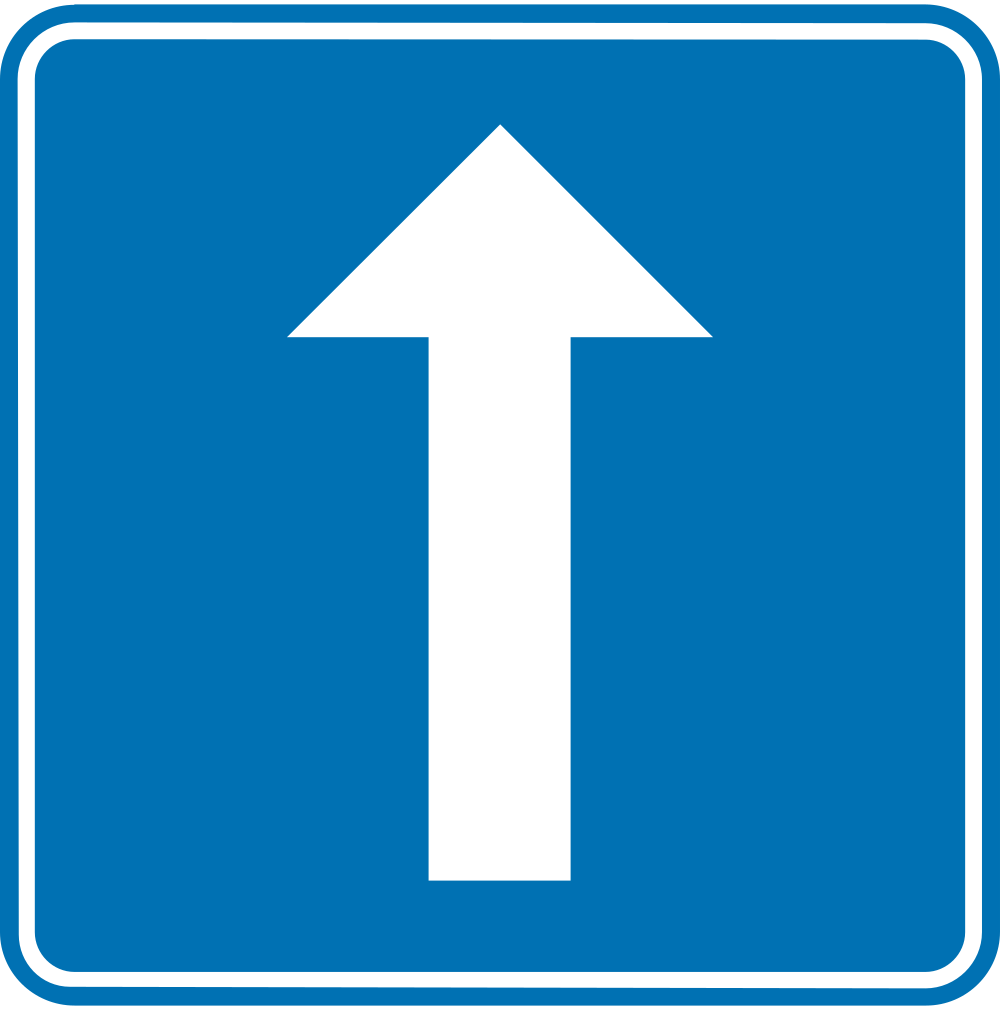 Road with one-way traffic.
Signal routier F19 • Voie publique à sens unique.
Verkeersbord F19 • Openbare weg met eenrichtingsverkeer.
What does Belgian traffic sign C1 mean?
Traffic sign C1 means that entry in that direction is prohibited for every driver, unless a supplementary sign provides an exception.
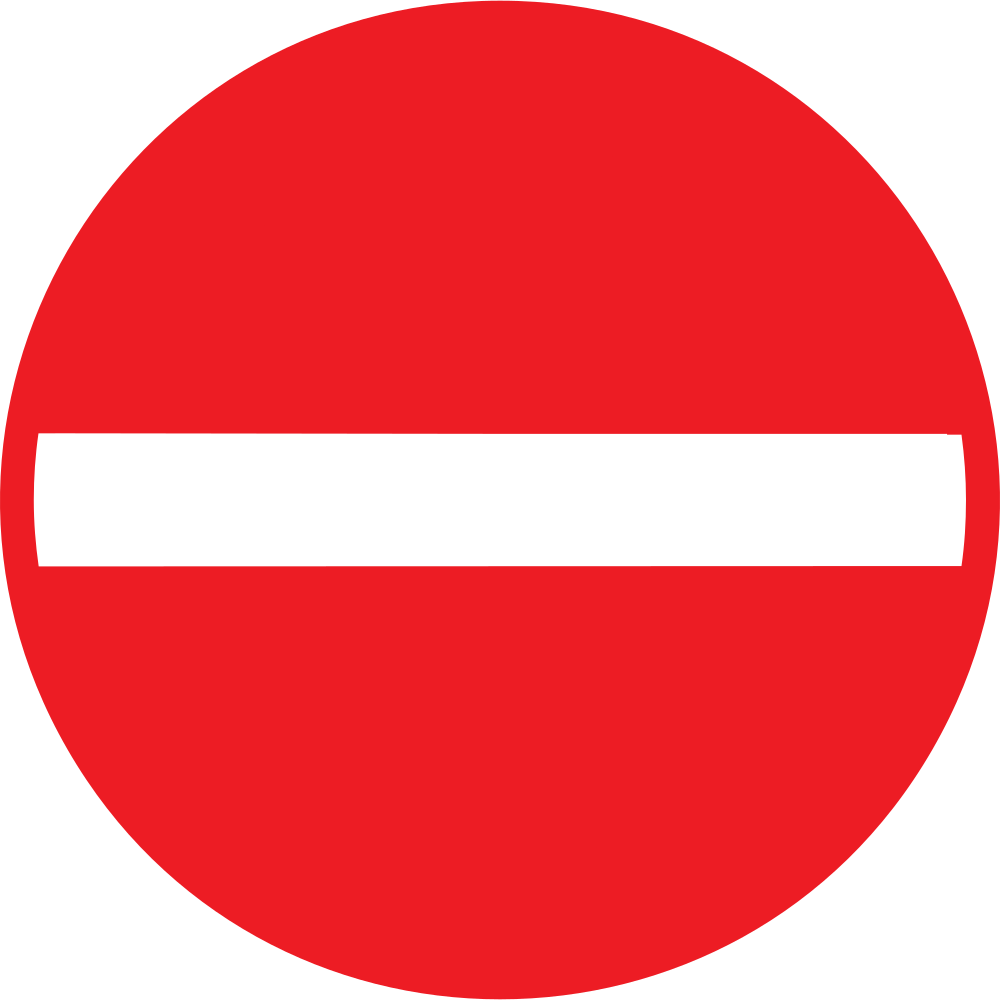 No entry.
Signal routier C1 • Sens interdit à tout conducteur.
Verkeersbord C1 • Verboden richting voor iedere bestuurder.
What changes for one-way traffic under Belgium’s new Road Code?
Belgium’s new Code of the Public Road takes effect on 1 June 2027. The main traffic signs for one-way traffic keep their existing numbers: traffic sign F19 continues to indicate a public road with one-way traffic, while traffic sign C1 continues to indicate a prohibited direction for all drivers. Traffic sign A39 continues to warn that two-way traffic begins after a section of one-way road. Drivers who are exceptionally allowed to travel in the opposite direction, such as certain cyclists, must keep as far to the right as possible.
 Road with one-way traffic.
Signal routier F19 • Voie publique à sens unique.
Verkeersbord F19 • Openbare weg met éénrichtingsverkeer.
 No entry.
Signal routier C1 • Sens interdit à tout conducteur.
Verkeersbord C1 • Verboden richting voor iedere bestuurder.
 Warning for a road with two-way traffic.
Signal routier A39 • Circulation admise dans les deux sens après une section de chaussée à sens unique.
Verkeersbord A39 • Verkeer toegelaten in beide richtingen na een gedeelte van de rijbaan met éénrichtingsverkeer.
What is the difference between F19 and C1?
F19 is placed at the permitted entrance and confirms the one-way direction. C1 is placed at the opposite end and prohibits entry from that direction.
Must drivers follow the direction shown by F19?
Yes. Drivers may not travel against the indicated direction unless their vehicle category is expressly exempted by a supplementary sign.
May cyclists ride against one-way traffic in Belgium?
Yes, when supplementary signs permit it. An M4 panel with F19 indicates that cyclists may ride in both directions. The corresponding exception is displayed beneath the C1 sign at the opposite entrance.
May class A mopeds ride against the direction?
They may do so when the signs contain the appropriate M5 or corresponding exception panel. Without that indicated exception, they must follow the ordinary one-way direction.
May speed pedelecs ride against the direction?
They may do so when the appropriate supplementary sign, such as M17 or M18, expressly permits them to travel in both directions.
Must drivers expect oncoming cyclists?
Yes. When supplementary signs permit contraflow cycling, drivers must expect cyclists or other authorised two-wheeled vehicles to approach from the opposite direction.
Does an oncoming contraflow cyclist come from a prohibited direction?
No. When the signs legally permit contraflow cycling, the cyclist is travelling in an authorised direction and must be treated as lawful traffic.
Does a Belgian one-way road automatically have priority?
No. F19 regulates only the direction of traffic. Drivers must continue to obey priority signs, traffic lights and the priority-from-the-right rule where applicable.
Can a contraflow cyclist have priority from the right?
Yes. When the cyclist is authorised to travel against the general one-way direction, the ordinary priority rules may apply. Drivers should not assume that an approaching cyclist is coming from a prohibited direction.
What is the speed limit on a Belgian one-way road?
There is no special speed limit solely because the road is one-way. The applicable limit depends on the region, built-up area, speed zone, road type and traffic signs.
Which side of a Belgian one-way road should you normally use?
Drivers must normally keep as close as possible to the right-hand side, unless lane selection, overtaking, congestion, turning or another traffic rule justifies a different position.
Where should you position yourself before turning left?
On a one-way carriageway, a driver turning left must normally move as close as possible to the left-hand edge before completing the turn at moderate speed.
May you overtake on the right?
Not merely because the road is one-way. Overtaking normally takes place on the left. Overtaking on the right is permitted in specific situations, such as when the vehicle ahead has indicated a left turn and has moved left. Faster movement in another marked lane or traffic queue may not legally count as overtaking in certain conditions.
May you stop or park on either side?
Yes. On a Belgian one-way carriageway, a stationary or parked vehicle may be positioned along either side, provided stopping or parking is permitted and all other positioning and clearance rules are respected.
May you park facing against the traffic direction?
The rule allowing parking on either side does not remove the other legal positioning requirements. Drivers should enter the parking place from the permitted direction and position the vehicle safely and lawfully.
May you reverse on a Belgian one-way road?
Reversing is a manoeuvre, so the driver must give way to all other road users. It may be used only where it is safe and not otherwise prohibited; it must not be used as a way to travel along the road against the prescribed direction.
May you make a U-turn?
You may not turn around and then continue against the one-way direction. A driver who has missed a destination should continue in the permitted direction and use another legal route.
Can part of a one-way carriageway temporarily carry traffic in both directions?
Yes. Traffic sign F85 indicates that traffic is permitted in both directions on a section of a carriageway that otherwise carries one-way traffic, often because of roadworks or a temporary traffic arrangement.
What does warning sign A39 mean?
Traffic sign A39 warns that two-way traffic begins after a section of carriageway with one-way traffic.
 Warning for a road with two-way traffic.
Signal routier A39 • Circulation admise dans les deux sens après une section de chaussée à sens unique.
Verkeersbord A39 • Verkeer toegelaten in twee richtingen na een gedeelte van de rijbaan met eenrichtingsverkeer.
When should you check for contraflow traffic?
Check carefully before turning across the road, leaving a parking place, crossing a cycle route or opening a door. Supplementary signs may permit cyclists, class A mopeds or speed pedelecs to approach from the opposite direction.
14. Quay
A quay is a constructed area beside a river, canal, harbour or other body of water, commonly used for loading, unloading, mooring vessels or providing waterside access. A road may run alongside the water or lead directly towards the quay edge.
In road traffic, a quay warning indicates a risk that a vehicle could leave the road and enter the water. Drivers should reduce speed, observe the road layout carefully and keep a safe distance from the waterside edge.

Wikimedia.org • Mark Ahsmann • CC BY-SA
Which Belgian sign warns of a quay or riverbank?
Belgian warning sign A11 indicates that the road leads onto a quay or riverbank.
 Warning for a quayside or riverbank.
Signal routier A11 • Débouché sur un quai ou une berge.
Verkeersbord A11 • Uitweg op een kaai of een oever.
What changes for quays under Belgium’s new Road Code?
Belgium’s new Code of the Public Road takes effect on 1 June 2027. The warning sign for an exit onto a quay or bank keeps its existing number: traffic sign A11. The design of the sign is updated to make it clearer that the danger involves water, but its meaning remains the same.
 Warning for a quayside or riverbank.
Signal routier A11 • Débouché sur un quai ou une berge.
Verkeersbord A11 • Uitweg op kaai of oever.
What does Belgian traffic sign A11 mean?
It warns that drivers are approaching a waterside edge where the road may lead directly towards or alongside a quay, bank, canal, harbour or similar body of water.
Does A11 mean that the road definitely ends?
Not necessarily. The road may end at the water, turn near it or continue along the quay. Drivers must slow down and observe the actual layout.
Does A11 prohibit vehicles from continuing?
No. A11 is a warning sign and does not itself prohibit access. A barrier, prohibition sign or instruction from an authorised person may impose an additional restriction.
Does A11 impose a speed limit?
No fixed numerical limit is created by A11. Drivers must respect the applicable speed limit and reduce their speed sufficiently to approach the danger safely.
How far before the quay is A11 placed?
In Brussels and Flanders, warning signs are normally placed approximately 150 metres before the danger. When the sign is placed at another distance, a supplementary panel indicates the approximate distance.
Must you be able to stop before the quay edge?
Yes. Drivers must adjust their speed so they remain able to stop before a foreseeable obstruction or danger, including the end or edge of the road.
Does A11 change the priority rules?
No. Drivers must continue to obey traffic lights, priority signs and the normal priority rules at nearby intersections.
May you stop or park near a Belgian quay?
A11 does not create an automatic stopping or parking prohibition. However, stopping or parking is prohibited wherever the vehicle would clearly create danger or unnecessarily obstruct other road users.
May local signs prohibit parking on a quay?
Yes. Parking signs, road markings, port regulations or access conditions may reserve areas for loading, authorised vehicles, emergency access or other specific purposes.
May you overtake after passing A11?
A11 does not create a specific overtaking prohibition. Overtaking is nevertheless unsafe when the road is narrow, visibility is limited or insufficient space remains beside the waterside edge.
What road users should you expect on a Belgian quay?
Drivers may encounter pedestrians, cyclists, dock workers, trucks, forklifts, cranes, railway vehicles and other port equipment. Their movements may be difficult to predict.
Must you obey instructions from port or customs personnel?
You must obey instructions given by persons who are legally authorised to regulate traffic. Gates, lights, temporary signs and marked traffic routes within a port or controlled site must also be respected.
Why can a Belgian quay be especially slippery?
Rain, frost, water, mud, algae, oil and cargo residue can reduce grip. Railway tracks, metal covers and painted surfaces may also become slippery when wet.
How should you park a vehicle near the water?
Use only an authorised parking place, keep a safe distance from the edge and secure the vehicle properly with its parking brake. Follow all local signs, markings and instructions.
Should you reverse towards a quay edge?
Only when necessary and after checking that the route is completely clear. Use assistance from another person where available, particularly with a truck, trailer or vehicle with restricted rear visibility.
Does the absence of A11 mean there is no waterside danger?
No. Drivers remain responsible for observing the road and adapting their speed. A quay, canal or riverbank may still require additional caution even when no A11 sign is present.
15. Slope
A slope is a section of road that rises or descends noticeably. A steep slope can affect vehicle speed, braking distance, traction, visibility and the ability of heavy or low-powered vehicles to maintain a steady speed.
Warning signs may indicate a steep ascent or dangerous descent and may show the gradient as a percentage. Drivers should adjust their speed early, select a suitable gear and remain prepared for slow vehicles, bends and changing road conditions.
Wikimedia.org • Astro • CC0
Which Belgian signs warn of a steep slope?
Traffic sign A3 warns of a dangerous descent, while traffic sign A5 warns of a steep ascent.
 Warning for a steep descent.
Signal routier A3 • Descente dangereuse.
Verkeersbord A3 • Gevaarlijke daling.
 Warning for a steep ascent.
Signal routier A5 • Montée à forte inclinaison.
Verkeersbord A5 • Steile helling.
What changes for steep ascents and descents under Belgium’s new Road Code?
Belgium’s new Code of the Public Road takes effect on 1 June 2027. The warning signs keep their existing numbers: traffic sign A3 warns of a dangerous descent and traffic sign A5 warns of a dangerous ascent. The percentage shown on the sign indicates the gradient of the slope. Under the new Road Code, the meaning of A5 is broadened from a “steep ascent” to a dangerous ascent.
 Warning for a steep descent.
Signal routier A3 • Descente dangereuse. Le pourcentage indique l’inclinaison de la pente.
Verkeersbord A3 • Gevaarlijke daling. Het percentage duidt de hellingsgraad aan.
 Warning for a steep ascent.
Signal routier A5 • Montée dangereuse. Le pourcentage indique l’inclinaison de la pente.
Verkeersbord A5 • Steile helling. Het percentage duidt de hellingsgraad aan.
What does Belgian traffic sign A3 mean?
Sign A3 warns that the road ahead descends steeply or dangerously in the direction of travel.
What does Belgian traffic sign A5 mean?
Sign A5 warns that the road ahead rises steeply in the direction of travel.
What does the percentage on a Belgian slope sign mean?
A displayed gradient of 10% means that the road rises or falls approximately 10 metres over a horizontal distance of 100 metres. It does not represent an angle of 10 degrees.
When may A3 or A5 be installed in Belgium?
Under the current Belgian placement rules, these signs may be used for carriageways with an ascent or descent of at least 7%.
Does A3 or A5 impose a speed limit?
No. They are warning signs. Drivers must respect the applicable maximum speed and reduce their speed sufficiently for the gradient, visibility, traffic and road conditions.
How should you drive down a steep Belgian road?
Reduce speed before the descent, select a suitable gear and keep the vehicle under control. Drivers must always be able to stop before a foreseeable obstruction.
Should you descend in neutral?
No. Keep the transmission engaged so that engine braking helps control the vehicle. Coasting can allow the vehicle to gain speed and places more demand on the brakes.
How should you drive uphill?
Select a suitable gear early and maintain a controlled speed. Expect heavy vehicles, agricultural vehicles or vehicles towing trailers to travel more slowly.
May you overtake near the top of a Belgian slope?
Left-side overtaking of a team, a two-wheeled motor vehicle or a vehicle with more than two wheels is prohibited when approaching the crest of a slope with insufficient visibility. An exception applies where overtaking can be completed without crossing the continuous line separating opposing traffic.
May you stop or park near the crest of a slope?
No, when visibility is insufficient. Stopping and parking on the carriageway near the top of a slope are prohibited where the vehicle would be difficult for approaching road users to see.
Does uphill traffic automatically have priority in Belgium?
No. Belgian law does not give uphill traffic a universal priority solely because of the slope. Drivers must follow priority signs and the ordinary crossing rules.
Who must give way when an obstruction narrows the road?
The driver whose passage is obstructed must slow down and, when necessary, stop to allow approaching road users to pass.
Does a slope sign change priority at an intersection?
No. Signs A3 and A5 warn of the gradient but do not alter intersection priority. Traffic lights, priority signs and the ordinary priority rules remain applicable.
Must you reduce speed below the posted limit?
Yes, when necessary. Belgian drivers must adapt their speed to the road layout, visibility, traffic, weather, vehicle condition and load.
Why should heavy vehicles leave additional distance?
Heavy vehicles require more distance to slow down and their brakes may heat up during long descents. Additional following distance provides more time to react and brake progressively.
How should cyclists be passed on a Belgian slope?
Drivers must leave at least one metre inside a built-up area and 1.5 metres outside a built-up area. They should wait when the crest, bend or oncoming traffic prevents a safe pass.
How should you secure a parked vehicle on a slope?
Apply the parking brake firmly, select a gear or the transmission’s parking position and take every necessary precaution to prevent the vehicle from moving or being misused.
16. Bus lane
A bus lane is a traffic lane reserved primarily for buses or other authorised public-transport vehicles. It is intended to improve the reliability and flow of public transport by allowing authorised vehicles to avoid general traffic congestion.
Other road users, such as taxis, cyclists, motorcycles or vehicles carrying several occupants, may also be permitted when signs expressly allow them. The operating hours, permitted vehicles, direction of travel and rules for entering or crossing the lane depend on local traffic signs and regulations.

Wikimedia.org • Jeanhousen • CC BY-SA
How can you recognise a bus lane in Belgium?
A Belgian bus lane is indicated by traffic sign F17 or traffic sign F18. A lane indicated by F17 is reserved for regular public-transport vehicles and is separated from the rest of the carriageway by one or two broad white broken lines. A special passable lane indicated by F18 is marked by a checkerboard pattern of white squares and may also be used by other categories of road users when this is permitted by the sign.
 Lane for buses.
Signal routier F17 • Indication des bandes de circulation d'une chaussée parmi lesquelles une est réservée aux autobus.
Verkeersbord F17 • Aanduiding van de rijstroken van een rijbaan met een strook voorbehouden voor autobussen.
 Lane for buses and trams.
Signal routier F18 • Indication d'un site spécial franchissable réservé à la circulation des véhicules des services réguliers de transport en commun.
Verkeersbord F18 • Aanwijzing van een bijzondere overrijdbare bedding, voorbehouden aan het verkeer van voertuigen van geregelde diensten voor gemeenschappelijk vervoer.
What changes for bus lanes under Belgium’s new Road Code?
Belgium’s new Code of the Public Road takes effect on 1 June 2027. The current distinction between the bus lane indicated by traffic sign F17 and the special passable lane indicated by traffic sign F18 disappears. Both are combined into a single system indicated by a redesigned traffic sign F17. The new bus lane may be separated by continuous or broken markings; where the continuous marking changes to a broken marking, other vehicles may enter the bus lane to change direction at the next intersection. The old F17 and F18 signs and their associated road markings may remain in use until 1 June 2030.
 Lane for buses.
Signal routier F17 • Bande bus. Les flèches apposées sur le signal indiquent le sens de circulation sur la partie de la voie publique concernée. Ce signal peut aussi reprendre le marquage des bandes de circulation. Selon le cas, ces marques routières peuvent être soit continues, soit discontinues, soit les deux.
Verkeersbord F17 • Busbaan. De pijlen op het verkeersbord geven de rijrichting aan op het betrokken weggedeelte. Dit verkeersbord kan ook de rijstrookmarkeringen weergeven. Naargelang het geval zijn deze wegmarkeringen doorlopend, onderbroken of beide.
Is a Belgian bus lane part of the carriageway?
No. Under the current Belgian Highway Code, a bus lane does not legally form part of the carriageway.
Which vehicles may always use a Belgian bus lane?
Vehicles operating scheduled public-transport services may use the bus lane.
May school-transport vehicles use a Belgian bus lane?
Yes. Under the current transitional rule, school-transport vehicles may use bus lanes until 31 May 2027 even when their symbol is not displayed. The new road code continues this transitional permission until 1 June 2030.
May taxis use a Belgian bus lane?
Yes. Taxis may currently use bus lanes even when the word or symbol for taxis is absent. This transitional permission continues under the new road code until 1 June 2030.
Which other vehicles may be permitted?
When their word, symbol or identification sign appears on F17 or an additional panel, the lane may also be used by cyclists, mopeds, motorcycles, coaches, buses, commuter vehicles, high-occupancy vehicles, sustainable-mobility vehicles or vehicles transporting people with disabilities.
May an ordinary private car use a Belgian bus lane?
Normally not. A private car may use it only when the signs expressly permit its category or in one of the limited situations allowed by the Highway Code.
May you use the bus lane to pass a traffic queue?
No. An unauthorised driver may not use the bus lane merely to overtake congestion or reach the front of a queue.
May an ordinary driver enter the bus lane to avoid an obstruction?
Yes. Another vehicle may temporarily use the bus lane when necessary to pass around an obstruction on the carriageway, provided the manoeuvre can be completed safely.
May you enter a Belgian bus lane to turn?
Yes, in the immediate vicinity of an intersection. The driver may use the bus lane to change direction but must first check for buses, cyclists and all other authorised users.
May you cross a bus lane at an intersection?
Yes. Other vehicles may cross the bus lane at an intersection when following their permitted route.
May you cross a bus lane to enter a property or parking place?
Yes. A driver may cross it to enter or leave a property or parking place situated beside the bus lane. The driver must give way where required and must not endanger authorised lane users.
May you drive along the bus lane to reach a property?
Only the necessary crossing movement is permitted. A driver may not continue along the bus lane for convenience unless another legal exception applies.
May cyclists use every Belgian bus lane?
No. Cyclists may use a bus lane only when the bicycle symbol or another legally valid indication permits them.
Must cyclists ride in single file in a Belgian bus lane?
Yes, under the current Highway Code. Cyclists using an authorised bus lane must ride one behind another.
May mopeds or speed pedelecs use a bus lane?
Only when the applicable moped class or speed-pedelec indication permits them. Drivers must check the F17 sign and its additional panel carefully.
What is the difference between F17 and F18?
F17 indicates a bus lane. F18 indicates a special traversable public-transport site, which is normally separated by broad continuous markings or checkerboard markings. The permitted movements for ordinary vehicles are more limited on an F18 site.
May you stop or park in a Belgian bus lane?
An unauthorised driver may not use a bus lane as a stopping or parking place. Separate bus-stop, parking and local signs must also be respected, and the passage of authorised vehicles may not be obstructed.
What is the speed limit in a Belgian bus lane?
There is no special general speed limit solely because it is a bus lane. The applicable road, regional, zonal, signed and vehicle-specific speed limits remain in force.
Does a bus have priority at every intersection?
No. The bus lane does not itself give buses automatic priority. Drivers must follow traffic lights, priority signs and the ordinary priority rules.
Must you allow a bus to leave its stop?
Yes, inside a built-up area. A driver travelling in the same direction must allow an autobus or trolleybus to leave its stop when its driver signals the intention to move off. The approaching driver must slow down and stop if necessary.
Can a Belgian bus lane carry traffic against the normal direction?
Yes. A contraflow arrangement may reserve a lane for public transport in the opposite direction. The arrows on F17 and any supplementary signs indicate the authorised direction.
What should you check before turning across a bus lane?
Check mirrors and blind spots and look for buses, taxis, cyclists, mopeds, motorcycles and other authorised vehicles. The bus lane may remain active while general traffic is stationary.
17. Dead end
A dead-end road is a road that does not provide a through route for some or all vehicles. It may end completely, terminate at a barrier or continue as a path that only certain road users may use.
Drivers may normally enter a dead-end road to reach homes, businesses, parking places or other destinations, but they must be prepared to turn around or leave by the same route. Signs may indicate that pedestrians or cyclists can continue beyond the point where motor traffic cannot.

Wikimedia.org • Jean Housen • CC BY-SA
Which Belgian traffic signs indicate a dead-end road?
Traffic sign F45 indicates a dead-end road with no through route, meaning drivers entering it must normally leave again by the same route. Traffic sign F45b indicates a dead-end road for motor traffic where pedestrians and cyclists can continue.
 Dead end street.
Signal routier F45 • Voie sans issue.
Verkeersbord F45 • Doodlopende weg.
 Dead end street with a passage for pedestrians and cyclists.
Signal routier F45b • Voie sans issue, excepté pour les piétons et les cyclistes.
Verkeersbord F45b • Doodlopende weg, uitgezonderd voor voetgangers en fietsers.
What changes for dead-end roads under Belgium’s new Road Code?
Belgium’s new Code of the Public Road takes effect on 1 June 2027. The current traffic sign F45 for a dead-end road becomes traffic sign F45a. Traffic sign F45b continues to indicate a dead-end road where pedestrians and cyclists can continue. For both signs, the road-layout symbol may be adapted to the local situation.
 Dead end street.
Signal routier F45a • Voie sans issue. Le symbole peut être adapté en fonction des lieux.
Verkeersbord F45a • Doodlopende weg. Het symbool kan aangepast zijn in functie van de plaatsgesteldheid.
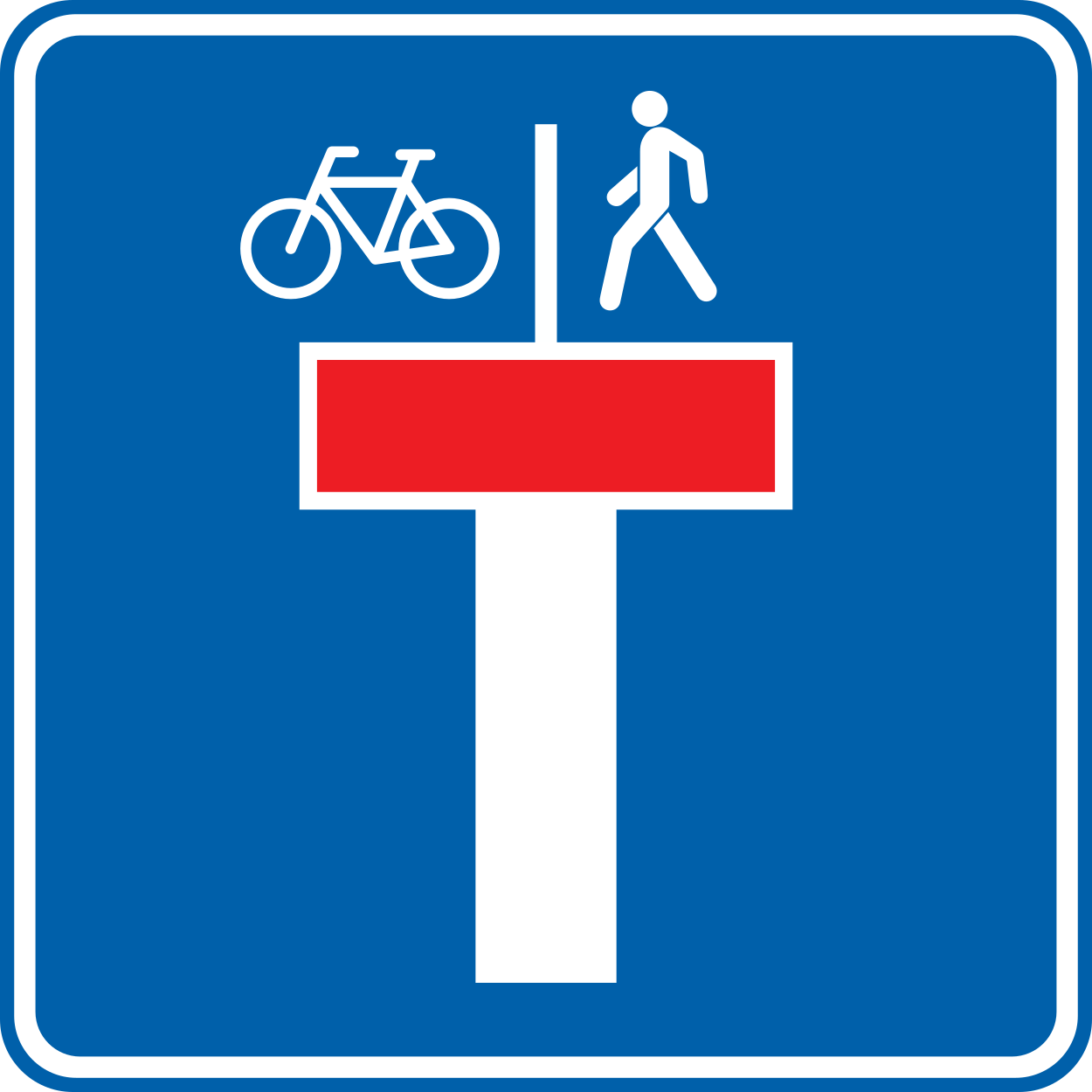 Dead end street with a passage for pedestrians and cyclists.
Signal routier F45b • Voie sans issue, à l’exception des cyclistes et des piétons. Le symbole peut être adapté en fonction des lieux.
Verkeersbord F45b • Doodlopende weg, uitgezonderd voor fietsers en voetgangers. Het symbool kan aangepast zijn in functie van de plaatsgesteldheid.
Does F45 prohibit drivers from entering?
No. F45 is an indication sign, not an access prohibition. Drivers may enter to reach a home, business, parking place or another destination unless an additional sign restricts access.
Can motor vehicles continue beyond an F45b sign?
No through route is available for motor traffic. Motor vehicles may enter the road but must turn around before the point where their passage ends.
May cyclists ride through an F45b dead end?
F45b indicates that a through connection exists for cyclists. Cyclists must still follow the signs and rules applying to the path or road beyond the dead end and may need to dismount where cycling is not permitted.
May pedestrians continue through an F45b dead end?
Yes. The sign specifically indicates that pedestrians can continue beyond the point where motor traffic cannot.
Does F45b permit mopeds or other motor vehicles to continue?
Not by itself. F45b identifies an exception for pedestrians and cyclists. Other vehicle categories require a separate legal permission or traffic sign.
Does F45 indicate whether pedestrians or cyclists can continue?
No. The ordinary F45 sign does not indicate a through connection for pedestrians or cyclists. Road users should observe the actual layout and any additional signs.
Does a Belgian dead-end sign impose a speed limit?
No. The applicable regional, zonal or posted speed limit remains in force. Drivers must still adjust their speed to the road width, visibility and presence of pedestrians or cyclists.
Does a dead-end road automatically have lower priority?
No. Its dead-end status does not determine priority. Drivers must follow priority signs, traffic lights and the ordinary priority rules.
Does a driver leaving a Belgian dead-end road always have to give way?
Not merely because the road is a dead end. The applicable priority depends on traffic signs, the type of road and the normal Belgian priority rules.
May you turn around in a Belgian dead-end road?
Yes, where it is not prohibited and can be done safely. Turning around is a manoeuvre, so the driver must give way to all other road users.
May you reverse in a Belgian dead-end road?
Yes, when necessary and safe. Reversing is a manoeuvre, so the driver must give way to every other road user and must not create danger or unnecessary obstruction.
Must you use the indicators while turning around?
The driver must indicate the intended movement in time when the manoeuvre involves a lateral movement or change of direction and the vehicle is equipped with direction indicators.
May you park in a Belgian dead-end road?
The F45 or F45b sign does not create a general parking prohibition. Drivers must follow the ordinary stopping and parking rules and any local signs or markings.
May you park in the turning area?
Only when parking is permitted and the vehicle does not create danger or unnecessary obstruction. Drivers should leave enough room for other vehicles, refuse trucks and emergency services to turn.
May you block the pedestrian or cycling connection?
No. A parked or stationary vehicle must not obstruct the lawful passage of pedestrians or cyclists or force them into an unsafe position.
What should large-vehicle drivers consider?
A Belgian dead-end road may have limited turning space. Drivers of trucks, buses, caravans or trailers should confirm that they can turn safely before entering.
18. Stop sign
A stop sign requires drivers to bring their vehicle to a complete stop and give way before entering or crossing the road ahead. The stop must be made at the stop line or another legally prescribed position.
After stopping, the driver may continue only when this can be done safely and without interfering with traffic that has priority. The sign does not create priority for the driver who has stopped.

Wikimedia.org • Jeanhousen • CC BY-SA
Which Belgian traffic signs indicate a stop?
Traffic sign B5 is the Belgian stop sign and means stop and give way. Traffic sign B7 announces an upcoming B5 stop sign and indicates approximately how far away it is.
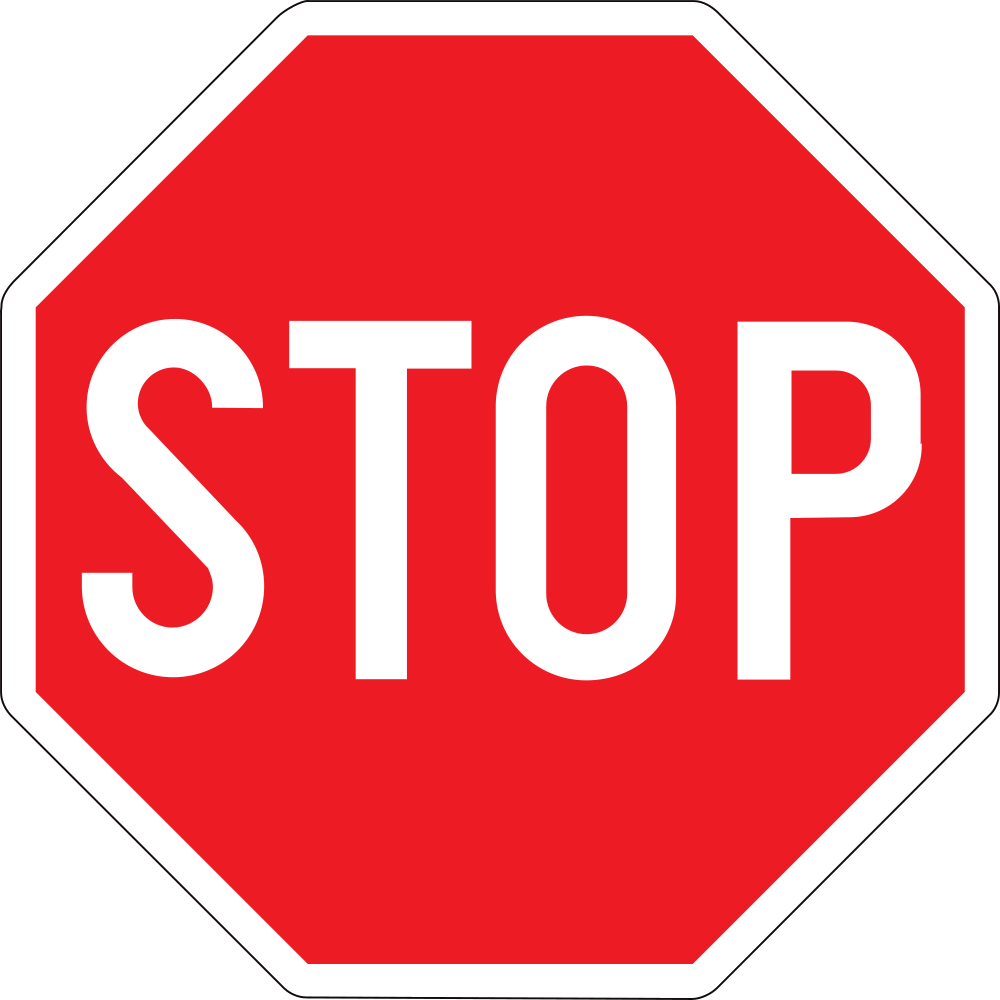 Stop and give way.
Signal routier B5 • Marquer l’arrêt et céder la priorité.
Verkeersbord B5 • Stoppen en voorrang verlenen.
 Stop and give way ahead.
Signal routier B7 • Signal annonçant le signal B5 à la distance approximativement indiquée.
Verkeersbord B7 • Verkeersbord dat het verkeersbord B5 aankondigt op de bij benadering aangeduide afstand.
What changes for stop signs under Belgium’s new Road Code?
Belgium’s new Code of the Public Road takes effect on 1 June 2027. Traffic sign B5 keeps its existing number and continues to mean stop and give way. The current traffic sign B7, which announces an upcoming B5 stop sign, is no longer included as a separate traffic sign. Instead, the new supplementary sign M3 is used with B5 to announce the stop sign at approximately the indicated distance.
 Stop and give way.
Signal routier B5 • Marquer l’arrêt et céder la priorité.
Verkeersbord B5 • Stoppen en voorrang verlenen.
 Stop ... metres ahead.
Signal routier M3 • Panneau additionnel qui annonce le signal B5 à la distance approximative indiquée (exemple).
Verkeersbord M3 • Onderbord dat het verkeersbord B5 aankondigt op de bij benadering aangeduide afstand (voorbeeld).
Must you always stop at Belgian sign B5?
Yes. You must come to a complete stop even when no other road user is visible.
Is slowing down enough at B5?
No. The vehicle must stop completely. A rolling or very slow passage does not comply with the sign.
Where must you stop when there is a stop line?
You must stop before the white continuous stop line. The line indicates the precise place where drivers must stop because of B5 or a traffic light.
Where must you stop when there is no stop line?
Stop before entering the intersection or priority road, in the immediate vicinity of the B5 sign and at a position from which you can give way safely.
What if you cannot see enough from the stop line?
You must first stop at the line. You may then move forward slowly to improve your view and must stop again when necessary before entering the road.
May your vehicle cross the stop line before stopping?
No. The stop line marks the place before which the mandatory stop must be completed.
Must every driver in a queue stop separately?
Yes. Each driver approaching B5 must make a separate complete stop, even when the preceding vehicle has already stopped.
Who must you give way to after stopping?
You must give way to every driver travelling on the public road or carriageway you are entering. Other priority duties concerning pedestrians, cyclists and crossed paths also remain applicable.
Must you check traffic from both directions?
Yes. Check every direction from which lawful traffic may approach, including contraflow cyclists or mopeds where signs permit them.
Does stopping at B5 give you priority?
No. You may proceed only when this can be done without danger, taking account of the position, speed and distance of the road users who have priority.
What is the difference between B5 and B1?
B5 requires you to stop and give way. B1 requires you to give way but does not require a complete stop when you can proceed safely without stopping.
What does Belgian sign B7 mean?
Traffic sign B7 announces that a B5 stop sign is ahead and indicates its approximate distance.
Is B7 always placed before B5?
No. It is generally used to announce B5, but it is not required in certain situations, including inside built-up areas and on some very narrow roads.
Can B5 warn about two-way cycle traffic?
Yes. A supplementary panel may indicate that cyclists, or cyclists together with certain mopeds, travel in both directions on the road being entered.
Can B5 apply only to cyclists or moped riders?
Yes. An appropriate supplementary panel may limit the stop obligation to cyclists or to cyclists together with indicated two-wheeled moped riders.
Must cyclists obey an ordinary B5 sign?
Yes. When B5 applies to their route and no exception is indicated, cyclists must stop and give way like other drivers.
Can B5 be placed at a roundabout?
Yes. Belgian roundabout entrances may be controlled by B1 or B5. When B5 is displayed, the driver must stop before giving way to traffic on the roundabout.
Does B5 apply when the traffic lights are working?
No, when functioning traffic lights control the same location. Belgian priority signs on that road do not apply while those traffic lights are operating.
What if the traffic light is flashing orange-yellow?
An orange-yellow flashing light does not change the priority arrangement. A B5 sign at that location therefore remains applicable.
What if a police officer directs you through the stop sign?
Follow the officer’s instruction. Orders from an authorised person take precedence over traffic lights, signs, road markings and ordinary traffic rules.
Can a stop line cross a cycle path?
Where longitudinal markings indicate a cycle path, the stop line is normally placed before those markings and may be repeated beyond them when necessary. Drivers must avoid blocking cyclists.
Does B5 change the speed limit?
No. The sign creates a stopping and yielding obligation but does not introduce a new maximum speed.
Why is B5 used instead of B1?
Belgian placement rules normally reserve B5 for situations where visibility is so limited that drivers cannot properly give way without first stopping.
19. Give way
A give-way sign requires drivers to allow traffic with priority to proceed before entering, crossing or joining a road. Drivers must reduce speed, observe approaching traffic and stop when necessary.
Unlike a stop sign, a give-way sign does not always require a complete stop. The driver may continue without stopping only when the route is clearly safe and no road user with priority is forced to change speed or direction.

Wikimedia.org • Jeanhousen • CC BY-SA
Which Belgian traffic signs indicate that you must give way?
Traffic sign B1 means that drivers must give way. Traffic sign B3 announces an upcoming B1 sign and indicates approximately how far away it is.
 Give way.
Signal routier B1 • Céder la priorité.
Verkeersbord B1 • Voorrang verlenen.
 Give way ahead.
Signal routier B3 • Signal annonçant le signal B1 à la distance approximativement indiquée.
Verkeersbord B3 • Verkeersbord dat het verkeersbord B1 aankondigt op de bij benadering aangeduide afstand.
What changes for give-way signs under Belgium’s new Road Code?
Belgium’s new Code of the Public Road takes effect on 1 June 2027. Traffic sign B1 keeps its existing number and continues to mean give way. The current traffic sign B3, which announces an upcoming B1 sign, is no longer included as a separate traffic sign. Instead, a distance indication can be given using supplementary sign M1 with B1.
 Give way.
Signal routier B1 • Céder la priorité.
Verkeersbord B1 • Voorrang verlenen.
 ... metres ahead.
Signal routier M1 • Panneau additionnel indiquant la distance approximative entre le signal et le début du passage dangereux ou le signal identique à celui sous lequel il est placé (exemple).
Verkeersbord M1 • Onderbord dat bij benadering de afstand aanduidt tussen het verkeersbord en het begin van de gevaarlijke passage of het identieke verkeersbord als dat waaronder het is geplaatst (voorbeeld).
Must you always stop at Belgian sign B1?
No. You must stop only when necessary to give way or to obtain a clear view. If the road is clearly free, you may continue cautiously without making a complete stop.
Who must you give way to at B1?
You must give way to every driver travelling on the public road or carriageway you are entering.
When may you continue after giving way?
You may proceed only when this can be done without danger, taking account of the position, speed and distance of the other road users.
What do the white triangles on the road mean?
A transverse row of white triangles indicates the place where drivers must, when necessary, stop to give way because of sign B1. These markings are commonly called shark teeth.
Must you stop before the white triangles?
Only when stopping is necessary to give way or observe traffic. When the road is clearly free, you may cross the markings cautiously without stopping.
What if there are no white triangles?
Approach B1 cautiously and give way before entering the intersection or priority road. Stop at a position from which you can observe traffic safely when necessary.
What is the difference between B1 and B5?
B1 requires drivers to give way but does not always require a stop. B5 requires drivers to stop completely and then give way.
What does Belgian sign B3 mean?
Traffic sign B3 announces that a B1 give-way sign is ahead and indicates its approximate distance.
Is B3 always placed before B1?
No. It is used where advance warning is required, particularly when B1 is not visible from a sufficient distance. Belgian placement rules provide exceptions, including certain locations inside built-up areas.
Does B1 replace priority from the right?
Yes, at that intersection. A driver approaching B1 must give way to traffic on the road being entered, even when that traffic approaches from the left.
Does B1 mean that the other road is a priority road?
Not necessarily. It establishes priority at that particular intersection. The other road is a continuing priority road only when signs such as B9 indicate that status.
Can B1 be used at a roundabout?
Yes. Belgian roundabout entrances are normally controlled by B1 or B5. A driver approaching B1 must give way to drivers already travelling on the roundabout.
Must you give way to traffic in every roundabout lane?
Yes. Do not enter when your movement would hinder a driver already circulating, including a vehicle travelling in an inner lane that may change position or leave the roundabout.
Can B1 warn about cyclists travelling in both directions?
Yes. A supplementary panel may indicate that cyclists, or cyclists together with certain two-wheeled mopeds, travel in both directions on the road being entered.
Must you check both directions for cyclists?
Yes. Where contraflow or two-way cycle traffic is permitted, cyclists or mopeds may lawfully approach from either direction.
Can B1 apply only to cyclists?
Yes. A supplementary panel may indicate that B1 applies only to cyclists or to cyclists together with specified two-wheeled moped riders.
Must cyclists obey an ordinary B1 sign?
Yes. When the sign applies to their route, cyclists must give way like other drivers.
Does B1 itself require you to give way to pedestrians?
B1 primarily regulates priority between drivers. Separate Belgian rules still require drivers to give way when turning across pedestrians with priority, crossing a pavement or cycle path, or approaching a pedestrian crossing.
Must you give way when crossing a bike path?
Yes. A driver crossing a bike path must give way to the road users legally using it, regardless of the additional B1 obligation.
Does stopping voluntarily give you priority?
No. Even after stopping, you remain subject to B1 and may proceed only when priority traffic can continue without being hindered.
Must every vehicle in a queue assess priority separately?
Yes. Each driver must check the road independently. You may not follow the vehicle ahead through the intersection without confirming that it remains safe.
Does B1 apply while traffic lights are operating?
No, when functioning traffic lights control the same road at that location. The traffic lights then determine whether you may proceed.
What if the traffic light is flashing orange-yellow?
An orange-yellow flashing light does not change the priority arrangement. You may pass it with extra caution, but the B1 sign remains applicable.
What if an authorised officer directs traffic?
Follow the officer’s instructions. Orders from a competent authorised person take precedence over traffic lights, signs, road markings and ordinary traffic rules.
Does B1 impose a speed limit?
No. It regulates priority. You must nevertheless approach at a speed that allows you to observe traffic and stop when necessary.
20. Roundabout
A roundabout is a circular road arrangement in which traffic travels around a central island in one designated direction. Vehicles enter and leave through connecting roads, and traffic signs or local rules determine who has priority.
Drivers should reduce speed, choose a suitable lane, observe all road users and signal as required when leaving. The direction of travel, entry priority, lane use and rules for cyclists and pedestrians depend on local traffic signs and regulations.
Wikimedia.org • Spotter2 • CC BY-SA
What is legally considered a roundabout in Belgium?
A Belgian rotonde is a road where traffic travels in one direction around a constructed central island. It is indicated by traffic sign D5, and its entrances are controlled by signs B1 or B5.
 Mandatory roundabout direction.
Signal routier D5 • Sens giratoire obligatoire.
Verkeersbord D5 • Verplicht rondgaand verkeer.
Give way.
Signal routier B1 • Céder la priorité.
Verkeersbord B1 • Voorrang verlenen.
Stop and give way.
Signal routier B5 • Marquer l’arrêt et céder la priorité.
Verkeersbord B5 • Stoppen en voorrang verlenen.
What changes for roundabouts under Belgium’s new Road Code?
Belgium’s new Code of the Public Road takes effect on 1 June 2027. Traffic sign D5 keeps its existing number and continues to indicate a roundabout with compulsory circulation in the direction shown by the arrows. The new Road Code sets out specific rules for lane use on roundabouts: on a roundabout with several lanes, drivers who are not taking the first exit may use a lane other than the right-hand lane. Drivers entering a roundabout must give way to traffic already on the roundabout, and direction indicators are required when leaving the roundabout, not when entering it.
 Mandatory roundabout direction.
Signal routier D5 • Rond-point. Sens giratoire obligatoire dans le sens indiqué par les flèches.
Verkeersbord D5 • Rotonde. Verplicht rondgaand verkeer in de door de pijlen aangeduide richting.
Which Belgian sign indicates a roundabout?
Traffic sign D5 requires traffic to circulate around the central island in the direction shown by the arrows.
Which direction do vehicles travel on a Belgian roundabout?
Vehicles travel anticlockwise, keeping the central island on their left.
Who has priority on a Belgian roundabout?
Drivers already travelling on the roundabout have priority over drivers entering through an access road controlled by B1 or B5.
Must you stop before entering?
At sign B1, stop only when necessary to give way. At sign B5, you must always stop completely before giving way.
Does priority from the right apply on a Belgian roundabout?
No. A driver travelling on a legally signposted roundabout does not have to give way to a driver entering from the right.
Is every circular junction legally a roundabout?
No. A circular road arrangement without the required D5 and entry-priority signs may be governed by ordinary priority rules. Drivers must check the actual signs rather than rely only on the road’s shape.
Must you use an indicator when entering a Belgian roundabout?
No. Under the current Belgian Highway Code, entering a roundabout is considered a change of direction for which the indicators do not have to be used.
Must you use an indicator when leaving?
Yes. You must use the right direction indicator in time when leaving the roundabout and switch it off once the movement has been completed.
Does using the indicator give you priority?
No. Signalling only communicates your intention. You must still give way when changing lanes or crossing the path of another road user.
Must you keep as far right as possible on a Belgian roundabout?
No. On a roundabout, drivers do not have to remain as close as possible to the right-hand edge unless a part of the road is specifically reserved for them.
Which lane may you use?
When the roundabout has marked lanes, you must follow the lane markings and may use the lane that best suits your destination.
May you use the inner lane?
Yes. You may use an inner lane when the markings permit it. Before moving to an outer lane or leaving, you must check that the movement can be made safely.
Who has priority when you change lanes?
Changing lanes is a manoeuvre. You must give way to all road users already travelling in the lane you want to enter.
May you leave directly from an inner lane?
Only when the lane markings expressly guide that lane towards the exit. Otherwise, you must first move safely into the appropriate outer lane without cutting across another driver’s path.
What should you do if you are in the wrong lane?
Do not force your way across another lane. Continue around the roundabout and reposition safely before attempting to leave again.
What speed limit applies on a Belgian roundabout?
There is no special general speed limit solely because it is a roundabout. The applicable regional, zonal or posted limit remains in force, but drivers must reduce their speed sufficiently for the layout and traffic conditions.
Do cyclists on the roundabout have priority?
A cyclist travelling lawfully on the roundabout carriageway has priority over traffic entering through B1 or B5. Drivers must remain alert because cyclists may be less visible beside or ahead of a vehicle.
Who has priority on a bike path around the roundabout?
This depends on the signs, markings and design of the cycle route. A driver crossing a continuing bike path must give way to its lawful users. At a separate cycle crossing, cyclists may have to give way before entering when B1 signs or give-way markings apply to them.
Must drivers give way to cyclists when leaving?
Yes, when the driver crosses a bike path used lawfully by the cyclist. Drivers must also give way to road users continuing along another part of the same public road when changing direction.
Must cyclists signal when leaving?
Cyclists should, when possible, indicate their intention to leave by extending the right arm. They must keep both hands available when signalling would make control unsafe.
Must you give way to pedestrians when leaving?
A driver changing direction must give way to pedestrians crossing the road being entered. At a marked pedestrian crossing, drivers must also give way to pedestrians who are on it or about to enter it.
May you stop or park on a Belgian roundabout?
The D5 sign does not by itself create a separate parking prohibition. However, the ordinary stopping and parking rules remain applicable. Parking on a carriageway divided into traffic lanes is prohibited unless an authorised parking place is provided, and no vehicle may create danger or unnecessary obstruction.
May you reverse or make a U-turn?
No. You must follow the mandatory direction around the central island. If you miss an exit, continue around the roundabout rather than reversing or turning against traffic.
21. Priority road
A priority road is a road whose traffic is given priority over traffic entering from intersecting roads. It is normally identified by a priority-road sign, while an end sign indicates where that continuing priority status stops.
Drivers on a priority road must still obey traffic lights, authorised officers, speed limits, crossings and turning rules. Having priority never allows a driver to proceed when doing so would create danger or block an intersection.
Wikimedia.org • Jeanhousen • CC BY-SA
Which Belgian traffic signs indicate the beginning and end of a priority road?
Traffic sign B9 indicates the beginning of a priority road. Traffic sign B11 indicates the end of a priority road.
 Start of a priority road.
Signal routier B9 • Voie prioritaire.
Verkeersbord B9 • Voorrangsweg.
 End of the priority road.
Signal routier B11 • Fin de voie prioritaire.
Verkeersbord B11 • Einde van voorrangsweg.
What changes for priority roads under Belgium’s new Road Code?
Belgium’s new Code of the Public Road takes effect on 1 June 2027. The priority-road signs keep their existing numbers: traffic sign B9 continues to indicate a priority road, while traffic sign B11 continues to indicate the end of a priority road. Their basic meaning therefore remains unchanged under the new Road Code.
 Start of a priority road.
Signal routier B9 • Voie prioritaire.
Verkeersbord B9 • Voorrangsweg.
 End of the priority road.
Signal routier B11 • Fin de voie prioritaire.
Verkeersbord B11 • Einde van voorrangsweg.
What does Belgian traffic sign B9 mean?
B9 means that drivers following the priority road have priority at intersections over drivers entering from controlled side roads.
Where does a Belgian priority road begin?
The priority road begins at traffic sign B9. Belgian placement rules require the sign to be installed at the beginning of the priority road.
Must B9 be repeated after an intersection?
Yes. Under the current Belgian placement rules, B9 must be repeated after every intersection while the road continues as a priority road.
Does a Belgian priority road end at every intersection?
No. Its priority status continues until sign B11 indicates the end. The repetition of B9 after intersections confirms that continuing status.
Which signs are normally placed on the side roads?
Drivers entering the priority road are normally controlled by traffic sign B1, meaning give way, or B5, meaning stop and give way.
Must traffic from both sides give way?
Yes. Drivers entering from controlled side roads must give way whether they approach from the left or the right.
Does priority from the right apply to drivers entering a B9 road?
No. A driver facing B1 or B5 must give way to traffic on the priority road, including traffic approaching from the left.
Does a Belgian priority road always continue straight ahead?
No. The priority road may bend or follow another branch at an intersection. A supplementary diagram may show the route followed by the priority road.
Must you use an indicator when the priority road bends?
Use the indicators whenever following the priority route causes an actual change of direction or lateral movement. Having priority does not remove the obligation to signal.
What is the difference between B9 and B15?
B9 indicates a continuing priority road and is repeated after intersections. B15 indicates priority only at the next intersection.
What is the difference between B9 and B17?
B9 indicates a priority road. B17 warns of an intersection where priority from the right applies.
Can B9 be placed on a Belgian roundabout?
No. Belgian placement rules prohibit B9 on a roundabout indicated by D5. Priority at the roundabout is established through the signs controlling its entrances.
Does B9 give priority at traffic lights?
When the traffic lights are functioning, the priority signs placed on the same road do not apply at that location. Drivers must follow the traffic lights.
What happens when the traffic lights flash orange-yellow?
The flashing orange-yellow light requires extra caution but does not suspend the priority arrangement. The B9 priority signs therefore remain relevant.
What if an authorised officer directs traffic?
Follow the officer’s instructions. Orders from an authorised person take precedence over traffic lights, traffic signs and ordinary traffic rules.
Does B9 give you priority over pedestrians?
No. B9 primarily regulates priority between drivers at intersections. Drivers must still give way to pedestrians at crossings and when turning where Belgian rules require it.
Must you give way to cyclists when turning?
Yes, where the cyclist continues lawfully along another part of the same public road or uses a bike path you cross. The priority-road sign does not remove these turning and crossing obligations.
Does B9 impose a speed limit?
No. The applicable regional, built-up-area, zonal, posted and vehicle-specific speed limits remain in force.
May you overtake on a Belgian priority road?
B9 does not itself authorise or prohibit overtaking. Drivers must respect the ordinary overtaking rules, road markings, visibility and any local prohibition signs.
May you park on a Belgian priority road outside a built-up area?
No, not on the carriageway. Parking on the carriageway of a B9 priority road outside a built-up area is prohibited.
May you briefly stop outside a built-up area?
The B9-specific rule prohibits parking on the carriageway, not every brief stop. General stopping prohibitions still apply wherever stopping would be dangerous, obstructive or otherwise prohibited.
May you park on a priority road inside a built-up area?
B9 alone does not create a general parking prohibition inside a built-up area. Drivers must follow the ordinary parking rules, signs and road markings.
Does a vehicle leaving a driveway have priority because it enters a B9 road?
No. A driver entering from a driveway, property or parking place is performing a manoeuvre and must give way to other road users.
May you block an intersection when driving on the priority road?
No. Priority does not allow you to enter an intersection when congestion would probably force you to stop and obstruct it.
Which Belgian sign ends a priority road?
Traffic sign B11 indicates the end of the priority road.
What does Belgian traffic sign B13 mean?
Traffic sign B13 announces that B11 is ahead and displays the approximate distance to the end of the priority road.
What priority rule applies after B11?
At the intersection where the priority road loses its status, the applicable rule must be indicated by B1, B5 or B17. Drivers must follow that sign rather than assume they still have priority.
22. Road narrowing
A road narrowing is a section where the available width of the road or carriageway becomes smaller. The narrowing may occur on both sides, on one side only, or because one or more traffic lanes end.
Drivers should reduce speed, observe approaching and adjacent traffic, maintain sufficient lateral clearance and merge when necessary. Warning signs do not always determine priority, so drivers must follow any priority signs, lane markings and local traffic rules.
Wikimedia.org • Jeanhousen • CC BY-SA
Which Belgian signs warn of a road narrowing?
Belgian warning signs A7a, A7b and A7c indicate a narrowing of the carriageway.
 Warning for a road narrowing.
Signal routier A7a • Rétrécissement de la chaussée.
Verkeersbord A7a • Rijbaanversmalling.
 Warning for a road narrowing on the left.
Signal routier A7b • Rétrécissement de la chaussée.
Verkeersbord A7b • Rijbaanversmalling.
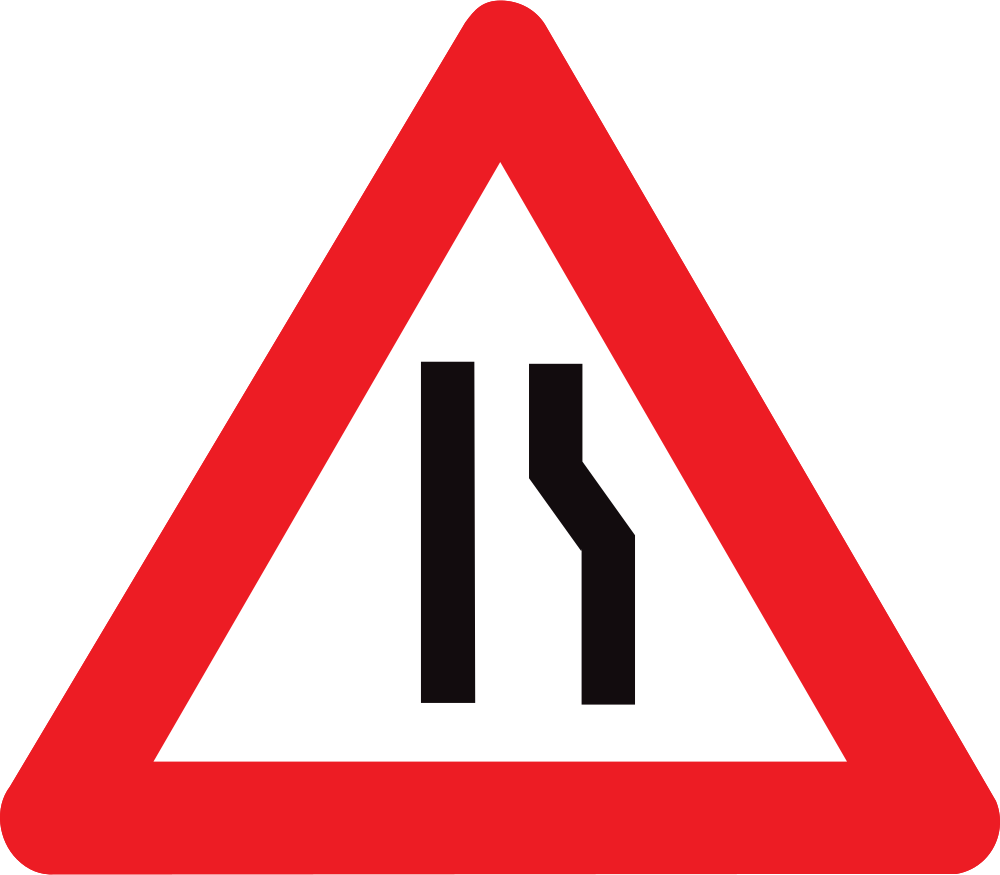 Warning for a road narrowing on the right.
Signal routier A7c • Rétrécissement de la chaussée.
Verkeersbord A7c • Rijbaanversmalling.
 Road narrowing, give way to oncoming drivers.
Signal routier B19 • Passage étroit. Obligation de céder le passage aux conducteurs venant en sens opposé.
Verkeersbord B19 • Smalle doorgang. Gebod voorrang te verlenen aan de bestuurders die uit de tegenovergestelde richting komen.
 Road narrowing, oncoming drivers have to give way.
Signal routier B21 • Passage étroit. Priorité de passage par rapport aux conducteurs venant en sens opposé.
Verkeersbord B21 • Smalle doorgang. Voorrang ten opzichte van de bestuurders die uit de tegenovergestelde richting komen.
What changes for road narrowing under Belgium’s new Road Code?
Belgium’s new Code of the Public Road takes effect on 1 June 2027. The warning signs for a road narrowing keep their existing numbers: traffic sign A7a warns that the carriageway narrows on both sides, traffic sign A7b indicates a narrowing on the left, and traffic sign A7c indicates a narrowing on the right. Their basic meaning therefore remains unchanged under the new Road Code.
 Warning for a road narrowing.
Signal routier A7a • Rétrécissement de la chaussée.
Verkeersbord A7a • Rijbaanversmalling.
 Warning for a road narrowing on the left.
Signal routier A7b • Rétrécissement de la chaussée.
Verkeersbord A7b • Rijbaanversmalling.
 Warning for a road narrowing on the right.
Signal routier A7c • Rétrécissement de la chaussée.
Verkeersbord A7c • Rijbaanversmalling.
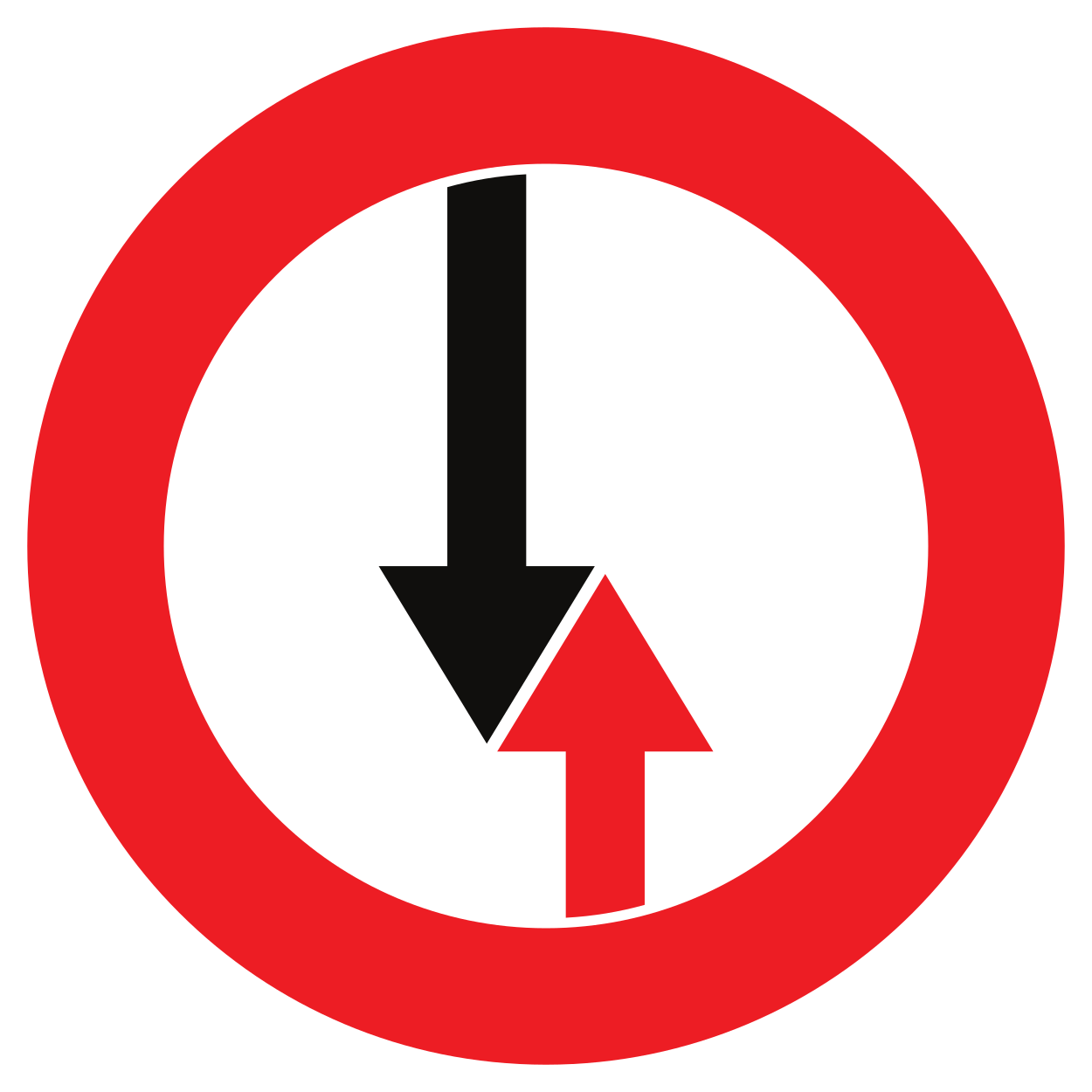 Road narrowing, give way to oncoming drivers.
Signal routier B19 • Passage étroit. Céder le passage aux conducteurs venant en sens opposé.
Verkeersbord B19 • Smalle doorgang. Voorrang verlenen aan de bestuurders die uit de tegenovergestelde richting komen.
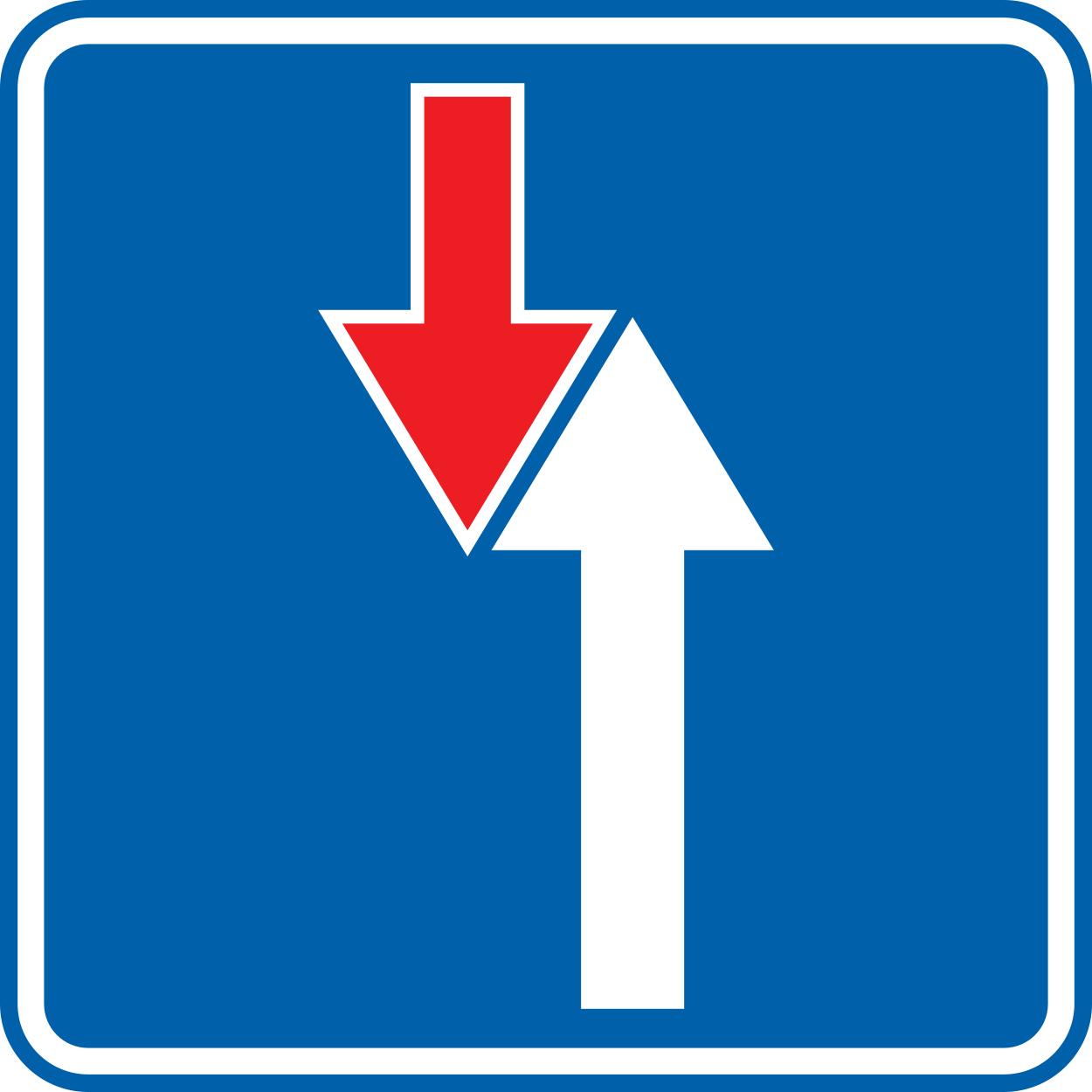 Road narrowing, oncoming drivers have to give way.
Signal routier B21 • Passage étroit. Priorité de passage par rapport aux conducteurs venant en sens opposé.
Verkeersbord B21 • Smalle doorgang. Voorrang ten opzichte van de bestuurders die uit de tegenovergestelde richting komen.
What does Belgian sign A7a mean?
Traffic sign A7a warns that the carriageway narrows from both sides.
What does Belgian sign A7b mean?
Traffic sign A7b warns that the carriageway narrows on the left side in the direction of travel.
What does Belgian sign A7c mean?
Traffic sign A7c warns that the carriageway narrows on the right side in the direction of travel.
Does an A7 sign determine priority?
No. A7a, A7b and A7c are warning signs. They do not indicate which direction has priority through the narrow section.
Does an A7 sign impose a speed limit?
No. Drivers must respect the applicable speed limit and reduce their speed further when necessary for the width, visibility and traffic conditions.
How far before the narrowing is an A7 sign placed?
In Brussels and Flanders, warning signs are normally placed approximately 150 metres before the danger. A supplementary panel indicates another approximate distance when necessary.
Which Belgian sign requires you to give way at a narrow passage?
Traffic sign B19 requires drivers to give way to drivers approaching from the opposite direction.
Which Belgian sign gives you priority at a narrow passage?
Traffic sign B21 indicates that you have priority over drivers approaching from the opposite direction.
Are B19 and B21 normally used together?
Yes. B19 is placed for one direction and B21 for the opposite direction. Under the current placement rules, they may be used where two cars cannot pass and the entire narrow section is visible from one end to the other.
Must you always stop at B19?
No. You must slow down and give way when an oncoming driver is approaching. You may continue cautiously when the passage is free and no priority traffic will be hindered.
May you enter first when facing B19?
You should not enter when a driver with priority is approaching closely enough to be hindered. The B19 obligation does not disappear merely because you reach or enter the narrow section first.
May a driver facing B21 enter without checking?
No. Even with priority, the driver must approach cautiously and avoid entering when another vehicle is already in the passage or when continuing would cause an accident.
Who gives way when there are no B19 or B21 signs?
A driver whose passage is obstructed by an obstacle or another road user must slow down and, when necessary, stop to allow approaching road users to pass.
What if the narrowing is symmetrical and there are no priority signs?
There is no automatic priority solely because one driver reaches the narrowing first. Both drivers must approach cautiously and avoid entering when they cannot pass one another safely.
Must you use an indicator to pass an obstruction?
Yes, when the movement requires a lateral displacement. Signal in time, check for following and approaching traffic and stop signalling when the movement is completed.
What if your traffic lane ends at the narrowing?
When traffic is flowing normally, changing into the adjacent lane is a manoeuvre and you must give way to its users. During strongly slowed traffic, the Belgian zipper-merging rule applies.
How does zipper merging work in Belgium?
During strongly slowed traffic, drivers in the ending or blocked lane must merge only immediately before the narrowing. Drivers in the continuing lane must alternately allow one merging driver to enter.
What if lanes end on both sides?
Drivers in the continuing lane first allow one vehicle from the right-hand lane to merge and then one vehicle from the left-hand lane.
Must you indicate while zipper merging?
Under the current Highway Code, zipper merging is not legally classified as a manoeuvre, but drivers should use their indicators in time to make their intention clear and merge predictably.
May you overtake at a Belgian road narrowing?
An A7 sign does not itself prohibit overtaking. Overtaking is permitted only when sufficient width and visibility are available and no other prohibition, marking or safety rule prevents it.
May you squeeze past a cyclist in a narrowing?
No. Drivers must maintain at least one metre inside a built-up area and 1.5 metres outside a built-up area when passing a cyclist. When this is impossible, they must wait.
What if pedestrians must walk around an obstruction?
Drivers passing an obstruction around which pedestrians must enter the carriageway must leave at least one metre of free space. If this is impossible while a pedestrian is present, the driver may pass only at walking pace.
May you stop or park in a Belgian road narrowing?
The A7 sign does not create an automatic prohibition, but stopping or parking is prohibited where it would clearly create danger or unnecessarily obstruct other road users.
How much road width must remain when parking?
Parking is prohibited when it would leave less than three metres of free passage on the carriageway.
May you park opposite another vehicle near a narrowing?
On a two-way carriageway, parking opposite another stationary or parked vehicle is prohibited when this would make it difficult for two other vehicles to pass one another.
When must a dangerous Belgian narrowing be signposted?
Under the current placement rules, A7 signs may be used for dangerous carriageway narrowings of at least one metre. A lane-sized narrowing must normally be signposted, except in residential areas and Zone 30 areas.
Will the narrowing signs remain in Belgium’s new road code?
Yes. The Code of the Public Road taking effect on 1 June 2027 retains A7a, A7b and A7c for carriageway narrowing and B19 and B21 for priority at a narrow passage. It also retains zipper merging.
23. Priority over oncoming traffic
Priority over oncoming traffic means that drivers travelling in one direction have priority through a narrow section of road over drivers approaching from the opposite direction. The rule is normally indicated by a priority sign facing one direction and a corresponding give-way sign facing the other.
Drivers with priority must still approach cautiously and must not force their way through when the passage is blocked or already occupied. The signs regulate priority through the narrow section, not speed, parking or priority at nearby intersections.

Wikimedia.org • Jean Housen • CC BY-SA
Which Belgian sign gives priority over oncoming traffic?
Traffic sign B21 indicates that drivers have priority over drivers approaching from the opposite direction through a narrow passage.
Road narrowing, oncoming drivers have to give way.
Signal routier B21 • Passage étroit. Priorité de passage par rapport aux conducteurs venant en sens opposé.
Verkeersbord B21 • Smalle doorgang. Voorrang ten opzichte van de bestuurders die uit de tegenovergestelde richting komen.
Road narrowing, give way to oncoming drivers.
Signal routier B19 • Passage étroit. Obligation de céder le passage aux conducteurs venant en sens opposé.
Verkeersbord B19 • Smalle doorgang. Gebod voorrang te verlenen aan de bestuurders die uit de tegenovergestelde richting komen.
How can you recognise Belgian sign B21?
B21 is a rectangular blue sign showing a large white arrow in your direction and a smaller red arrow representing oncoming traffic.
Which sign does traffic at the opposite end see?
Oncoming drivers normally face traffic sign B19, which requires them to give way to drivers approaching from the opposite direction.
What does Belgian sign B19 mean?
B19 means that drivers must give way to oncoming drivers through the narrow passage.
Are B19 and B21 used together?
Yes. When B19 is placed at one end of the passage, B21 is placed for traffic approaching from the other direction.
When may Belgium use B19 and B21?
Under the current placement rules, they may be used where two cars cannot pass one another and drivers can see the entire narrow passage from one end to the other.
Does B21 make the road one-way?
No. The road remains open in both directions. B21 determines which direction has priority when opposing vehicles cannot pass simultaneously.
Must you stop at B21?
No. You may continue when the passage is clear, but you must approach cautiously and stop when necessary to avoid danger.
May you enter when an oncoming vehicle is already inside?
You should not force your way into the passage. Slow down or stop and allow the occupied passage to clear, even though B21 normally gives your direction priority.
Does B21 allow you to force another vehicle to reverse?
No. Priority does not justify creating a dangerous situation. Drivers must cooperate when another vehicle is already committed to the passage.
What if both drivers arrive at the same time?
The driver facing B21 may normally proceed first. The driver facing B19 must give way.
Does reaching the narrowing first automatically give priority?
No. Priority is determined by B19 and B21 rather than simply by which vehicle arrives first.
Does B21 apply to cyclists?
Yes. Cyclists are drivers under Belgian traffic law and are included in the priority arrangement unless another traffic control provides otherwise.
Must you leave room when passing a cyclist?
Yes. Drivers must maintain at least one metre inside a built-up area and 1.5 metres outside a built-up area. If that distance cannot be maintained in the narrow passage, the driver must wait.
What if a truck or bus approaches?
Large vehicles may require the full available width. Reduce speed and wait outside the passage when necessary, even when you have priority.
Does B21 impose a speed limit?
No. The applicable regional, zonal or posted speed limit remains in force. Drivers must nevertheless adapt their speed to the limited width and visibility.
Does B21 give priority at a nearby intersection?
No. It applies only against traffic approaching from the opposite direction through the narrow passage. Intersection priority is determined separately.
May you overtake near B21?
B21 does not itself prohibit overtaking, but overtaking is unsafe when the available width or visibility is insufficient. Other signs or road markings may also prohibit it.
May you stop or park in the narrow passage?
B21 creates no separate parking rule, but stopping or parking is prohibited when it would create danger, obstruct traffic or leave insufficient free passage.
How much free road width must remain when parking?
Belgian parking rules require at least three metres of free carriageway to remain available.
What if temporary traffic lights are installed?
Follow the active traffic lights. They control the alternating traffic movement and take precedence over the fixed B19 and B21 arrangement at that location.
What if a police officer or road worker directs traffic?
Follow the instructions of an authorised person. Those instructions take precedence over traffic signs and ordinary traffic rules.
Will B21 remain in Belgium’s new road code?
Yes. The Code of the Public Road taking effect on 1 June 2027 retains B21 for priority over oncoming drivers and B19 for the direction that must give way.
24. Give way to oncoming traffic
Give way to oncoming traffic means that drivers must allow vehicles approaching from the opposite direction to pass first through a narrow section of road. The rule is normally indicated by a sign facing the direction that must yield and a corresponding priority sign facing oncoming traffic.
Drivers must reduce speed and stop when necessary before entering the narrow passage. They may continue only when they can do so safely and without obstructing oncoming traffic that has priority.

Wikimedia.org • Miguel Tremblay • CC0
Which Belgian sign means give way to oncoming traffic?
Traffic sign B19 requires drivers to give way to drivers approaching from the opposite direction through a narrow passage.
Road narrowing, give way to oncoming drivers.
Signal routier B19 • Passage étroit. Obligation de céder le passage aux conducteurs venant en sens opposé.
Verkeersbord B19 • Smalle doorgang. Gebod voorrang te verlenen aan de bestuurders die uit de tegenovergestelde richting komen.
Road narrowing, oncoming drivers have to give way.
Signal routier B21 • Passage étroit. Priorité de passage par rapport aux conducteurs venant en sens opposé.
Verkeersbord B21 • Smalle doorgang. Voorrang ten opzichte van de bestuurders die uit de tegenovergestelde richting komen.
Which sign does traffic at the opposite end see?
Drivers approaching from the other direction normally see traffic sign B21, which gives them priority over oncoming traffic.
Are B19 and B21 used together?
Yes. When B19 is installed for one direction, B21 is installed for traffic approaching from the opposite direction.
When may B19 and B21 be installed in Belgium?
Under the current placement rules, they may be used when two cars cannot pass one another and the entire narrow passage is visible from one end to the other.
Does B19 make the road one-way?
No. Traffic may continue in both directions, but the direction facing B19 must allow opposing traffic to pass first.
Must you always stop at B19?
No. You must slow down and stop when necessary to give way. You may continue cautiously when the passage is clear and no oncoming driver with priority will be hindered.
Where should you wait?
Wait before entering the narrow passage and leave sufficient space for oncoming vehicles to exit safely.
When may you enter the narrow passage?
You may enter only when you can clear it without forcing an oncoming driver to slow down, stop, reverse or alter course.
Does reaching the passage first override B19?
No. The sign determines priority. You must not enter when a driver facing B21 is approaching closely enough to be hindered.
What if an oncoming vehicle is already inside?
You must wait and allow it to leave the passage. Do not enter and block its route.
What if you entered before noticing the oncoming vehicle?
Avoid making the situation more dangerous. Stop or leave the passage when possible and cooperate with the other driver, but remember that the B19 obligation applied before you entered.
May the driver facing B21 force you to reverse?
Priority does not permit either driver to cause an accident. However, the driver facing B19 must normally avoid entering while priority traffic is approaching.
Does B19 apply to cyclists?
Yes. Cyclists are drivers under Belgian traffic law and must give way when B19 applies to their direction of travel.
Must you give way to an oncoming cyclist?
Yes. If the passage is too narrow to pass while maintaining the required lateral distance, wait until the cyclist has cleared it.
What passing distance applies to cyclists?
Drivers must leave at least one metre inside a built-up area and 1.5 metres outside a built-up area. When this is impossible, they must not pass.
What should you do when a bus or truck approaches?
Wait before the narrowing when necessary. Large vehicles may require the entire passage and additional room to manoeuvre.
Does B19 impose a speed limit?
No. The applicable regional, zonal, posted and vehicle-specific speed limits remain in force. You must still approach at a speed that allows you to stop safely.
Does B19 affect priority at an intersection?
No. It regulates priority only between opposing drivers at the narrow passage. Intersection priority is governed by other signs and rules.
May you overtake near B19?
B19 does not itself prohibit overtaking, but the manoeuvre is not permitted when the width, visibility or presence of oncoming traffic makes it unsafe.
May you stop or park in the narrow passage?
B19 creates no separate stopping or parking rule, but a vehicle may not create danger, obstruct opposing traffic or leave insufficient free passage.
How much free carriageway must remain when parking?
At least three metres of free carriageway must remain available. Parking is prohibited when this minimum passage cannot be maintained.
What if an obstruction is on your side of the road?
Even without B19, a driver whose passage is obstructed must slow down and, when necessary, stop to allow oncoming road users to pass.
What if temporary traffic lights are installed?
Follow the active traffic lights controlling the alternating traffic flow. Traffic-light signals take precedence over the fixed priority signs at that location.
What if an authorised person directs traffic?
Follow the instructions of the authorised person. Those instructions take precedence over traffic lights, signs, markings and ordinary traffic rules.
Will B19 remain under Belgium’s new road code?
Yes. The Code of the Public Road taking effect on 1 June 2027 retains B19 for the direction that must give way and B21 for the direction with priority. The arrow design is adjusted for greater clarity and international harmonisation.
25. Pedestrian crossing
A pedestrian crossing is a designated place where pedestrians may cross a road. It is commonly indicated by road markings, traffic signs, signals or a combination of these measures.
Drivers must approach with appropriate caution and give way when required by local law. Pedestrians must also observe approaching traffic and follow any pedestrian signals or instructions from authorised traffic controllers.

Wikimedia.org • Jeanhousen • CC BY-SA
Which Belgian traffic signs indicate or warn of a pedestrian crossing?
Traffic sign F49 indicates the location of a pedestrian crossing, while warning sign A21 warns drivers that they are approaching a pedestrian crossing.
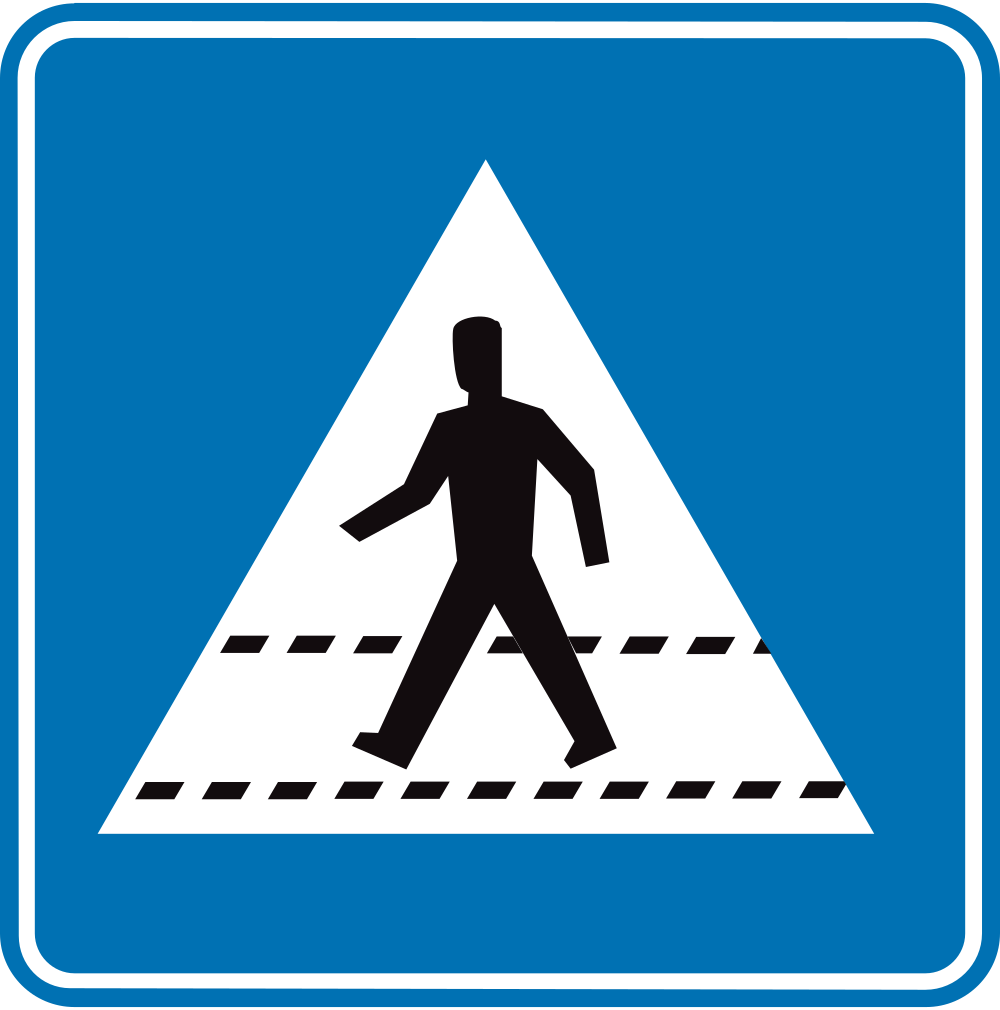 Crossing for pedestrians.
Signal routier F49 • Passage pour piétons.
Verkeersbord F49 • Oversteekplaats voor voetgangers.
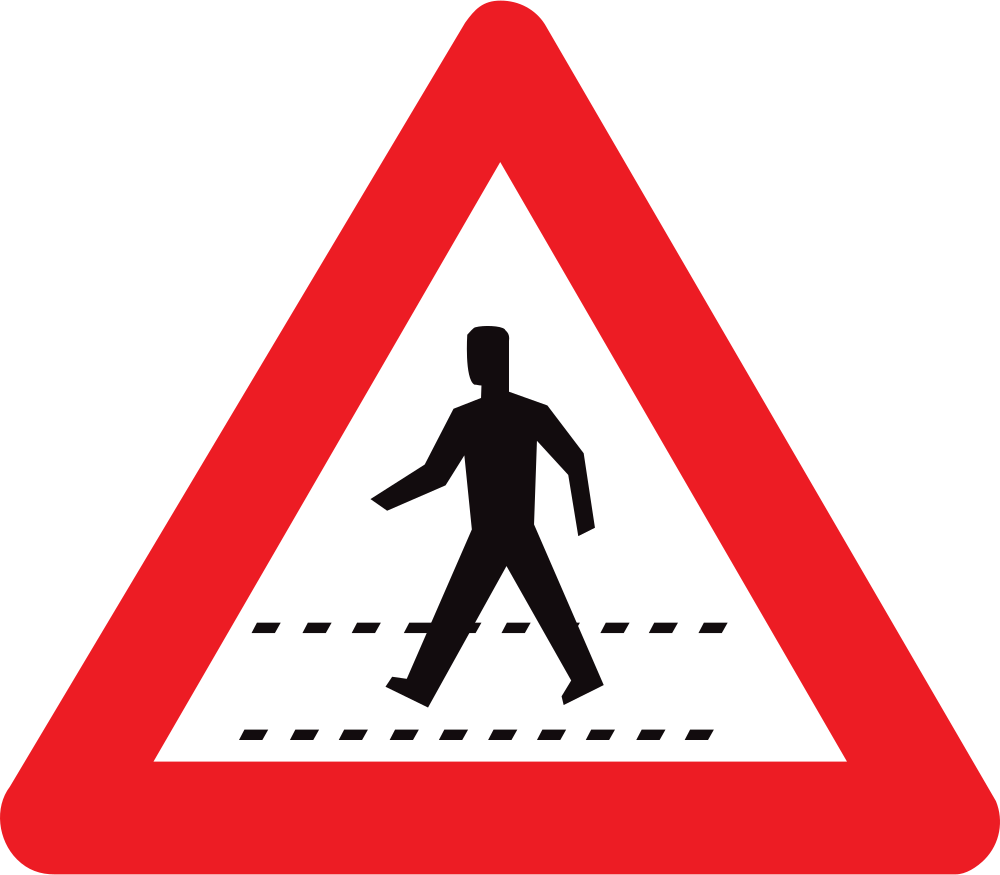 Warning for a pedestrian crossing.
Signal routier A21 • Passage pour piétons.
Verkeersbord A21 • Oversteekplaats voor voetgangers.
How is a pedestrian crossing marked in Belgium?
A Belgian pedestrian crossing is marked by white rectangles placed parallel to the centre line of the carriageway. It is commonly called a zebra crossing.
Which Belgian sign warns that a pedestrian crossing is ahead?
Warning sign A21 warns drivers that they are approaching a pedestrian crossing.
Do pedestrians have priority at an uncontrolled Belgian crossing?
Yes. Drivers must give way to pedestrians who are on the crossing or are about to enter it.
How must drivers approach an uncontrolled crossing?
Drivers must approach at a moderate speed and be prepared to stop for pedestrians.
Must you stop for someone standing near the crossing?
You must give way when the pedestrian is clearly about to enter the crossing. Observe the pedestrian’s position and apparent intention and be prepared to stop.
May a pedestrian step onto the crossing without looking?
No. At a crossing without traffic lights or an authorised controller, pedestrians may enter only cautiously and while taking approaching vehicles into account.
Where should a driver stop?
Stop before the pedestrian crossing and leave it completely clear. Where traffic lights provide a stop line, stop before that line when the signal requires it.
May you stop on the crossing during congestion?
No. You may not enter a pedestrian crossing when congestion is likely to force you to stop on it.
What happens at a crossing controlled by traffic lights?
Drivers and pedestrians must follow the applicable signals. Even when vehicle traffic receives a green light, drivers must allow pedestrians who entered lawfully to finish crossing at a normal pace.
Where must you stop when the traffic light is red?
Stop before the stop line. When the crossing is positioned before or at the signal, you must not stop on the pedestrian crossing.
May pedestrians enter when their pedestrian light is red?
No. Where two-colour pedestrian lights are installed, pedestrians may not enter the carriageway while their signal prohibits crossing.
Must pedestrians use a nearby Belgian crossing?
Yes. When a pedestrian crossing is located within approximately 20 metres, pedestrians must use it.
How must pedestrians cross when no crossing is nearby?
They must cross approximately perpendicular to the centre line, proceed cautiously and avoid lingering or stopping unnecessarily on the carriageway.
May you overtake a vehicle near an uncontrolled pedestrian crossing?
Left-side overtaking of certain vehicles is prohibited when the vehicle being overtaken stops for or approaches an uncontrolled pedestrian or cycle crossing.
Why is overtaking near a crossing dangerous?
The stopped or slowing vehicle may conceal a pedestrian. Passing it could place the overtaking vehicle directly in the pedestrian’s path.
May you stop or park on a Belgian pedestrian crossing?
No. Both stopping and parking are prohibited on the crossing.
How far before a pedestrian crossing is stopping or parking prohibited?
Stopping and parking on the carriageway are prohibited within five metres before the crossing.
Does the five-metre prohibition apply after the crossing?
The crossing-specific five-metre rule applies before the crossing, not automatically after it. Other parking restrictions may still prohibit stopping or parking after the crossing.
May cyclists ride across a Belgian pedestrian crossing?
A cyclist may cross where this is otherwise permitted, but a cyclist who remains on the bicycle is a driver and does not receive pedestrian priority merely because of the zebra crossing.
What if a cyclist dismounts and walks across?
A person walking beside a bicycle is treated as a pedestrian and benefits from the pedestrian-crossing rules.
Is a zebra crossing also a cycle crossing?
No. A cycle crossing is indicated separately. Drivers and cyclists must follow the rules and markings applying to that crossing.
What if a pedestrian crossing crosses tram tracks?
Unless traffic lights permit crossing, pedestrians may not enter a pedestrian crossing over tram tracks or a reserved tram site when a tram is approaching.
Must turning drivers give way to pedestrians?
Yes. Drivers changing direction must give way to pedestrians crossing the road they are entering, in addition to respecting any marked pedestrian crossing.
Do police instructions override crossing signals?
Yes. Instructions from an authorised person take precedence over traffic lights, traffic signs, road markings and ordinary rules.
Must drivers obey an authorised crossing supervisor?
Yes. Drivers must follow the instructions given by authorised supervisors protecting groups of children, school pupils, older people or persons with disabilities.
Must drivers take extra care around vulnerable pedestrians?
Yes. Belgian drivers must be especially careful around children, older people and persons with disabilities and must slow down or stop when necessary.
Does a pedestrian crossing impose a special speed limit?
No. The crossing does not create a numerical speed limit, but drivers must approach an uncontrolled crossing at moderate speed and remain able to stop.
What changes under Belgium’s new road code?
From 1 June 2027, the pedestrian-crossing indication sign will be numbered F48 instead of F49. The white rectangular crossing markings and the duty to give way to pedestrians on or about to enter the crossing remain.