


Stop signBelgium
 Traffic rules
 Belgium
18. Stop sign
A stop sign requires drivers to bring their vehicle to a complete stop and give way before entering or crossing the road ahead. The stop must be made at the stop line or another legally prescribed position.
After stopping, the driver may continue only when this can be done safely and without interfering with traffic that has priority. The sign does not create priority for the driver who has stopped.

Wikimedia.org • Jeanhousen • CC BY-SA
Which Belgian traffic signs indicate a stop?
Traffic sign B5 is the Belgian stop sign and means stop and give way. Traffic sign B7 announces an upcoming B5 stop sign and indicates approximately how far away it is.
 Stop and give way.
Signal routier B5 • Marquer l’arrêt et céder la priorité.
Verkeersbord B5 • Stoppen en voorrang verlenen.
 Stop and give way ahead.
Signal routier B7 • Signal annonçant le signal B5 à la distance approximativement indiquée.
Verkeersbord B7 • Verkeersbord dat het verkeersbord B5 aankondigt op de bij benadering aangeduide afstand.
What changes for stop signs under Belgium’s new Road Code?
Belgium’s new Code of the Public Road takes effect on 1 June 2027. Traffic sign B5 keeps its existing number and continues to mean stop and give way. The current traffic sign B7, which announces an upcoming B5 stop sign, is no longer included as a separate traffic sign. Instead, the new supplementary sign M3 is used with B5 to announce the stop sign at approximately the indicated distance.
 Stop and give way.
Signal routier B5 • Marquer l’arrêt et céder la priorité.
Verkeersbord B5 • Stoppen en voorrang verlenen.
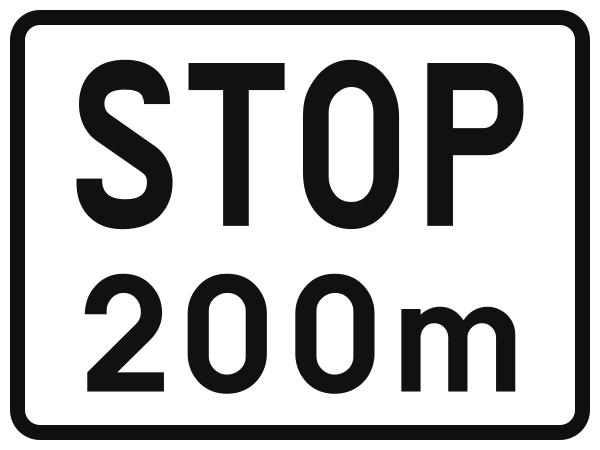 Stop ... metres ahead.
Signal routier M3 • Panneau additionnel qui annonce le signal B5 à la distance approximative indiquée (exemple).
Verkeersbord M3 • Onderbord dat het verkeersbord B5 aankondigt op de bij benadering aangeduide afstand (voorbeeld).
Must you always stop at Belgian sign B5?
Yes. You must come to a complete stop even when no other road user is visible.
Is slowing down enough at B5?
No. The vehicle must stop completely. A rolling or very slow passage does not comply with the sign.
Where must you stop when there is a stop line?
You must stop before the white continuous stop line. The line indicates the precise place where drivers must stop because of B5 or a traffic light.
Where must you stop when there is no stop line?
Stop before entering the intersection or priority road, in the immediate vicinity of the B5 sign and at a position from which you can give way safely.
What if you cannot see enough from the stop line?
You must first stop at the line. You may then move forward slowly to improve your view and must stop again when necessary before entering the road.
May your vehicle cross the stop line before stopping?
No. The stop line marks the place before which the mandatory stop must be completed.
Must every driver in a queue stop separately?
Yes. Each driver approaching B5 must make a separate complete stop, even when the preceding vehicle has already stopped.
Who must you give way to after stopping?
You must give way to every driver travelling on the public road or carriageway you are entering. Other priority duties concerning pedestrians, cyclists and crossed paths also remain applicable.
Must you check traffic from both directions?
Yes. Check every direction from which lawful traffic may approach, including contraflow cyclists or mopeds where signs permit them.
Does stopping at B5 give you priority?
No. You may proceed only when this can be done without danger, taking account of the position, speed and distance of the road users who have priority.
What is the difference between B5 and B1?
B5 requires you to stop and give way. B1 requires you to give way but does not require a complete stop when you can proceed safely without stopping.
What does Belgian sign B7 mean?
Traffic sign B7 announces that a B5 stop sign is ahead and indicates its approximate distance.
Is B7 always placed before B5?
No. It is generally used to announce B5, but it is not required in certain situations, including inside built-up areas and on some very narrow roads.
Can B5 warn about two-way cycle traffic?
Yes. A supplementary panel may indicate that cyclists, or cyclists together with certain mopeds, travel in both directions on the road being entered.
Can B5 apply only to cyclists or moped riders?
Yes. An appropriate supplementary panel may limit the stop obligation to cyclists or to cyclists together with indicated two-wheeled moped riders.
Must cyclists obey an ordinary B5 sign?
Yes. When B5 applies to their route and no exception is indicated, cyclists must stop and give way like other drivers.
Can B5 be placed at a roundabout?
Yes. Belgian roundabout entrances may be controlled by B1 or B5. When B5 is displayed, the driver must stop before giving way to traffic on the roundabout.
Does B5 apply when the traffic lights are working?
No, when functioning traffic lights control the same location. Belgian priority signs on that road do not apply while those traffic lights are operating.
What if the traffic light is flashing orange-yellow?
An orange-yellow flashing light does not change the priority arrangement. A B5 sign at that location therefore remains applicable.
What if a police officer directs you through the stop sign?
Follow the officer’s instruction. Orders from an authorised person take precedence over traffic lights, signs, road markings and ordinary traffic rules.
Can a stop line cross a cycle path?
Where longitudinal markings indicate a cycle path, the stop line is normally placed before those markings and may be repeated beyond them when necessary. Drivers must avoid blocking cyclists.
Does B5 change the speed limit?
No. The sign creates a stopping and yielding obligation but does not introduce a new maximum speed.
Why is B5 used instead of B1?
Belgian placement rules normally reserve B5 for situations where visibility is so limited that drivers cannot properly give way without first stopping.


