


PedestrianBelgium
 Traffic rules
 Belgium
66. Pedestrian
A pedestrian is a person travelling on foot along or across a road, street, path or other public space. Depending on local traffic law, people pushing bicycles, wheelchairs, prams or certain other small devices may also be treated as pedestrians.
Pedestrians normally use pavements, sidewalks, footpaths and pedestrian areas where these are available. When crossing a road or walking where no suitable pedestrian facility exists, they must follow the applicable crossing rules, traffic lights and other local traffic regulations.

Wikimedia.org • Jeanhousen • CC BY-SA
Who is considered a pedestrian in Belgium?
A Belgian pedestrian is a person travelling on foot. Certain people pushing small vehicles or mobility devices are also legally treated as pedestrians.
 Pedestrians prohibited.
Signal routier C19 • Accès interdit aux piétons.
Verkeersbord C19 • Verboden toegang voor voetgangers.
 Mandatory path for pedestrians.
Signal routier D11 • Chemin obligatoire pour les piétons.
Verkeersbord D11 • Verplichte weg voor voetgangers.
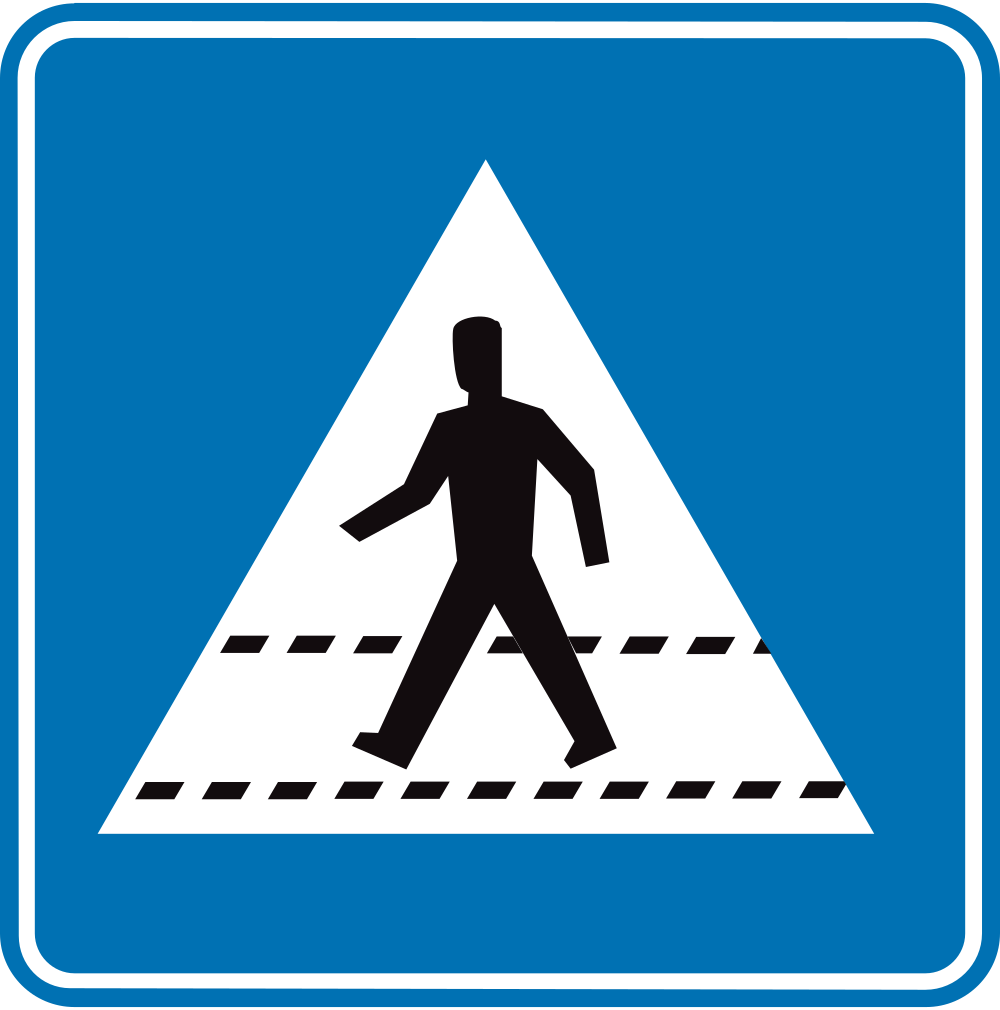 Crossing for pedestrians.
Signal routier F49 • Passage pour piétons.
Verkeersbord F49 • Oversteekplaats voor voetgangers.
 Direction to pedestrian underpass.
Verkeersbord F51 • Ondergrondse of bovengrondse toegang voor voetgangers.
 Start of a zone for pedestrians.
Signal routier F103 • Commencement d'une zone piétonne. Ce signal est placé à droite, à chaque accès d'une zone piétonne; il peut être répété à gauche.
Verkeersbord F103 • Begin van een voetgangerszone. Dit verkeersbord wordt rechts geplaatst aan elke toegang tot een voetgangerszone; het mag links herhaald worden.
 End of the zone for pedestrians.
Signal routier F105 • Fin d'une zone piétonne. Ce signal est placé à droite, à chaque sortie d'une zone piétonne; il peut être répété à gauche.
Verkeersbord F105 • Einde van een voetgangerszone. Dit verkeersbord wordt rechts geplaatst aan elke uitgang van een voetgangerszone; het mag links herhaald worden.
 Reserved road for the indicated road users.
Verkeersbord R9 • Begin van een weg of van wegen voorbehouden voor het verkeer van de aangeduide weggebruikers (voorbeelden). Het verkeersbord kan aangepast zijn volgens de categorieën van weggebruikers. Op dit bord zijn ten minste 2 categorieën van weggebruikers aangeduid. De maximale snelheid die er geldt, kan als aanwijzing rechtsonder op het verkeersbord aangeduid zijn.
 End of reserved road.
Verkeersbord R11 • Einde van een weg of van wegen voorbehouden voor het verkeer van de aangeduide weggebruikers (voorbeelden).
Is someone walking a bicycle considered a pedestrian in Belgium?
Yes. A person who leads a bicycle by hand is legally treated as a pedestrian. The same applies to someone walking a motorised bicycle or two-wheeled moped by hand.
Are wheelchair users considered pedestrians in Belgium?
People using certain mobility devices at walking speed can be treated as pedestrians. Belgian rules specifically include persons with reduced mobility using a motorised device intended exclusively for them when travelling no faster than walking pace.
Where must pedestrians walk in Belgium?
Pedestrians must use the available and passable parts of the public road in a prescribed order, starting with the pavement or designated pedestrian facility, followed where necessary by suitable verges and other permitted parts of the road.
May pedestrians walk on the carriageway in Belgium?
Yes, when the more appropriate pedestrian facilities are unavailable or unusable. When pedestrians use the carriageway, they must remain as close as possible to its edge.
Which side of the road should Belgian pedestrians walk on?
When walking on the carriageway or lateral strip, pedestrians normally walk on the left relative to their direction of travel so that they face approaching traffic. They may walk on the right when safety reasons justify it.
Must pedestrians use a pedestrian crossing in Belgium?
Yes, when a pedestrian crossing is less than approximately 20 metres away. Pedestrians must then use that crossing rather than cross elsewhere.
Do pedestrians have priority on an uncontrolled pedestrian crossing in Belgium?
Yes. Where traffic is not controlled by traffic lights or an authorised person, drivers must approach a pedestrian crossing at moderate speed and give way to pedestrians who are on the crossing or about to enter it.
Can a pedestrian step onto a Belgian crossing without looking?
No. At locations without traffic lights or an authorised person, pedestrians may enter the carriageway only with caution and while taking account of approaching vehicles.
What does a red pedestrian light mean in Belgium?
A red pedestrian light means that pedestrians may not enter the carriageway. A green pedestrian light means that they may enter it.
Must turning drivers give way to pedestrians in Belgium?
Yes. A driver changing direction must give way to pedestrians crossing the carriageway that the driver is about to enter.
How much distance must a driver leave when passing a pedestrian on the carriageway?
A driver must leave at least 1 metre between the vehicle and a pedestrian lawfully using the carriageway. Outside a built-up area, the minimum distance is 1.5 metres. If that distance cannot be maintained, the driver must travel at walking speed and stop if necessary.


