
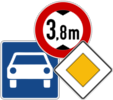
Height limitGermany

An introduction to the traffic rules and road signs of Germany. Learn about driving, road safety and much more in our illustrated book, with answers to frequently asked questions.

For informational purposes only. Always follow official regulations. Some content and images were created with AI assistance.

44. Height limit

A height limit prohibits vehicles whose total height exceeds the value shown from entering or passing a road section, bridge, tunnel, gateway or other structure. The vehicle’s height includes its load and any equipment attached above it.

Drivers of high vehicles must know their exact height, observe advance warnings and use an alternative route when necessary. They should never rely only on visual judgement or attempt to pass beneath a structure when safe clearance is uncertain.

Height limit of 2.90 metres at a bridge. (Bayern, Germany)
Wikimedia.org • Derzno • CC BY-SA
How should you read a low-bridge height restriction in Germany?

Germany’s signed height restriction prohibits vehicles whose actual height, including the load, exceeds the displayed figure in metres. Check roof boxes, bicycles and other fitted equipment before choosing the route. An advance warning of a restriction does not replace the prohibition at the restricted passage.

🔗 gesetze-im-internet.de • Germany StVO: Annex 2, common rule for signs 262–266 and sign 265; §§18(1),22

Does a roof load count when checking vehicle height in Germany?

Yes for practical clearance: measure the vehicle at its highest point with its load and fitted accessories, such as a roof box, bicycle or roof rack. Check the local legal measurement rules as well; an empty vehicle’s registered height is not enough when equipment has been added.

🔗 gesetze-im-internet.de • Germany StVO: Annex 2, common rule for signs 262–266 and sign 265; §§18(1),22

What should you do if your vehicle is too high for a bridge or tunnel in Germany?

Do not try to squeeze under the structure. Use the signed alternative route and, if you are already close to the obstruction, stop where safe and seek traffic-control assistance rather than reversing unpredictably into moving traffic.

🔗 gesetze-im-internet.de • Germany StVO: Annex 2, common rule for signs 262–266 and sign 265; §§18(1),22

1 Germany 2 Motorway 3 Expressway 4 Residential area 5 Zone 6 Speed limit 7 Footpath 8 Bike path 9 Shared-use path 10 Pedestrian warning 11 Tunnel 12 Bridge 13 Cycling street 14 Pedestrian zone 15 Toll road 16 Customs 17 One-way traffic 18 Quay 19 Slope 20 Bus lane 21 Bus stop 22 Dead end 23 Stop sign 24 Give way 25 Roundabout 26 Priority road 27 Road narrowing 28 Priority over oncoming traffic 29 Give way to oncoming traffic 30 Pedestrian crossing 31 Railway crossing 32 Mandatory direction 33 School area 34 Overtaking 35 Crossing animals 36 Slippery road 37 Rockfall 38 Aircraft 39 Curve 40 Chevron 41 Wrong-way driving 42 Roadworks 43 Crosswind 44 Height limit 45 Width limit 46 Length limit 47 Weight limit 48 Radar speed sign 49 Selective barriers 50 Low-emission zone 51 Intersection direction sign 52 Priority at the next junction 53 Traffic lights 54 Traffic lights warning 55 Pedestrian lights 56 Road markings 57 Junction layout 58 Bike box 59 Speed feedback 60 Driving licence 61 Location marker 62 Countdown markers 63 Traffic mirror 64 Emergency telephone 65 International border 66 Pedestrian underpass 67 Cycling route 68 End of restriction 69 Parking 70 No parking 71 No stopping 72 Parallel parking 73 Park and ride 74 Kiss and ride 75 Parking meter 76 Parking disc 77 Disabled parking 78 Traffic management 79 Reversing 80 Traffic jam 81 Detour 82 Uncontrolled crossroad 83 Road surface 84 Exit 85 Horse riding 86 Provisional licence 87 Hazardous cargo 88 Emergency exit 89 Runaway truck ramp 90 Oversize load 91 Cycle highway 92 Carsharing 93 City limit 94 Gantry 95 Distance board 96 Breakdown bay 97 Hiking 98 Pavement parking 99 Road church 100 Tourist attraction ...