

GermanyGermany
 Traffic rules
 Germany
1. Germany
Germany lies in Central Europe and shares borders with nine countries, including Denmark, Poland, the Czech Republic, Austria, Switzerland, France, Luxembourg, Belgium and the Netherlands. Traffic drives on the right. Germany is particularly known for its Autobahn network: some sections have no general maximum speed for passenger cars, although a recommended speed of 130 km/h applies where no lower limit is posted. Passenger cars do not need a nationwide motorway vignette, but drivers entering certain cities may need an environmental sticker.
German is the main language used on traffic signs, and destination signs use German place names. In the Sorbian settlement areas of Brandenburg and Saxony, drivers can also encounter bilingual German-Sorbian place names and road signs. Driving conditions vary considerably across the country, from busy urban and motorway traffic to rural roads and mountainous areas in the south. Germany also uses a condition-based winter-tyre rule, meaning suitable winter tyres are required when roads are affected by snow, slush, ice or frost rather than during a fixed calendar period.
AI-generated by Rijbewijs-online.be • WCIT • CC BY-SA
Which number can you call in an emergency in Germany?
Call 112 for urgent emergency assistance. Give the operator your location and explain what happened.
What is the legal alcohol limit for drivers in Germany?
The general blood-alcohol threshold is 0.5‰ (0.5 g/l). Drivers who are under 21 or still in their probationary driving period are subject to a zero-alcohol rule. Driving can also be punishable below 0.5‰ when alcohol affects the driver's ability to drive safely.
🔗 europa.eu • Your Europe / national authorities, Germany road rules, Alcohol limits
What speed limits apply to passenger cars in Germany?
Built-up areas: The general maximum speed is 50 km/h, unless signs indicate another limit. Lower limits such as 30 km/h are common in residential and other sensitive areas.
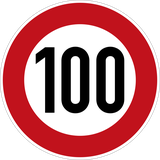
Outside built-up areas: For passenger cars and other qualifying vehicles up to 3.5 tonnes, the general maximum speed on ordinary roads outside built-up areas is 100 km/h, unless signs indicate another limit.
Autobahns: There is no general maximum speed for passenger cars on unrestricted Autobahn sections. A recommended speed of 130 km/h applies, and any posted speed limit must be followed.
What are the seat-belt and child-restraint rules in Germany?
Seat belts must be worn during a journey wherever they are required and fitted, subject to specific legal exceptions.
Children under 12 and shorter than 150 cm must normally use a suitable approved child restraint. Once either age 12 or 150 cm is reached, the fitted seat belt is sufficient under the main rule.
A child aged 3 or older may use a rear-seat belt when other child restraints leave no room to install another restraint. In a vehicle without seat belts, children under 3 may not travel; children aged 3 or older and shorter than 150 cm must sit in the rear. Special taxi and bus provisions also apply.
Can you use a mobile phone while driving in Germany?
A driver may not pick up or hold a mobile phone or similar electronic device while driving. A device may be used without holding it when permitted functions such as voice control are used or only a brief glance appropriate to the traffic conditions is required.
When are winter tyres mandatory in Germany?
Germany has a situational winter-tyre requirement. Suitable winter tyres must be fitted when driving in black ice, packed snow, slush, ice or frost. Qualifying winter tyres must carry the Alpine symbol.
What safety equipment must you carry in a car in Germany?
Passenger cars must generally carry a warning triangle, high-visibility safety vest and first-aid material that meets the applicable requirements.
Can a visitor use a driving licence issued in another EU country in Germany?
Yes. A valid, full EU driving licence is recognised for the vehicle categories it covers. You must meet the applicable minimum age. A learner licence or a temporary replacement certificate does not have the same automatic recognition.
Are motorcycle helmets compulsory in Germany?
Yes. On an ordinary, open motorcycle, both the rider and passenger must wear a protective helmet. Use a helmet that meets the applicable approval requirements and fasten it correctly. Check the specific rules before relying on an exemption for an enclosed or specially equipped vehicle.

