

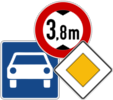
Toll roadGermany
An introduction to the traffic rules and road signs of Germany. Learn about driving, road safety and much more in our illustrated book, with answers to frequently asked questions.
For informational purposes only. Always follow official regulations. Some content and images were created with AI assistance.
 Traffic rules
 Germany
15. Toll road
A toll road is a road, motorway, bridge, tunnel or other route for which users must pay a charge. The toll may apply to all vehicles or only to particular vehicle categories, and the amount can depend on factors such as distance travelled, vehicle type, weight or emissions.
Tolls may be collected at toll booths, electronically or through a vignette or distance-based charging system. Drivers should check the applicable payment rules before using a toll road, especially when travelling in another country.
Wikimedia.org • Mateus2019 • CC BY-SA
Which road-charging system should I check in Germany?
Germany’s federal motorway and trunk-road toll concerns qualifying vehicles intended or used for goods transport with a technically permissible maximum laden mass over 3.5 tonnes. An ordinary passenger car is outside this goods-vehicle system.
What should I check before using a charged road in Germany?
Check the motor vehicle’s relevant permitted mass, use and any statutory exemption. Do not treat a caravan combination or a car as a lorry solely because its combined mass is higher; other facility-specific charges are separate.
Does the absence of a toll booth prove that a road is free in Germany?
The absence of a payment booth is not proof that a charged road is free. A vignette, electronic account, vehicle-registration record or another payment procedure may be used where the actual scheme provides for it. Follow the responsible authority or operator’s instructions for that road.


