

Priority at the next junctionWorldwide
 Traffic rules
 Worldwide
58. Priority at the next junction
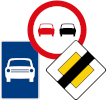
Priority at the next junction means that drivers travelling on a particular road have priority over traffic entering from intersecting roads at the next junction. The priority arrangement is normally indicated by signs facing both the priority traffic and the traffic that must give way.
Unlike a continuing priority road, this priority applies only at the indicated intersection. Drivers must still approach cautiously and obey traffic lights, authorised officers, crossings, turning rules and other applicable signs.
Wikimedia.org • Pieter Delicaat • CC BY-SA
What does priority at the next junction mean?
It means that drivers travelling on the indicated road have priority over traffic entering from intersecting roads at the next junction.
Is this the same as a priority road?
No. Priority at the next junction applies to one particular junction. A priority road normally keeps its priority across several junction until its status ends.
Is a main road always a priority road?
No. The term main road may describe a larger, busier or more important road, but legal priority is determined by traffic signs, signals and local rules.
How can you recognise priority at the next junction?
It may be indicated by a priority-junction sign showing a thick line for the priority route and thinner lines for the roads that must give way.
Does the thick line show the priority route?
Yes. On signs using a junction diagram, the thicker line normally represents the road followed by traffic with priority.
Does the priority route always continue straight ahead?
No. The priority route may turn left or right. A diagram or supplementary panel may show which branch retains priority.
What signs do drivers on the side roads normally see?
They commonly face a give-way or stop sign, requiring them to yield to traffic on the priority route.
Does priority from the right still apply?
Not when legally placed signs establish another priority arrangement at that junction. Drivers must follow the actual signs rather than the ordinary default rule.
Does the sign give priority at later junctions?
No. After passing the indicated junction, the priority arrangement at the next junction must be determined separately.
Does having priority mean you may enter without slowing down?
No. Approach at a safe speed and remain prepared for another road user to fail to give way.
Does having priority mean you must proceed first?
No. Priority is not an obligation to continue. Slow down or stop whenever proceeding would create danger.
May you enter a blocked junction?
No. Do not enter when congestion is likely to leave your vehicle stopped inside the junction and obstructing other traffic.
Does the sign impose a speed limit?
No. The applicable general, zonal, posted or vehicle-specific speed limit remains in force.
Does it give priority over pedestrians?
No. Drivers must still yield to pedestrians where crossings, traffic signals or turning rules require it.
Does it give priority over cyclists?
It regulates priority between traffic approaching the junction, but drivers must still respect continuing bike paths, cycle crossings and turning rules.
Must you signal when the priority route turns?
Yes, when following the route involves a change of direction and local law requires signalling. Priority does not remove the obligation to indicate.
Does signalling give you priority?
No. An indicator communicates your intended movement but does not allow you to endanger or obstruct another road user.
Must you yield to oncoming traffic when turning left?
Normally, yes. Priority over side-road traffic does not automatically give a left-turning driver priority over lawful oncoming traffic.
Do functioning traffic lights override the priority signs?
Functioning traffic lights normally control the junction instead of the priority signs. Local rules determine what applies when the lights are switched off or flashing.
Do authorised officers override the signs?
Yes. Instructions from an authorised traffic controller normally take precedence over signs, signals and ordinary priority rules.
Does the sign prohibit overtaking?
No. Overtaking remains subject to the ordinary rules, visibility, road markings and any separate prohibition signs.
Does the sign prohibit stopping or parking?
No. The ordinary stopping and parking rules and any local signs or markings remain applicable.
What applies after you pass the intersection?
The special priority indicated by the sign has been completed. At later junctions, follow the signs, signals or default priority rule applying there.


