

WorldwideWorldwide
 Traffic rules
 Worldwide
1. Worldwide
Traffic rules differ from country to country, but many basic principles are shared around the world. Countries may drive on the left or right side of the road, use kilometres or miles per hour, and follow different systems for speed limits, priority, parking and road markings. Traffic signs also vary: many countries use European-style red triangular warning signs, while others use systems such as the yellow diamond warning signs common in North America and parts of Oceania.
International agreements have helped make cross-border driving more consistent, especially for road signs, driving permits and vehicle standards, but there is no single worldwide traffic code. Every country sets its own traffic laws and enforcement rules. This worldwide section highlights common traffic-rule concepts, international differences and sign systems, making it easier to compare how driving works across different countries and regions.
AI
Which countries use km/h?
Kilometres per hour (km/h) are used for road speeds in the great majority of countries, including almost all of continental Europe, Canada, Mexico, most of Central and South America, most of Africa and Asia, and countries such as Australia and New Zealand. Ireland also uses km/h despite driving on the left. The relatively small group of countries and territories using mph is listed separately below.
Which countries use mph?
At sovereign-state level, miles per hour (mph) are used for road speeds in the United Kingdom, United States, Antigua and Barbuda, The Bahamas, Belize, Dominica, Grenada, Marshall Islands, Micronesia, Palau, Saint Kitts and Nevis, Saint Lucia and Saint Vincent and the Grenadines. Liberia retains some mixed or legacy mph use alongside km/h. mph is also used in several territories, including Anguilla, the Cayman Islands, Falkland Islands, Guam, Puerto Rico, the Isle of Man, Jersey and Guernsey.
Which countries drive on the left?
Left-hand traffic is used in Antigua and Barbuda, Australia, The Bahamas, Bangladesh, Barbados, Bhutan, Botswana, Brunei, Cyprus, Dominica, Eswatini, Fiji, Grenada, Guyana, India, Indonesia, Ireland, Jamaica, Japan, Kenya, Kiribati, Lesotho, Malawi, Malaysia, Maldives, Malta, Mauritius, Mozambique, Namibia, Nauru, Nepal, New Zealand, Pakistan, Papua New Guinea, Saint Kitts and Nevis, Saint Lucia, Saint Vincent and the Grenadines, Samoa, Seychelles, Singapore, Solomon Islands, South Africa, Sri Lanka, Suriname, Tanzania, Thailand, Timor-Leste, Tonga, Trinidad and Tobago, Tuvalu, Uganda, the United Kingdom, Zambia and Zimbabwe. Several territories, including Hong Kong and the U.S. Virgin Islands, also drive on the left.
Which countries drive on the right?
All sovereign states not listed among the left-driving countries above generally use right-hand traffic. This includes most of continental Europe, the United States, Canada, Mexico, China, South Korea, the Philippines, most of the Middle East and Africa, and almost all of mainland Central and South America. Territories can differ from the country responsible for them: for example, Hong Kong and Macau drive on the left while mainland China drives on the right.
Which countries use metric measurements on road signs?
Most countries use the metric system for road measurements. Distances are normally shown in kilometres or metres, vehicle dimensions in metres and centimetres, and weight restrictions in tonnes or kilograms. This includes most of Europe, Canada, Mexico, Latin America, Africa, Asia and Oceania. Individual countries can still use a mixture of units for particular signs or older regulations.
Which countries use imperial or US customary measurements on road signs?
The most prominent examples are the United States and United Kingdom. U.S. signs use miles, feet and inches extensively, while British road signs use miles and yards for distance and retain imperial measurements for several other road-sign applications. A number of Caribbean and Pacific countries and territories that use mph also retain miles, feet or other non-metric measurements. Some jurisdictions use a mixture of metric and non-metric units.
Which countries use Vienna Convention-style road signs?
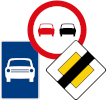
Vienna-style road signs dominate across most of continental Europe, including countries such as Belgium, France, Germany, Italy, Spain, Austria, Switzerland, Poland and the Netherlands, and closely related systems are used in many other parts of Europe, Asia, the Middle East, Africa and Latin America. Typical features include red-bordered triangular warning signs, circular prohibition signs and blue circular mandatory signs. “Vienna-style” is not itself a formal legal classification: some countries use similar designs without being parties to the Convention, while Contracting Parties can retain permitted national variations.
Which countries use MUTCD-style road signs?
The United States uses the Manual on Uniform Traffic Control Devices (MUTCD) as its official national traffic-control-device standard. Separate systems in Canada, Mexico and several countries in Central America and the Caribbean share important North American design characteristics, particularly yellow diamond-shaped warning signs, but they are not literally governed by the U.S. MUTCD. Australia and New Zealand also use yellow diamond warning signs but have their own road-sign standards and should not simply be classified as MUTCD countries.
Which countries use STOP, PARE or other words on stop signs?
STOP is the most internationally widespread wording and is used even in many countries where English is not the main language. PARE is used in Brazil and in several Spanish-speaking South American countries, including Argentina, Chile, Colombia, Peru and Uruguay. ALTO is used in Mexico and parts of Central America. Other local forms exist, such as ARRÊT in parts of French-speaking Canada and DUR in Turkey. Some countries display both a local-language word and STOP.
Which countries use GIVE WAY, YIELD or other wording?
The United States uses YIELD, while GIVE WAY is standard terminology in countries such as the United Kingdom, Ireland, Australia and New Zealand. Many Vienna-style systems use the familiar red-bordered inverted triangle without any wording. Spanish-language rules commonly refer to CEDA EL PASO, while Portuguese-language systems use terms such as Dê a Preferência. The shape is therefore often more internationally consistent than the wording.
Which countries require daytime headlights?
Daytime-light rules exist in many countries but are not identical. Broad requirements apply in countries including Finland, Estonia, Lithuania, Bulgaria, Poland, Slovenia and Uruguay, generally allowing dipped headlights and/or approved daytime running lights. Other countries apply the requirement only to particular roads: for example, Argentina requires lights on national routes, while Peru requires low beams 24 hours a day on its national and departmental/regional road networks. Seasonal and vehicle-specific rules also exist elsewhere.
Which countries require winter tyres?
Winter tyres are compulsory during specified periods or winter conditions in a number of countries, including Finland, Sweden, Lithuania, Austria, Germany, Czechia, Slovenia and Croatia. The exact rule varies considerably: some countries use fixed winter dates, others require winter tyres only when there is snow, ice or other winter weather, and some distinguish between vehicle classes. Many countries with occasional snow, including Belgium and the Netherlands, have no general winter-tyre requirement.
Which countries use priority from the right?
Priority from the right is common at equal, uncontrolled intersections in much of continental Europe, including Belgium, France, Germany, the Netherlands, Austria, Switzerland, Poland, Czechia, Slovakia, Hungary, Romania, Finland, Sweden and Norway. Similar rules also exist in countries such as Argentina and Uruguay. It is never safe to treat this as a universal rule: priority roads, signs, traffic lights, roundabouts and other statutory exceptions can override it.
Which countries require drivers to carry a warning triangle?
Warning triangles are compulsory equipment in many countries, including Belgium, Germany, Poland, Portugal, Italy, Greece and Argentina, although the number required and the rules for placing them differ. Spain is now an important exception: from 1 January 2026, Spanish-registered vehicles use the connected V-16 warning beacon instead of traditional triangles. Foreign vehicles in international traffic can still use triangles in Spain under the applicable international rules.
Which countries require drivers to carry a reflective safety vest?
Reflective-vest requirements are common in Europe. Countries with requirements include Belgium, France, Germany, Austria, Italy, Portugal, Spain, Lithuania, Slovenia and Croatia, among others. The legal detail varies: in some countries the vest must be carried inside the vehicle, while elsewhere the principal obligation is to wear it when leaving a stopped vehicle on or beside the road.
Which countries require a fire extinguisher or first-aid kit?
Requirements vary widely. Countries requiring both a fire extinguisher and first-aid equipment for ordinary cars include examples such as Bulgaria, Greece and Lithuania. Poland requires a fire extinguisher, while Germany and Czechia require first-aid equipment. Argentina requires a compliant fire extinguisher in ordinary cars. Requirements can depend on vehicle category, registration country and whether the vehicle is used privately or commercially.

