

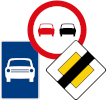
Priority roadWorldwide
 Traffic rules
 Worldwide
31. Priority road
A priority road is a road whose traffic is given priority over traffic entering from intersecting roads. It is normally identified by a priority-road sign, while an end sign indicates where that continuing priority status stops.
Drivers on a priority road must still obey traffic lights, authorised officers, speed limits, crossings and turning rules. Having priority never allows a driver to proceed when doing so would create danger or block an intersection.
Wikimedia.org • Marc Mongenet • CC BY-SA
What is a priority road?
A priority road is a road on which drivers normally have priority over traffic entering from intersecting side roads.
How can you recognise a priority road?
It is normally indicated by a priority-road sign at or near its beginning. A corresponding end sign indicates where its continuing priority status stops.
Does a priority road have priority at every intersection?
Normally, yes, while the priority-road designation remains in force. Drivers must still observe traffic lights, authorised officers and any signs applying at a particular intersection.
Does an intersection end a priority road?
Not necessarily. A priority road commonly continues across successive intersections until an end sign or another legally defined change in priority.
Must side roads have give-way or stop signs?
Side roads are commonly controlled by give-way or stop signs, but sign placement and legal requirements differ between countries.
Does traffic from both the left and right have to give way?
Where the priority-road signs apply, drivers entering from intersecting side roads must normally give way regardless of whether they approach from the left or right.
Is a priority road the same as having priority at one intersection?
No. A priority-road sign normally creates continuing priority across several intersections. Another sign may grant priority only at the next intersection.
Does a priority road always continue straight ahead?
No. The priority route may turn at an intersection. A supplementary diagram may show which branch retains priority.
Must you signal when the priority road bends?
Priority does not remove the duty to signal. Use the direction indicators whenever following or leaving the priority route involves a change of direction or lateral movement.
Does having priority mean you may enter without slowing down?
No. Approach every intersection at a safe speed and remain prepared for another road user to fail to give way.
Does a priority road have a special speed limit?
No. The applicable general, zonal or posted speed limit remains in force.
Do traffic lights override priority-road signs?
Functioning traffic lights normally control the intersection instead of the priority signs. Local rules determine what applies when the lights are switched off or flashing.
Do police instructions override priority-road signs?
Yes. Instructions from an authorised traffic officer normally take precedence over traffic signs and ordinary priority rules.
Do pedestrians still have priority at crossings?
Yes, where the applicable crossing rules give them priority. Priority over side-road traffic does not remove duties towards pedestrians.
Must you give way when turning off a priority road?
You must still give way to oncoming traffic, pedestrians, cyclists and other road users where the normal turning rules require it.
Do cyclists on a priority road have priority?
Cyclists using the road or a continuing bike path may have priority over entering or turning traffic, depending on signs, markings and local law.
Does a priority road give priority at a roundabout?
Not automatically. Roundabout priority is determined by its own signs, signals and local rules.
May you overtake on a priority road?
Priority-road status does not itself permit or prohibit overtaking. Drivers must follow the ordinary overtaking rules, markings and visibility requirements.
May you stop or park on a priority road?
This depends on local law and signs. Some countries prohibit parking on priority roads outside built-up areas, while other parking rules may apply inside towns and cities.
Does a vehicle leaving a property have priority?
No. A driver entering the road from a property, parking place or other off-road location normally performs a manoeuvre and must give way to road users already present.
May you enter a blocked intersection when you have priority?
No. Do not enter when congestion would force you to stop inside the intersection and obstruct crossing traffic.
How does a priority road end?
Its continuing priority normally ends at an end-of-priority-road sign. Drivers must then follow the signs or ordinary priority rule applying at the next intersection.


