
Tourner au feu rougeBelgique
63. Tourner au feu rouge
Tourner au feu rouge est une règle ou un dispositif de signalisation qui permet à certains usagers de poursuivre dans une direction déterminée malgré un feu rouge. Le plus souvent, il autorise un virage après que le conducteur s’est arrêté ou a cédé le passage, mais la procédure précise varie selon les pays.
Tourner au rouge n’est pas autorisé partout. Cela peut être permis de manière générale, uniquement lorsqu’un panneau ou signal spécifique est présent, ou être totalement interdit. Les conducteurs doivent toujours respecter les feux, panneaux, règles de priorité et passages pour piétons ou cyclistes locaux avant de s’engager.
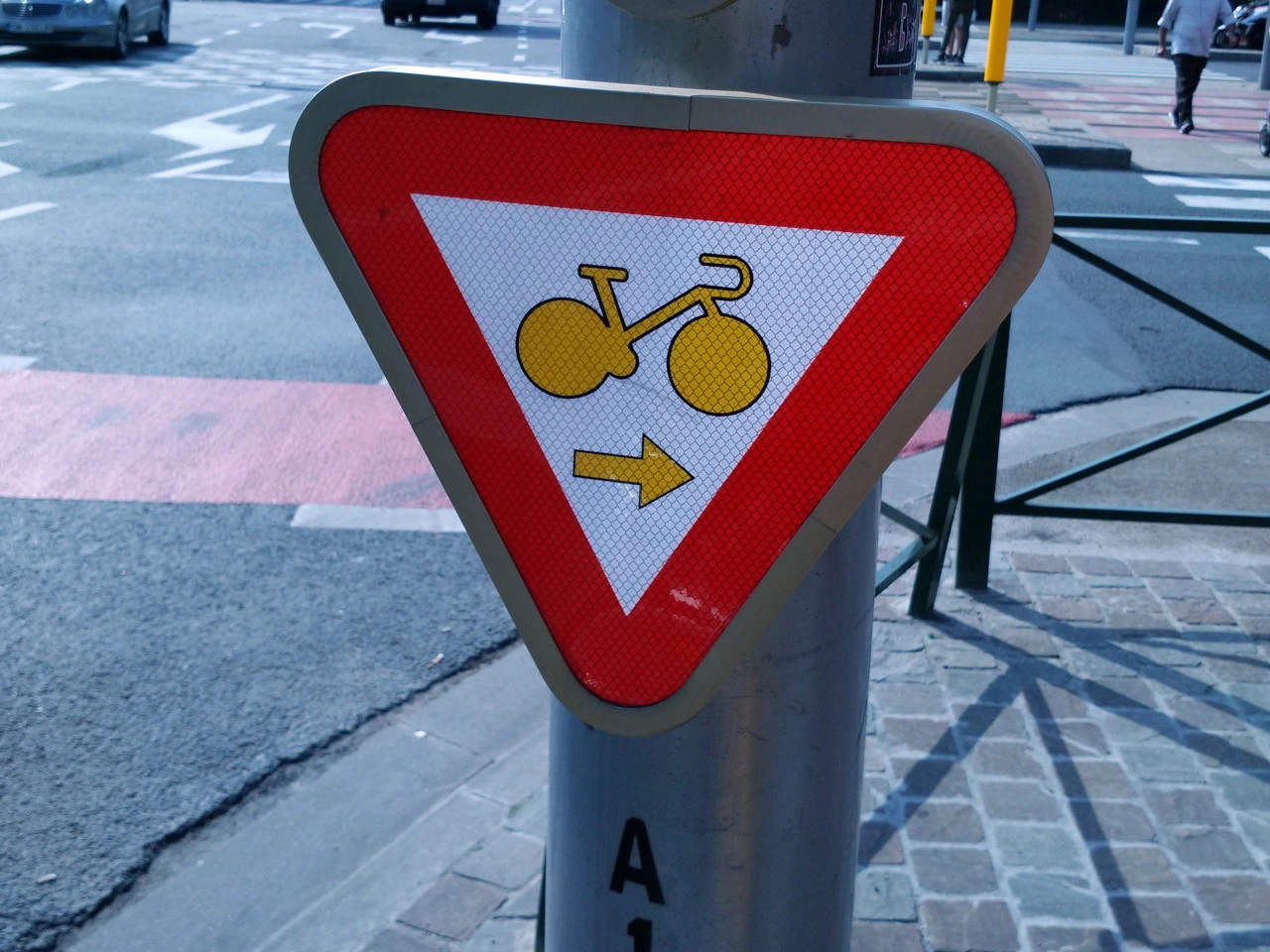
May motorists normally turn right on red in Belgium?
No. Belgium does not have a general rule allowing ordinary motorists to turn right simply because the way is clear. A red traffic light normally prohibits passing the stop line or traffic light.
Can a Belgian driver proceed while the main traffic light is red?
Yes, when a specific additional green arrow permits it. If a green arrow is illuminated together with the red or orange-yellow light, drivers may proceed only in the direction indicated by the arrow.
Do you have priority when following a green arrow beside a red light?
No. A driver proceeding under an additional green arrow must give way to drivers lawfully approaching from other directions and to pedestrians.
Can cyclists turn right on red in Belgium?
Yes, where a B22 sign is installed. Cyclists and speed-pedelec riders may pass a red or orange-yellow traffic light to turn right, provided they give way to the other road users who have priority.
Does every Belgian red light allow cyclists to turn right?
No. The exception applies only where the appropriate B22 sign or another authorised signal specifically permits the movement.
What does the Belgian B22 sign mean?
The B22 sign allows cyclists and speed-pedelec riders to pass a red or orange-yellow traffic light in order to turn right, while giving way to other road users.
What does the Belgian B23 sign mean?
The B23 sign allows cyclists and speed-pedelec riders to pass a red or orange-yellow traffic light and continue straight ahead, while giving way to other road users.
May a B23 sign be installed at every intersection?
No. Under the current Belgian rules, B23 may only be used where cyclists proceeding straight ahead do not have to cross another traffic stream.
Must cyclists come to a complete stop at B22 or B23?
The current B22 and B23 rules do not impose a separate general requirement to make a complete stop. However, cyclists and speed-pedelec riders must give way to other road users and may proceed only when this can be done safely.
Can ordinary cars use the B22 or B23 exception?
No. B22 and B23 are specifically intended for cyclists and speed-pedelec riders. They do not allow cars, motorcycles or other ordinary motor vehicles to pass the red light.
Can Belgian cyclists also receive a special flashing signal at a red light?
Yes. An additional flashing orange-yellow bicycle signal with an arrow can permit cyclists and certain two-wheeled riders to proceed in the direction indicated while the main signal is red or orange-yellow, provided they give way as required.
Will the Belgian turn-on-red rules change in 2027?
Yes. From 1 June 2027, the new Code of the Public Road will use a single B22 system with one or more arrows. It will allow cyclists and speed-pedelec riders to pass a prohibiting traffic light in the direction or directions shown, including right, straight ahead or left where indicated, while giving way to other road users.

Règles de circulation
Belgique